
Bayshore Safety & Industrial Supplies Guide
What are the downsides of nitrile gloves? Disposable and coated nitrile, by what the standards and the data say
Nitrile has four limits the data shows. It is not a chemical shield for everything: the EN ISO 374-1 letters tell the story, and Portwest’s nitrile chemical glove lists methanol, toluene, heptane, the acids and bases, peroxide and formaldehyde, but not acetone (letter B) or dichloromethane (letter D), the ketones and chlorinated solvents that pass through nitrile quickly. It can still cause skin reactions: NIOSH’s latex alert names allergic contact dermatitis from the accelerators used to cure synthetic rubbers (thiurams, carbamates) and irritant dermatitis from sweat and friction, both possible with nitrile. A thin disposable nitrile glove tears readily once punctured and gives no cut, heat or abrasion protection, which is why it carries no ANSI/ISEA 105 level. And on coated work gloves the nitrile layer, especially a full dip, holds heat and sweat; makers answer with foam and sandy finishes and three-quarter dips, which Portwest lists as separate styles. Against those: no natural rubber latex proteins, good puncture and oil resistance for a thin film, and the widest range of coatings on cut-resistant knits.
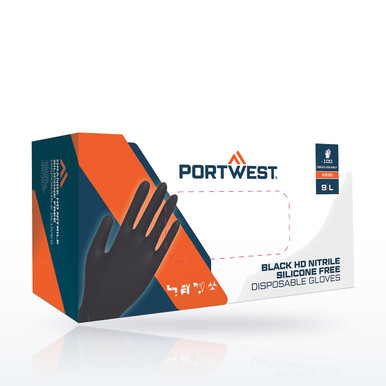 Portwest A930 Disposable Nitrile Gloves, 7 mil, Box of 100, Food SafeDisposable nitrile, 7 mil, with the listings Portwest states (Portwest data)
Why “nitrile” is not one answer. The word covers a 4 mil disposable exam glove, a 15 mil flock-lined chemical gauntlet and the palm coating on a 13 gauge cut-resistant knit, and the downsides are different for each. The disposable is about barrier and skin: thin, single-use, no mechanical rating, and a possible accelerator reaction. The chemical glove is about which chemicals: nitrile does well against oils, fuels, many acids and bases and aliphatic solvents and poorly against ketones, chlorinated and aromatic solvents, and the EN ISO 374-1 letters on the glove say exactly which were tested and passed. The coated work glove is about comfort and wear: a smooth nitrile palm is slick when wet and warm in summer, a foam or sandy finish fixes the grip at the cost of a thinner barrier, and the coating wears through before the knit does. Portwest’s product pages carry the EN 388 code, the finish and the EN ISO 374 letters for each, which is the data to read before deciding whether a given nitrile glove’s downside matters for the job.
The downsides, one by one
Each with where it comes from.
What Portwest’s nitrile gloves state
- Disposable: the A930 (7 mil, box of 100) lists EN ISO 374-5 virus protection, EN 455 and the European food-contact listing, no latex, no ANSI/ISEA 105 level.
- Chemical: the A812 and A810 are flock-lined EN ISO 374-1 Type A nitrile gloves 13 inches long; the A812 prints letters A F J K L M N O P S T, which leaves out B (acetone) and D (dichloromethane).
- Coated work and cut-resistant gloves: 61 styles on this site list a nitrile coating in smooth, sandy or micro-foam finish on polyester, nylon or HPPE knits, each with its EN 388 code and ANSI level; the Portwest Aqua Gloves are the full nitrile dips for wet work, the Portwest General Handling and Portwest Cut Resistant series the palm dips.
- Winter: the A146 and AP02 pair a sandy nitrile palm with an acrylic liner and an EN 511 contact-cold level 2, Portwest’s answer to nitrile stiffening in the cold.
- Nothing on the pages claims nitrile protects against a chemical it was not tested for; the letters and codes are the whole claim.
What Radians states about nitrile against the other coatings
Radians lists its palm coatings with the properties it claims for each. Smooth nitrile: a latex-free synthetic rubber with excellent abrasion and puncture resistance, tactile sensitivity and a flexible grip. Foam nitrile: lightweight micro texture, good grip wet or dry, breathable, flexible and porous, excellent abrasion resistance. Sandy foam nitrile: a micro-roughened texture for excellent wet or dry grip, breathable and porous. Foam latex and sandy foam latex: micro texture, better breathability and comfort, excellent flexibility, resistant to tears and cuts. Crinkle latex: a rough texture for grip and abrasion. Polyurethane: semi-smooth, extremely flexible, superior dexterity, and in Radians’ words “not as durable as nitrile or latex.” FDG, Radians’ own coating, is described as flexible and durable with a better grip than nitrile; Radians states that with foam nitrile more grip costs some abrasion resistance and the reverse, and that FDG is meant to remove that trade. The Coating line on each Radians and DEWALT coated glove page names which one the style carries.
Radians Knowledge Base, Hand Protection Solutions (radians.com/kb-hand-protection, radians.com)More questions people ask
When should you not use nitrile gloves?
They do not stop ketones or chlorinated solvents (the EN ISO 374-1 letters show which chemicals passed), the curing accelerators can cause a delayed skin reaction, a thin disposable tears once punctured and carries no mechanical rating, and a coated work glove holds heat and is slick when smooth and wet.
What are the disadvantages of nitrile gloves?
As the standards and the data say above: no protection against ketones such as acetone and some chlorinated solvents (short breakthrough times on the chemical charts), less stretch and tactile feel than latex at the same thickness, a tear that runs once started, single-use economics (nothing is washed), and heat in a non-breathing glove. None of those is a reason to pick latex where latex proteins are the hazard.
Are nitrile gloves good for insulation?
Not against electricity. A disposable nitrile glove is thin and untested for voltage; only a rubber insulating glove tested to ASTM D120 and marked with a class is electrical protection, as the electrical glove guides explain.
Which gloves are more durable, nitrile or vinyl?
Nitrile. At the same thickness nitrile resists punctures and tears better than vinyl and holds up to oils, which is why the industrial-grade disposable in the band is nitrile; vinyl is the lighter, cheaper glove for short tasks.
Are all nitrile gloves BPA-free?
Nitrile is a copolymer of acrylonitrile and butadiene and is not made from bisphenol A; a manufacturer may still print a BPA-free statement. Liberty Safety prints its DuraSkin nitrile gloves as powder free and FDA food contact, which are the statements that matter for food work.
Are nitrile gloves FDA approved?
The FDA does not approve work gloves; it lists examination gloves as medical devices and lists materials for food contact under 21 CFR. Liberty Safety prints "FDA Food Contact: Yes" on its DuraSkin and BioSkin gloves; the food-safe nitrile guide explains the listing.
Will nitrile gloves melt in heat?
A nitrile-coated work glove carries no heat rating unless the manufacturer prints one, and the knit under the coating is the limit: Armor Guys’ catalog states that "HPPE will start to melt above 158° Fahrenheit", against its Taeki5 knit at 302 °F (13 and 15 gauge), 482 °F (10 gauge) and up to 662 °F (7 gauge). For hot parts use a glove with an EN 407 or ANSI/ISEA 105 contact heat figure; the guide linked below has the numbers.
Answers from the sources named above and in the byline.Questions people ask
Can you be allergic to nitrile gloves?
Not to a latex protein, because nitrile has none; but NIOSH names allergic contact dermatitis from the accelerators used to make nitrile and other synthetic gloves, and irritant dermatitis from sweat and friction under any glove.
Do nitrile gloves protect against chemicals?
By the EN ISO 374-1 letters Portwest prints on its nitrile chemical glove, acetone (B) and dichloromethane (D) are not listed; ketones, chlorinated and most aromatic solvents are the usual gaps for nitrile. The glove’s own letters are the answer for a given style.
Which one is better, latex or nitrile gloves?
Different: nitrile has no latex protein and better puncture and oil resistance; latex stretches further and does not tear as readily once cut. The standards rate each glove, not the material, and this site shows the rating on each product page.
Why do nitrile coated gloves make hands sweat?
The coating is airtight where it covers the knit. Palm-only dips with a bare knit back and foam finishes are how makers, Portwest included, trade some barrier for air; a full dip for wet work keeps the barrier and the sweat.
When should you not use nitrile gloves?
They do not stop ketones or chlorinated solvents (the EN ISO 374-1 letters show which chemicals passed), the curing accelerators can cause a delayed skin reaction, a thin disposable tears once punctured and carries no mechanical rating, and a coated work glove holds heat and is slick when smooth and wet.
Are nitrile gloves stronger than latex?
Nitrile has the higher puncture resistance and holds against oils and fuels where latex swells; latex has more stretch and a stronger grip, and carries the allergy risk. Both tear readily once punctured as thin disposables; neither carries a cut level, and the thickness in mil on the box is the only strength figure a disposable states.
What gloves should you use if you are allergic to latex, and can you be allergic to nitrile?
Nitrile and vinyl contain no natural rubber latex proteins, and OSHA’s bloodborne pathogens standard requires a hypoallergenic alternative for allergic employees. Nitrile can still cause allergic contact dermatitis from the accelerators used to cure it (thiurams, carbamates), which NIOSH’s latex alert names; accelerator-free nitrile gloves are the manufacturers’ answer for those workers.
Do nitrile gloves offer protection from all chemicals?
No. Nitrile holds up to oils, fuels, many acids and bases and some solvents, and fails quickly against ketones (acetone) and chlorinated solvents (methylene chloride, dichloromethane): PIP's permeation data shows acetone through unsupported nitrile in under 6 minutes. The EN ISO 374-1 letters or the ASTM F739 breakthrough time on the manufacturer's chart are the claim, chemical by chemical; a chemical not on the chart has no claim. The chemical resistance chart guide shows how to read one.
Can you use nitrile gloves for medical use?
Examination-grade nitrile gloves, made to ASTM D6319 and cleared by the FDA as medical devices, yes; industrial-grade nitrile gloves are not cleared for medical use and are labeled for industrial use. The grade is on the box. Under OSHA's bloodborne pathogens standard either grade is acceptable only if it keeps blood from reaching the skin for the whole task.
Do they make 3XL nitrile gloves?
Some disposable styles run to 2XL and a few to 3XL; most coated nitrile work gloves run XS to 2XL, and the sizes the manufacturer offers are listed on each product page here. A hand over 11 inches around the knuckles is a size 11 (2XL) on the EN 420 table; above that the choice narrows to the styles that list a 3XL.
Why are latex gloves no longer used in many workplaces?
Natural rubber latex proteins cause allergy, and nitrile offers the same barrier without them; the latex-allergy guide covers it.
Related guides
Nitrile vs latex vs vinyl glovesWhat each material resistsCan you use nitrile gloves if you are allergic to latex?And reactions to non-latex glovesWhich gloves protect against chemicals?How to read a chemical resistance chartWhat is a glove coating?Nitrile, polyurethane, latex and foam comparedWhere can you buy cheap disposable gloves, and what do gloves cost?Box, case and dozen pricingWhat are the different types of rubber gloves?And which gloves for cleaning, dishes and bleachWill nitrile gloves melt in heat?What a nitrile coating and an HPPE shell are rated forThe ratings, test results and standards shown here are the manufacturers' published values, reproduced as published. Nothing on this page is a recommendation by Bayshore Safety that any product is suitable for a particular task, hazard or workplace. Selecting safety products and protective equipment is the responsibility of the end user and the employer, based on their own hazard assessment and the regulations that apply to their work. Confirm every value on the manufacturer's own documentation before use.
© 2026 Bayshore Safety & Industrial Supplies, Inc. All rights reserved. This guide may not be copied or republished without written permission.