
Bayshore Safety & Industrial Supplies Guide
Can you wear a hat instead of a hairnet? What the FDA Food Code counts as a hair restraint, who has to wear one, bald heads and beards, how to wear a hairnet and a beard net, what a medical hair net is called, and what to use instead
Yes, under the FDA Food Code a hat can be the hair restraint, but only if it does the job the Code names: section 2-402.11 says food employees "shall wear hair restraints such as hats, hair coverings or nets, beard restraints, and clothing that covers body hair, that are designed and worn to effectively keep their hair from contacting exposed food; clean equipment, utensils, and linens; and unwrapped single-service and single-use articles". A ball cap with hair hanging out the back does not keep hair off the food, so a hat only counts when the hair is up inside it; a bouffant cap or hairnet is the item that always does, and a beard restraint is separate. The Code exempts "counter staff who only serve beverages and wrapped or packaged foods, hostesses, and wait staff if they present a minimal risk". A bald head has no hair to restrain, but a beard or mustache does, and plant rules usually put a cover on everyone for inspection’s sake.
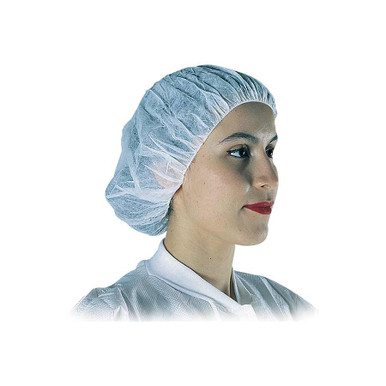 Liberty Safety APA 15821W Bouffant Cap, Size 21"Liberty Safety prints 21 inch spunbonded polypropylene bouffant cap, latex-free elastic, 500 per case
What the rule actually says. Two sentences in the FDA Food Code carry the whole hairnet question. Section 2-402.11(A): food employees "shall wear hair restraints such as hats, hair coverings or nets, beard restraints, and clothing that covers body hair, that are designed and worn to effectively keep their hair from contacting exposed food; clean equipment, utensils, and linens; and unwrapped single-service and single-use articles". Section 2-402.11(B): the rule "does not apply to food employees such as counter staff who only serve beverages and wrapped or packaged foods, hostesses, and wait staff if they present a minimal risk of contaminating exposed food". The Food Code is a model that states and counties adopt into their own retail food rules, so the local health code is the one an inspector cites, and most adopt this wording as written. For food manufacturing (not retail) the federal good manufacturing practice rule the Code’s annex cites says the same thing in its own words: "wearing, where appropriate, in an effective manner, hair nets, head bands, caps, beard covers, or other effective hair restraints".
Why the question keeps being asked. Because the rule names the result, not the item. A hat, a net, a bouffant, a scarf, a beard cover: any of them passes if it keeps the hair in, and any of them fails if it does not. The inspector looks at the hair, not the label.
The restraints, and what each one is for
Each product description is Liberty Safety’s; the rule is the Food Code’s.
The questions, one by one
Each answer is from the Food Code sections and the manufacturer’s statements named in the byline.
Can you wear a hat instead of a hairnet?
Under the FDA Food Code, yes, if it works: 2-402.11 lists "hats, hair coverings or nets, beard restraints" as examples of hair restraints and requires that they be "designed and worn to effectively keep their hair from contacting exposed food". A hat passes when the hair is inside it and fails when it is not. Your health department’s adopted code and your employer’s rules may be stricter than the model (many plants require a bouffant or net under any hat, and a hat is not a beard restraint), so the practical answer is: a hat over a net or with all the hair tucked up, and a beard cover if there is a beard.
What to use instead of a hair net, and what can I wear instead of a hairnet?
Anything that does the same job: a bouffant cap (the usual answer in kitchens and plants), a hat or cap with the hair fully inside it, a scarf or bandana tied so no hair shows, a snood, or a hood. The Code does not name a required item; it names the result. For a beard the only substitutes are another beard cover or the all-in-one hood. What does not count: a headband, a visor, a loose bun, or a hat with hair out the back.
Why do food handlers wear hair nets?
Because hair sheds, and hair in food is both a contamination route and the complaint that closes a restaurant. The Food Code’s annex gives the reason in one sentence: restraints keep hair "from contacting exposed food; clean equipment, utensils, and linens; and unwrapped single-service and single-use articles", and the federal manufacturing rule it cites requires "hair nets, head bands, caps, beard covers, or other effective hair restraints". The net also stops the hand-to-hair-to-food habit: a worker in a net does not touch their hair.
What is the meaning of hair net, and what does a hair net do?
A hairnet is a mesh bag with an elastic edge that holds the hair against the head; in food work it is the restraint that keeps hair off food and equipment, and outside food work it is the same item used to hold a hairstyle, a bun or a wig in place (which is why the question "why do some guys wear hair nets" exists: a durag, a wave cap and a hairnet all hold hair flat and are worn for the hairstyle, not for the Food Code). The food-plant hairnet is nylon, 1/8 inch honeycomb, in a color to match the hair.
Does a bald person need to wear a hairnet?
The Code requires a restraint "to effectively keep their hair from contacting exposed food"; a bald head has no hair to keep, so the Code itself does not require a net on it. Two things still apply: a beard or mustache needs a beard restraint whether the head is bald or not, and most plants and many health departments put a cover on every head as a matter of policy and so the inspector does not have to judge how bald is bald. The usual answer in a plant is a bouffant on everyone.
How to wear a hairnet?
Hair up first (tie long hair back or put it in a bun), then the net: hold it open with both hands, stretch it from the front hairline back over the whole head, and tuck every strand inside, ears in or out by the plant rule. The elastic sits at the hairline, not on the forehead, and the net is large enough that nothing shows at the nape. For a bouffant it is the same motion; the 21 inch size fits most heads and the 24 inch a full head of long hair. Put it on before entering the production area and before washing hands, so the hands are not touching hair after they are washed.
How to wear a beard net properly, and how to use a hair net for a bun?
A beard cover goes under the chin and over the beard, mustache and sideburns with the loops over the ears, as Liberty Safety describes its covers ("fits over beard, mustache and side burns"); it should enclose the whole beard with no hair below its edge. For a bun: make the bun, then stretch a hairnet or a 24 inch bouffant over bun and head together; a small hairnet over the bun alone (the dance-class use) is not a food-service restraint because the rest of the hair is exposed.
What is a medical hair net called?
A bouffant cap, scrub cap or surgical cap: the pleated disposable cap worn in surgery and clean areas is the same spunbonded polypropylene bouffant sold to food plants, and the fitted tie-back version is the surgical cap. Hospitals buy them in blue; food plants in white and colors.
Do chefs need to wear hair nets, and why do professional chefs not wear hairnets?
A chef handling exposed food is a food employee under the Code and needs a hair restraint; the chef’s toque, skull cap or bandana is that restraint when the hair is inside it, which is why you rarely see a net on a chef: the hat is doing the job. A chef with long hair out of the hat is as out of code as a line cook would be.
Are waiters, waitresses and counter staff required to wear hair nets?
The Code’s own exemption, 2-402.11(B): the rule "does not apply to food employees such as counter staff who only serve beverages and wrapped or packaged foods, hostesses, and wait staff if they present a minimal risk of contaminating exposed food". A server who plates, garnishes or scoops is handling exposed food and is not exempt; one who carries plates and pours drinks is.
Where can you buy a hair net, and where can I buy hairnets?
From us, by the case (we sell nationwide): nylon hairnets in four sizes and four colors (1,000 a case), bouffant caps in three sizes (500 or 1,000 a case), beard covers and the all-in-one hood, all in the band below with the live price. A box of 100 from a pharmacy is the same item at many times the per-piece price.
Do hair nets prevent lice, and do hair nets really work?
A hairnet keeps hair in; it is not a barrier to lice, which move head to head by direct contact, and no manufacturer claims it is. As a food restraint it works as well as it is worn: a net that covers all the hair and is changed when soiled is the industry standard precisely because it works; a net with hair out the back does not.
What is a bouffant cap for, and what does a bouffant look like?
A bouffant cap is the pleated, puffed disposable cap (the word is French for "puffed"), elastic at the edge, that holds all the hair; it looks like a round shower cap in white or blue. It is for food plants, kitchens, clean rooms and hospitals, and it is the item most people mean when they say hairnet. The hairstyle of the same name has nothing to do with it except the shape.
In plain words
- The Food Code requires a hair restraint that works: hats, coverings, nets, beard restraints and body-hair clothing all count if they keep hair off the food.
- A hat counts only with the hair inside it. Most plants put a net or bouffant under any hat.
- A beard needs its own restraint; a bouffant does not cover a beard.
- Bald heads have no hair to restrain, but plant policy usually covers everyone.
- Counter staff serving only drinks and wrapped food, hostesses and wait staff at minimal risk are exempt (2-402.11(B)).
- Nylon hairnets are near-invisible and come in hair colors; bouffants are 19, 21 and 24 inch; the all-in-one hood covers hair and beard.
- Buy by the case: 500 or 1,000 per case. We sell nationwide.
Questions people ask
Can you wear a hat instead of a hairnet?
Under FDA Food Code 2-402.11, yes, if it keeps the hair off the food; a hat with hair hanging out does not. Local codes and plant rules are often stricter.
What can I wear instead of a hairnet?
A bouffant cap, a hat with all hair inside, a scarf tied over the hair, a snood or a hood; a beard still needs a beard cover.
Why do food handlers wear hair nets?
To keep hair from contacting exposed food, equipment, utensils and single-use articles, as the Food Code requires.
Does a bald person need to wear a hairnet?
The Code requires restraint of hair, so not for the head; a beard still needs a cover, and most plants cover everyone by policy.
How do you wear a hairnet?
Hair up, net stretched from the hairline back over the whole head, every strand tucked in, elastic at the hairline; put it on before washing hands.
What is a medical hair net called?
A bouffant cap, scrub cap or surgical cap.
Are waiters and counter staff required to wear hairnets?
Not if they serve only drinks and wrapped food or present minimal risk (2-402.11(B)); staff who handle exposed food are.
Do chefs need to wear hair nets?
A chef handling exposed food needs a restraint; the toque or skull cap is one when the hair is inside it.
How do you wear a beard net?
Under the chin and over beard, mustache and sideburns with the loops over the ears, enclosing all the hair.
What is the meaning of hair net?
A mesh bag with an elastic edge that holds hair against the head; in food work it is the hair restraint.
Do hair nets prevent lice?
No; a net holds hair in and is not a barrier to lice.
Where can you buy hairnets?
From us by the case (we sell nationwide): nylon hairnets, bouffant caps, beard covers and hoods.
What size bouffant cap do I need?
21 inch fits most heads; 24 inch for long hair or a bun; 19 inch for small heads and short hair.
Related guides
Bouffant caps, hairnets and beard covers for food plantsWhat the rules requireWhat gloves do food handlers use?Nitrile, vinyl, poly and latex in the Food CodeCut-resistant gloves for food handlingThe two listings to look forAre aprons required in food service?Poly, vinyl, denim and PVC aprons and what each is forShoe covers and boot coversWhen they are requiredWhy are lab coats white?Colors, when one is worn, the types and the costThe ratings, test results and standards shown here are the manufacturers' published values, reproduced as published. Nothing on this page is a recommendation by Bayshore Safety that any product is suitable for a particular task, hazard or workplace. Selecting safety products and protective equipment is the responsibility of the end user and the employer, based on their own hazard assessment and the regulations that apply to their work. Confirm every value on the manufacturer's own documentation before use.
© 2026 Bayshore Safety & Industrial Supplies, Inc. All rights reserved. This guide may not be copied or republished without written permission.