
Bayshore Safety & Industrial Supplies Guide
What gloves do food handlers use? Nitrile, vinyl, poly and latex in the kitchen, raw meat and ready-to-eat food, the Food Code rules on single-use gloves, color coding and how to tell a food-contact glove
Food handlers use single-use gloves whose material the manufacturer lists for food contact, and the FDA Food Code tells them when and how. Section 3-301.11 says food employees may not touch exposed ready-to-eat food with their bare hands and must use suitable utensils “such as deli tissue, spatulas, tongs, single-use gloves, or dispensing equipment”; section 3-304.15 says a single-use glove is used for only one task, such as working with ready-to-eat food or with raw animal food, and is discarded when damaged, soiled or contaminated, or when the work is interrupted. The glove itself has to be made of a material allowed in contact with food, which in the United States is the 21 CFR Part 177 listing: PIP marks its Ambi-dex nitrile, latex and vinyl gloves “21 CFR”, MCR Safety marks its NitriShield gloves “FDA food contact”, Radians prints the listing on its RWG94 pages, and Portwest marks its A930 nitrile “CE food safe” under the European rule. Nitrile is the material most kitchens have moved to because it has no natural rubber latex protein and tears show against food (blue is the usual color for that reason); vinyl is the lower-cost glove for short, dry, low-risk tasks; poly (polyethylene) gloves are the loose, cheapest glove for sandwich lines and quick changes; latex is allowed by the Food Code but its 2026 annex now addresses latex gloves and adverse reactions, and several states restrict them. Raw meat is handled with a glove that comes off before the next task; a glove worn for raw chicken does not touch the salad. Cut-resistant gloves at the slicer follow their own paragraph: direct contact only with food that will be cooked, unless the glove has a smooth nonabsorbent surface or a single-use glove is worn over it. Color coding is a kitchen practice, not a Food Code rule, and heat is a separate hazard with its own gloves.
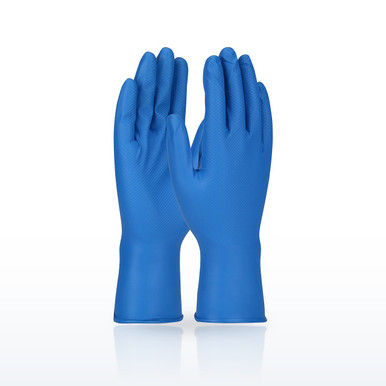 Grippaz Food Plus 67-308 Disposable Gloves, Nitrile CoatedPIP lists this nitrile glove for food contact (21 CFR; ASTM D6978), 8 Mil, powder free (PIP data)
Why the glove and the rule are two separate questions. The Food Code governs the handler: when bare hands may not touch food, what the glove is for, when it comes off. It does not approve gloves. The material question is answered by the FDA’s food-contact regulations, 21 CFR Part 177, which list the polymers and rubber articles that may touch food and the limits on what can migrate out of them; the rubber-article section 177.2600 is the one nitrile, latex and vinyl glove manufacturers cite, and a glove marked “21 CFR” or “FDA food contact” on this site is one whose manufacturer states its formulation meets that rule. The two questions come together on the box: a glove that is food-contact listed and single-use is what 3-301.11 means by a single-use glove. The Food Code’s own marking tells you what matters most: paragraph (B) of 3-301.11 (no bare-hand contact with ready-to-eat food) and paragraphs (A) and (C) of 3-304.15 (one task; discard when damaged, soiled, contaminated or interrupted) are marked P, priority items, the violations an inspector writes first; the slash-resistant glove paragraph is Pf, priority foundation. The 2026 edition added a paragraph (B) to 3-304.15 that lets an approved operation keep an interior single-use glove on under a loose-fitting exterior glove that is removed by gravity and discarded, and it added to the annex new text on selecting gloves for food employees, the advantages and disadvantages of the glove types, and latex gloves and adverse reactions. None of that chooses nitrile over vinyl for you; it tells you to pick a glove that fits the task and to change it. The manufacturer data does the rest: thickness in mil (3 to 8 on the food-contact gloves here), powder-free (every medical glove since 2017, and most industrial ones), the color, and the standards line.
The questions, one by one
From the Food Code text, the 21 CFR listing and the product data.
The Food Code paragraphs that mention gloves, in plain words
The glove provisions of the FDA Food Code 2026, with the 2017 wording for the slash-resistant and cloth glove paragraphs that carried over.
- 3-301.11(B): food employees may not contact exposed ready-to-eat food with their bare hands and must use suitable utensils such as deli tissue, spatulas, tongs, single-use gloves or dispensing equipment. Priority item.
- 3-301.11(C): food employees must minimize bare hand and arm contact with exposed food that is not ready to eat. Priority foundation item.
- 3-301.11(D): bare-hand contact with ready-to-eat food is allowed when it is being added as an ingredient to a food that will be cooked to the required temperature.
- 3-304.15(A): a single-use glove is used for only one task, such as working with ready-to-eat food or with raw animal food, and for no other purpose. Priority item.
- 3-304.15(B) (new in 2026): with approval, an interior single-use glove may be kept on under a task-specific loose-fitting exterior glove that is removed by gravity, without touching the interior glove, and discarded, provided the interior glove stays intact and clean.
- 3-304.15(C): single-use gloves are discarded when damaged or soiled, or contaminated when interruptions occur in the operation. Priority item.
- 3-304.15(D): slash-resistant gloves used for cutting are used in direct contact only with food that will be cooked, such as frozen food or a primal cut of meat; (E): unless the slash-resistant glove has a smooth, durable, nonabsorbent outer surface or is covered with such a glove or a single-use glove. (F): cloth gloves may not touch food unless it will be cooked.
- 2-301.12 (referenced in 3-301.11(A)): hands are washed before gloving; a glove is not a substitute for handwashing.
Food-contact glove materials on this site, as the manufacturers list them
| Material | What the listing says | Thickness here | Where it fits in a kitchen | What it is not |
|---|---|---|---|---|
| Nitrile (synthetic rubber) | PIP: 21 CFR; MCR Safety: FDA food contact; Radians: 21 CFR on RWG94; Portwest A930: CE food safe | 3 to 8 mil | Raw meat, prep, plating, cleaning; the general kitchen glove | Not heat-rated; thin disposables tear once punctured |
| Vinyl (PVC) | PIP Ambi-dex 64-V: 21 CFR, CFIA; MCR Safety SensaTouch 5015: FDA food contact | 4 to 5 mil | Short, dry, low-risk tasks: plating, sandwich assembly, service | Loose fit; low puncture and tear resistance; few chemicals |
| Latex (natural rubber) | PIP Ambi-dex 2550: 21 CFR; Radians RWG91 (industrial and examination grades) | 4 to 14 mil | Allowed by the Food Code; restricted by some states | Latex protein can reach food and a latex-allergic customer |
| Polyethylene (poly) | Food-contact polyethylene gloves are sold by others; this site lists none | — | Sandwich lines, quick changes, deli service | Loose, embossed film; not a barrier for wet or long tasks |
| Cut-resistant knit with 21 CFR listing | PIP: 21 CFR on uncoated HPPE, Kevlar, Dyneema and PolyKor knits, A2 to A9 | Knit | Slicers and knives, under 3-304.15(D) and (E) | Not single-use; direct contact only with food to be cooked unless covered |
| Hot mill and terry gloves | PIP: ANSI/ISEA 105 contact heat level, 392 to 500 °F | 24 oz and heavier | Ovens, grills, hot pans | Not a food-contact barrier; not single-use |
A listing is a statement about the glove material; it is not a Food Code approval, and the Food Code approves no glove.
Source: The Standards, FDA Food Contact and Thickness lines on the PIP, MCR Safety, Radians and Portwest product pages on this site; MCR Safety Disposable Glove Guide 2024 as the nitrile vs latex vs vinyl guide quotes it.
Questions people ask
What gloves do food handlers use?
Single-use gloves whose material the manufacturer lists for food contact (21 CFR, FDA food contact or CE food safe on the box): nitrile for most work, vinyl for short dry tasks, polyethylene on sandwich and deli lines, latex where the local code allows it; cut-resistant knits with a 21 CFR listing at the slicer and hot mill gloves at the oven.
Can I use regular nitrile gloves for food prep?
If the manufacturer lists the glove for food contact. PIP marks its Ambi-dex nitrile 21 CFR, MCR Safety marks NitriShield FDA food contact, Radians prints 21 CFR on the RWG94 examination gloves; a glove with no such line has not been stated for food.
Are nitrile exam gloves good for food prep?
When they also carry the food-contact listing, which many do and print; medical clearance alone is a different thing. Radians prints both ASTM D6319 and 21 CFR on its RWG94 gloves.
Can I handle raw meat with nitrile gloves?
Yes. Under Food Code 3-304.15 the glove is for that one task and comes off, discarded, before the hand touches ready-to-eat food or anything else; hands are washed between.
Are vinyl or nitrile gloves better for food?
The Food Code treats both as single-use gloves. The manufacturers’ data gives nitrile the higher puncture and tear resistance and the closer fit, vinyl the lower cost and a looser fit for short dry tasks. The vinyl glove guide has the figures.
How do I know if my gloves are food grade?
The box or product page says 21 CFR or FDA food contact (US) or CE food safe (EU); if it says neither, the manufacturer has not stated it. “Food grade” is not an FDA term for gloves; the Part 177 listing is.
What are purple nitrile gloves for?
Purple is a pigment one examination-glove brand made its mark and hospitals often read as chemotherapy-tested; it is not a Food Code color and carries no different listing. Blue is the kitchen color because tears show against food.
Are gloves color coded in food service?
Not by the Food Code. Kitchens assign colors to raw meat, produce and allergen stations as a house system, which the one-task rule in 3-304.15 supports.
What are the ServSafe rules for using gloves?
The Food Code rules: wash hands first, no bare-hand contact with ready-to-eat food, one task per glove, change when damaged, soiled, contaminated or interrupted and between raw and ready-to-eat food, never wash and reuse single-use gloves.
Do you legally have to wear gloves in a kitchen?
The Food Code requires a barrier for ready-to-eat food (utensils, tissue, tongs, single-use gloves or dispensing equipment), not gloves as such, and allows bare hands when the food will be cooked; whether it is law depends on the state or local code that adopts it.
Can I wear latex gloves while cooking?
The Food Code does not ban latex; its 2026 annex addresses latex gloves and adverse reactions and some states restrict them. Latex protein can transfer to food, which is why most kitchens use nitrile or vinyl.
Which gloves are used in the kitchen for cutting?
A cut-resistant knit with a 21 CFR listing, used in direct contact only with food that will be cooked unless it has a smooth nonabsorbent surface or a single-use glove over it (3-304.15(D) and (E)). The food cut glove guide lists them by cut level.
How often should you replace kitchen gloves?
Single-use gloves at every task change and whenever damaged, soiled, contaminated or interrupted; the Code sets no clock. Reusable cut and heat gloves when worn or no longer clean.
What kind of clothing should be worn by a food handler?
Clean outer clothing, an effective hair restraint and no hand or arm jewelry beyond a plain ring (Food Code 2-304.11, 2-402.11, 2-303.11), with aprons and sleeves as the usual pieces; the glove is the hand barrier.
What are heat-resistant gloves for cooking?
Hot mill and terry gloves with an ANSI/ISEA 105 contact heat level, such as PIP’s 94-932 at 500 °F; a single-use food glove has no heat rating.
Why don’t some chefs wear gloves when cooking?
The Food Code allows bare-hand contact with food that will be cooked to temperature (3-301.11(D)) and requires the barrier for exposed ready-to-eat food; a cook searing meat is in the first case, a cook plating a salad in the second.
Related guides
Are nitrile gloves food safe?What the 21 CFR food-contact listing meansCut-resistant gloves for food handlingThe two listings to look forDisposable gloves: when must they be changed?The rules on single-use glovesNitrile vs latex vs vinyl glovesWhat each material resistsWhy black nitrile gloves?What nitrile is made of, and why latex fell out of useNitrile gloves and latex allergyAnd can you react to a non-latex glove?The ratings, test results and standards shown here are the manufacturers' published values, reproduced as published. Nothing on this page is a recommendation by Bayshore Safety that any product is suitable for a particular task, hazard or workplace. Selecting safety products and protective equipment is the responsibility of the end user and the employer, based on their own hazard assessment and the regulations that apply to their work. Confirm every value on the manufacturer's own documentation before use.
© 2026 Bayshore Safety & Industrial Supplies, Inc. All rights reserved. This guide may not be copied or republished without written permission.