
Bayshore Safety & Industrial Supplies Guide
Will nitrile gloves melt in heat? Why a nitrile coating has no heat rating, the 158 °F HPPE note Armor Guys prints, which gloves carry a heat figure, which coating grips oily or wet parts, and what chemicals nitrile handles
Yes, with enough heat, and no manufacturer in the band prints a temperature at which a nitrile coating is safe, because a nitrile coating is not rated for heat at all. The figures a coated work glove carries are cut, abrasion, puncture and sometimes impact; the shell under the coating is the limit first, and Armor Guys prints that limit in its catalog: "HPPE will start to melt above 158° Fahrenheit", HPPE being the fiber in most cut-resistant knits. So a micro-foam nitrile glove is for grip in dry and oily work, which is what Armor Guys’ workbook says its HCT micro-foam nitrile coating offers, "incredible grip, softness, flexibility and breathability, while remaining thin, durable and resistant to oils", and a hot part calls for a glove that prints a heat figure: Armor Guys’ Taeki5 styles with the EN 407 marking, or a glove with an ANSI/ISEA 105 contact heat level, which the band lists. A disposable nitrile exam glove is thinner than any coating and has no heat figure either.
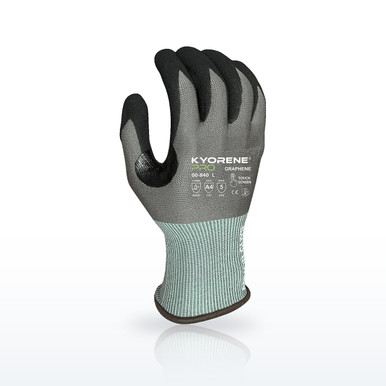 Armor Guys 00-840 Kyorene Pro Cut Resistant Gloves, ANSI A4, Foam Nitrile PalmThe Armor Guys Kyorene Pro 00-840 pairs a black HCT micro-foam nitrile palm with an 18-gauge graphene knit, A4 and EN 388 4X42D as printed, no heat figure: a grip glove for oily parts, $131.26 a dozen
What nitrile is, on a work glove. Nitrile is a synthetic rubber. On a coated knit it is the palm: Armor Guys dips a knitted shell in a foamed or smooth nitrile compound, and the foam is what grips an oily surface, because the open cells wick the oil film away from the contact. The workbook lists the versions: HCT micro-foam nitrile, the standard one; HCT nano-foam nitrile, "thinner and smoother" with "exceptional grip in dry conditions"; HCT Lite nitrile, thinner again, for "wet, dry and oily conditions"; smooth nitrile, "thick coating excellent for dry-grip applications" with the most protection against snags and abrasion; foam nitrile, "thin, breathable" for "light oil and greasy environments"; and full blue nitrile under an HCT micro-foam palm, "full nitrile coating for added liquid resistance". None of the six carries a temperature.
Where the heat goes. Hold a hot part and the heat has to get through the coating, then the shell, then to the skin. A nitrile foam is thin, a millimeter or less, and softens and tacks long before it chars; the HPPE shell under it starts to melt above 158 °F by Armor Guys’ figure, and a melted synthetic sticks to skin, which is the injury people are asking about. That is why the heat-resistant gloves in the band are a different construction: the Taeki5 knit, which Armor Guys rates to 302 °F at 13 and 15 gauge, 482 °F at 10 gauge and up to 662 °F at 7 gauge, under a sewn leather palm; or leather and aramid gloves with an ANSI/ISEA 105 contact heat level printed by their makers. The EN 407 guide linked below reads those figures.
The questions in short
From the Armor Guys workbook, catalog and product pages; the long answers follow.
The questions, one by one
Each answer draws on the Armor Guys workbook and catalog statements and the product pages named in the byline, and on the linked chemical and allergy guides.
Will nitrile gloves melt in heat, and at what temperature?
No manufacturer in the band prints a melting point or a safe temperature for a nitrile coating, and we will not invent one. What Armor Guys does print is the shell’s limit, "HPPE will start to melt above 158° Fahrenheit", in the catalog beside the EN 407 table, which is why its cut-resistant coated knits carry no heat figure and its heat gloves use a different yarn, Taeki5, rated by the catalog to 302, 482 and up to 662 °F by gauge. The practical reading: a micro-foam nitrile palm handles parts that are warm to the touch and should not be used to hold anything that would burn a bare hand in a few seconds. A disposable nitrile glove, 4 to 8 mil of unsupported nitrile, is the same material with no shell and no figure.
What gloves help with grip, wet, dry and oily?
Armor Guys’ coating page answers it coating by coating. Oily: HCT micro-foam nitrile, "resistant to oils", and foam nitrile for "light oil and greasy environments". Wet: HCT micro-foam latex, which "channels liquids from the surface ensuring a positive grip in wet environments", and crinkle latex, "good dry and wet grip". Dry: polyurethane, "a good dry grip and abrasion resistance" with "excellent tactile sensitivity", and nano-foam nitrile, "exceptional grip in dry conditions". Smooth surfaces: micro-foam nitrile with dots, which adds dots "for increased abrasion resistance of the coating". The coatings guide linked below compares the same families across brands.
What type of glove for oily parts?
A foam nitrile palm, and more coverage as the oil gets wetter. Palm-only micro-foam nitrile for parts with an oil film, the standard Armor Guys glove. Knuckle coating, as on the Kyorene 00-002 and 00-004 and the Extraflex 04-002 and 04-007, for "added back-of-hand liquid resistance" in Armor Guys’ words. Full blue nitrile with an HCT micro-foam palm, the Kyorene 00-005, for "liquid resistance with HCT® microfoam nitrile for optimal grip in dry and oily environments", listed for aerospace and automotive. The Kyorene Pro 00-845, listed for fluid handling and engine assembly, is the cut-rated A4 version of the oily-parts glove.
What chemicals is nitrile compatible with, and what is it not?
Nitrile as a glove material resists oils, greases, fuels, many alcohols and a range of acids and bases, and does poorly against ketones, some chlorinated solvents and aromatics; the chemical resistance chart guide linked below carries the letters and the breakthrough data by chemical as the glove manufacturers publish them. Two cautions. A nitrile-coated knit is not a chemical glove: the back is open knit and the coating is foam, so it is splash and grip protection only. A chemical glove is a sealed one, unsupported or supported, with an EN ISO 374-1 marking, which is what Armor Guys prints on the Chemiflex 05-003, a 15 mil flocked nitrile at 13 inches with EN ISO 374-1 and 374-5 as printed, listed for chemical processing, printing and petrochemicals.
Do nitrile gloves contain harmful chemicals?
Nitrile is latex-free, which is why it replaced natural rubber for people with latex allergy; the allergy guide linked below covers the rarer reaction to the accelerators used in curing rubber, which can occur with nitrile too. Armor Guys prints a California Proposition 65 warning on some of its styles, 16 of the 110 we list, and we show the warning on those product pages as printed; the warning is a California labeling requirement, not a statement about use. Armor Guys also prints "silicone free" on a number of Kyorene and Kyorene Pro styles, which matters in paint and coating shops where silicone transfer ruins a finish.
Can you wash or dry nitrile-coated gloves?
Armor Guys’ care and laundering page says that whether a glove can be laundered "depends on the specific liner, coating, contamination, and SKU-level instructions", and its FAQ says to remove gloves when "coating breakdown" affects grip. Heat is the enemy of a foam coating in a dryer the way it is on a hot part, so a coated knit that is washed is air dried, and the washing guide linked below has the general practice. No Armor Guys style we list prints a wash temperature.
Which gloves are heat resistant, then?
The ones that print a figure. Armor Guys prints the EN 407 marking on the Taeki5 01-006 and 01-020 (A4, sewn leather palm over a 10-gauge Taeki5 knit) and the 01-017 liner (A2, 13 gauge), with the Taeki5 temperatures in the catalog; the other manufacturers in the band print ANSI/ISEA 105 contact heat levels on leather and aramid gloves. The EN 407 guide linked below reads the six digits and the ANSI levels against each other.
In plain words
- A nitrile coating has no heat rating. Armor Guys prints that the HPPE shell under it starts to melt above 158 °F.
- For hot parts, a glove that prints a heat figure: Armor Guys’ Taeki5 (EN 407 marking) or a glove with an ANSI/ISEA 105 contact heat level.
- Foam nitrile grips oily parts, latex grips wet ones, polyurethane grips dry ones; more coverage (knuckle, full dip) for wetter oil.
- A nitrile-coated knit is splash protection only; a chemical glove is a sealed one with an EN ISO 374-1 marking, like the Chemiflex 05-003.
- Nitrile is latex-free; some styles carry a Prop 65 warning as printed, and some are printed silicone free.
Questions people ask
Will nitrile gloves melt in heat?
With enough heat, yes; no nitrile coating in the band carries a temperature, and Armor Guys prints that the HPPE shell under it starts to melt above 158 °F.
Are nitrile-coated gloves heat resistant?
No; their figures are cut, abrasion, puncture and impact. A heat glove prints EN 407 or an ANSI/ISEA 105 contact heat level.
Which Armor Guys gloves are for heat?
The Taeki5 01-006, 01-020 and 01-017, which print the EN 407 marking; the catalog rates the Taeki5 knit to 302, 482 and up to 662 °F by gauge.
Which coating grips oily parts?
Micro-foam or foam nitrile; a knuckle coat or full nitrile dip for parts wet with oil.
Which coating grips wet surfaces?
Micro-foam latex, which Armor Guys says channels liquid off the surface, or crinkle latex for good wet and dry grip, by its coating notes.
Is a nitrile-coated knit a chemical glove?
No; it is splash and grip protection. A chemical glove is sealed and prints EN ISO 374-1, like the Armor Guys Chemiflex 05-003.
Do nitrile gloves contain latex?
No; nitrile is a synthetic rubber and is the usual choice for latex allergy. Accelerator allergy is the rarer reaction and is covered in the allergy guide.
Why does a glove carry a Prop 65 warning?
It is a California labeling requirement; Armor Guys prints it on some styles and we show it as printed.
Related guides
What does EN 407 mean on gloves?The six heat and flame figures and the levels 1 to 4What is a glove coating?Nitrile, polyurethane, latex and foam comparedHeat-resistant glovesThe ANSI/ISEA 105 heat and flame levelsWhich gloves protect against chemicals?How to read a chemical resistance chartWhich gloves for isopropyl alcohol, acetone, bleach, acids and fuels?Chemical by chemicalNitrile gloves and latex allergyAnd can you react to a non-latex glove?What are the downsides of nitrile gloves?By what the standards and the data sayCan cut-resistant gloves be washed?Care and when to replace themIs nylon a good material for gloves?Nylon, polyester, HPPE, Taeki5 and Kyorene shellsThe ratings, test results and standards shown here are the manufacturers' published values, reproduced as published. Nothing on this page is a recommendation by Bayshore Safety that any product is suitable for a particular task, hazard or workplace. Selecting safety products and protective equipment is the responsibility of the end user and the employer, based on their own hazard assessment and the regulations that apply to their work. Confirm every value on the manufacturer's own documentation before use.
© 2026 Bayshore Safety & Industrial Supplies, Inc. All rights reserved. This guide may not be copied or republished without written permission.