
EN 397 vs EN 12492 vs ANSI Z89.1 Type II: what each helmet standard tests, and why a climbing helmet is not automatically a Type II hard hat
EN 397 is the European industrial hard hat standard: a top-impact shock absorption test, a penetration test, flame resistance, and a chin strap that is required to release at 150 to 250 newtons so the hat does not strangle a worker. EN 12492 is the European mountaineering helmet standard: impact from the top, front, sides and rear, penetration, and a chin strap that must hold at least 500 newtons so the helmet stays on in a fall. ANSI/ISEA Z89.1 Type II is the US rating for top and lateral impact with an integrated foam liner. PIP states that safety helmets meeting EN 12492 also meet Z89.1 Type I for top impact and meet EN 12492 for side, front and rear shock absorption with a manufacturer-installed 4-point chin strap, and that EN 12492 requires venting, so a Class E hat rated EN 12492 has been tested for impact and retention only, with the venting requirement excluded.
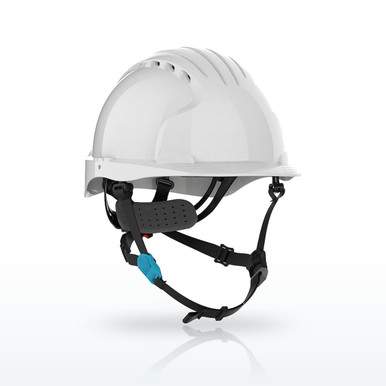 JSP Evolution Deluxe 6252 280-EV6252V-CH Safety Helmets, Type II Class C, VentedType II safety helmet the manufacturer also lists to EN 12492 (PIP data)
Why the chin strap is the tell. The two European standards disagree on purpose about the strap. An industrial hat under EN 397 is meant to come off rather than hang a worker caught on a ladder or in machinery, so the strap releases between 150 and 250 newtons. A mountaineering helmet under EN 12492 is meant to stay on through a fall against rock, so the strap has to hold 500 newtons or more. A helmet sold for work at height with an EN 12492 strap therefore stays on in a fall, which is the feature general contractors specify, while the Z89.1 Type II rating covers the lateral impact itself; the manufacturer lists both on the same helmet when it has passed both.
What each standard tests
As the standards are described by the manufacturers; the figures are the published test values.
What the manufacturer states about helmets carrying both
From the PIP sheet:
- ANSI Type II hard hats offer top, side, front and rear impact protection and have an integrated liner; a 4-point chin strap can be factory installed or added as an accessory (PIP Q9).
- Safety helmets that meet EN 12492 also meet ANSI Z89.1 Type I for top impact protection and meet EN 12492 for side, front and rear shock absorption, and have a manufacturer-installed 4-point chin strap (PIP Q9).
- EN 12492 requires venting, so when a manufacturer rates a Class E hard hat as EN 12492 it has excluded the venting requirement and tested for impact and retention only (PIP Q9, note).
- A helmet is Type II only when its inside label says so; EN 12492 alone is not a Type II rating, and the helmets below list both standards in the manufacturer’s data.
Portwest’s dual-listed hats
Most Portwest hard hats and helmets on this site list EN 397 beside ANSI/ISEA Z89.1 (the data sheets print the EN 397 temperature marking −30 °C/+50 °C), and the PS73 Type I Class C helmet lists EN 397 and EN 12492 together; the Type II helmets (PS71, PS81, PS82) list ANSI/ISEA Z89.1 Type II only on their US pages. Each page states the standards Portwest lists.
Portwest product pages and US data sheets for the styles shown (documents.portwest.com), fetched Nov 7 2026More questions people ask
What is the EN 12492 safety standard?
EN 12492 is the European mountaineering helmet standard: shock absorption from the top, front, sides and rear, penetration, ventilation, and a chin strap that must hold at least 500 newtons so the helmet stays on in a fall. Work helmets certified to it alongside ANSI/ISEA Z89.1 meet Z89.1 Type I for top impact and EN 12492 for side, front and rear; the inside label must say Type II for the Z89.1 lateral rating, and a Class E hat listed to EN 12492 has had the venting requirement excluded.
What is CSA Z94.1, and what does ANSI and CSA dual certified mean on a helmet?
CSA Z94.1 is the Canadian industrial head protection standard, the counterpart of ANSI/ISEA Z89.1, with its own Type 1 and Type 2 impact levels and its own classes; a helmet sold for Canadian sites is certified to it, and a helmet sold for US sites to Z89.1. A dual-certified helmet has been tested to both, so one part number can be issued on either side of the border. Studson lists its SHK-1 Full Brim ANSI + CSA versions to ANSI/ISEA Z89.1-2014 (R2019) Type II and CSA Z94.1-2015 Type II, in Class C (vented) and Class E (non-vented); every other SHK-1 is ANSI only and Studson states plainly that those are not certified to CSA Z94.1. (CSA Z94.3, which people also ask about, is the Canadian eye and face protection standard, not a helmet standard.) Which clauses of EN 12492 the ANSI-only SHK-1 lists, and why no SHK-1 is listed to EN 397, are in the cards above.
Answers from the sources named above and in the byline.Questions people ask
What is the difference between EN 397 and EN 12492?
EN 397 is the industrial hard hat standard (top impact, penetration, flame, a chin strap that releases at 150 to 250 N); EN 12492 is the mountaineering standard (impact from top, front, sides and rear, a chin strap that holds at least 500 N, ventilation required).
Is an EN 12492 helmet a Type II hard hat?
Not by itself. PIP states an EN 12492 helmet meets Z89.1 Type I for top impact and EN 12492 for side, front and rear; it is Type II only when its label carries the Type II rating from the Z89.1 lateral test.
Why does an EN 397 chin strap come off?
By design: the standard requires release between 150 and 250 N so a snagged worker is not hung by the strap; EN 12492 requires the opposite, 500 N or more, to keep the helmet on in a fall.
Can a Class E hard hat be EN 12492?
The manufacturer states that when it rates a Class E hat as EN 12492 it has excluded the venting requirement and tested impact and retention only, because EN 12492 requires venting and Class E hats are non-vented.
Are safety helmets replacing hard hats?
Many contractors now specify Type II with a chin strap for work at height; OSHA requires a Z89.1 helmet and leaves the Type to the hazard assessment under 1910.132(d). The safety helmet vs hard hat guide covers it.
What is the EN 12492 safety standard?
EN 12492 is the European mountaineering helmet standard: shock absorption from the top, front, sides and rear, penetration, ventilation, and a chin strap that must hold at least 500 newtons so the helmet stays on in a fall. Work helmets certified to it alongside ANSI/ISEA Z89.1 meet Z89.1 Type I for top impact and EN 12492 for side, front and rear; the inside label must say Type II for the Z89.1 lateral rating, and a Class E hat listed to EN 12492 has had the venting requirement excluded.
What is the ISO or EN standard for industrial safety helmets?
EN 397 is the European industrial helmet standard (top impact, penetration, flame resistance, a chin strap that releases at 150 to 250 newtons); EN 12492 is the mountaineering helmet standard used for work-at-height helmets; EN 50365 adds electrical insulation to 1,000 V AC; EN 812 covers bump caps. ISO 3873 was the older international industrial helmet standard that EN 397 descends from. In the US the rule reads ANSI/ISEA Z89.1.
What are the ANSI helmet standards?
One standard, ANSI/ISEA Z89.1 (Z89.1-2014 reaffirmed in 2019, and the 2026 edition), with Type I (top impact) and Type II (top and lateral impact) and Class G (2,200 volts), E (20,000 volts) and C (no electrical test). OSHA 1910.135 and 1926.100 require it; the European marks on Portwest’s helmets are listed beside it, not instead of it.
What is CSA Z94.1?
The Canadian industrial head protection standard, the counterpart of ANSI Z89.1; a helmet for Canadian sites is certified to it.
What does CSA Z94-3 mean?
The Canadian eye and face protection standard, not a helmet standard; the helmet one is Z94.1.
Is the Studson SHK-1 certified to EN 397?
No. Studson lists the ANSI-only SHK-1 to Z89.1 and to clauses of EN 12492:2012, and the dual-cert versions to Z89.1 and CSA Z94.1; none is listed to EN 397.
Is the MSA V-Gard certified to CSA Z94.1?
Yes: MSA lists the V-Gard Cap and Hat, V-Gard 500 and V-Gard GREEN as Type I, Class E under CSA Z94.1-2015 as well as ANSI/ISEA Z89.1-2014, third-party certified by SEI.
Related guides
Type I vs Type II hard hatsWhat the types meanSafety helmet vs hard hatChin straps and Type IIClass G, E and C hard hatsThe electrical classesDoes OSHA allow stickers on hard hats?And the required markingsMSA V-Gard questions answeredService life, CSA, Fas-Trac III, Skullgard and what fitsThe ratings, test results and standards shown here are the manufacturers' published values, reproduced as published. Nothing on this page is a recommendation by Bayshore Safety that any product is suitable for a particular task, hazard or workplace. Selecting safety products and protective equipment is the responsibility of the end user and the employer, based on their own hazard assessment and the regulations that apply to their work. Confirm every value on the manufacturer's own documentation before use.