
MSA V-Gard hard hat questions answered: what V-Gard means, how long an MSA hard hat is good for and the date code, CSA approval, the Fas-Trac III and Staz-On suspensions, Skullgard, the V-Gard H1, bandanas under the hat, and which accessories fit
The MSA V-Gard is a Type I, Class E hard hat under ANSI/ISEA Z89.1-2014, third-party certified by SEI and also certified Class E under CSA Z94.1-2015, made of virgin high-density polyethylene with a UV inhibitor, sold as a slotted cap and a full-brim hat with the Staz-On pinlock or Fas-Trac III ratchet suspension. MSA’s stated service life is 12 months for the suspension and 5 years for the shell from the day it goes into service, with replacement after any impact; the date molded under the brim is the molding date, not an expiry. MSA says it has sold well over 100 million V-Gard helmets. This page answers the questions people ask about it from MSA’s own helmet FAQ, technical sheet and product pages.
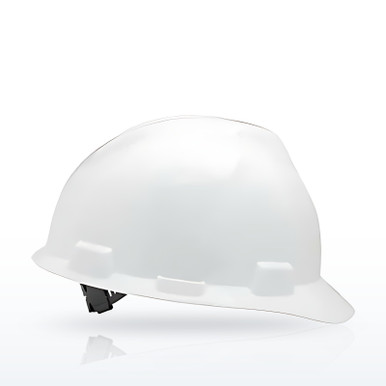 MSA 463942 V-Gard Cap Style Hard Hat, Type I Class E, White, Staz-OnMSA lists the V-Gard Cap at 0.86 lb, Type I Class E to Z89.1-2014 and CSA Z94.1-2015, virgin HDPE, 21 stocked colors
Why a page for one hard hat. The V-Gard is the hard hat most of the trades we sell to have worn at some point, and the questions about it (how long is it good for, is it CSA approved, can I wear a bandana under it, which suspension fits, what is the difference between the cap and the hat, is MSA approved by OSHA) are asked by name. MSA publishes the answers in its Care and Use of MSA Helmets FAQ and its V-Gard technical sheet, and this page quotes them. Where a question is really about the standard rather than the hat (what Class E means, when a hard hat is required, whether stickers are allowed), the live guides linked at the end carry it; this page is what MSA states about its own helmets.
The V-Gard, question by question
Quotations are MSA’s, from the helmet FAQ and the V-Gard technical specifications sheet.
The V-Gard in plain words
- Type I, Class E to ANSI/ISEA Z89.1-2014 and CSA Z94.1-2015, SEI certified; HDPE with UV inhibitor; 0.86 lb; 21 stocked colors.
- Service life MSA states: suspension 12 months, shell 5 years from the day in service, replace after any impact; the brim code is the molding date.
- Class E is tested at 20,000 volts, Class G at 2,200, Class C not at all; the V-Gard 500 vented is MSA’s Class C hat.
- Staz-On (pinlock) and Fas-Trac III (ratchet) interchange across the V-Gard, V-Gard 500, V-Gard GREEN and SmoothDome; never another brand’s suspension.
- Bandanas, hoods and skullcaps are allowed worn flat; baseball caps are not; nothing in the gap between suspension and shell.
- V-Gard caps and hats may be worn backwards with the suspension reversed; only MSA accessories go on an MSA helmet.
- No paint except on Thermalgard and Skullgard; mild soap and warm water; store below 120 °F.
MSA V-Gard and the other MSA hard hats on this site, as MSA states them
| Model | Type and class (ANSI/ISEA Z89.1-2014) | CSA Z94.1 | Shell | Weight and sizes | Service life MSA states |
|---|---|---|---|---|---|
| V-Gard Cap (slotted cap style) | Type I, Class E (third-party certified by SEI) | Class E (CSA Z94.1-2015) | Virgin HDPE with UV inhibitor | 0.86 lb; Small 6 to 7 1/8, Standard 6 1/2 to 8, Large 7 to 8 1/2 | Suspension after no more than 12 months of use; shell after no more than five years of use; always after an impact |
| V-Gard Hat (full brim) | Type I, Class E | Class E | HDPE | As the product page states | Same |
| V-Gard 500 Cap | Type I; vented Class C, non-vented Class E | As listed | HDPE | As the product page states | Same |
| V-Gard H1 Safety Helmet (brimless) | Type I; Novent Class E, Trivent and Bivent Class C | As listed on the page | As the product page states | As the product page states | Same |
| Topgard Cap and Hat | Type I, Class E; rated to 275 °F radiant heat (tested and then impacted) | Class E | Polycarbonate | As the product page states | Same |
| Skullgard Cap and Hat | Type I, Class G; rated to 350 °F radiant heat | — | Phenolic resin | As the product page states | Same, with MSA’s note that a Skullgard tends to exceed the suggested life because of the material |
| Comfo-Cap | Type I, Class G | — | Polycarbonate | As the product page states | Same |
MSA’s FAQ: Class E ratings inherently include Class G; "Class E (electrical) tested to 20,000 volts, Class G (general) tested to 2,200 volts, and Class C (conductive) that provides no electrical protection", with the note that "these voltage ratings are not intended as an indication of the voltage at which the helmet protects the wearer".
Source: MSA V-Gard Cap technical specifications sheet (0600-65-MC); Care and Use of MSA Helmets FAQ; MSA product pages, fetched Nov 10 2026.
Questions people ask
Are MSA hard hats CSA approved?
The V-Gard, V-Gard GREEN, V-Gard 500 and Topgard are certified Class E under CSA Z94.1-2015 as well as ANSI/ISEA Z89.1-2014, third-party by SEI, as MSA states; Skullgard and Comfo-Cap carry the Z89.1 listing on our pages.
How long do MSA hard hats last?
MSA’s schedule: replace the suspension every 12 months and the helmet every 5 years from the date placed in service, and immediately after any impact or penetration.
How long is an MSA hard hat good for?
Five years in service for the shell and 12 months for the suspension, per MSA, subject to daily inspection; the date under the brim is when the shell was molded.
Are MSA hard hats approved by OSHA?
OSHA approves no hard hat; the V-Gard meets 1910.135 and 1926.100 by its SEI certification to ANSI/ISEA Z89.1-2014, which is what the rule asks for.
What is the expiration date for a V-Gard hard hat?
There is none; MSA states the molded date code is the molding date and the service life starts when the hat goes into use.
Can you wear a bandana under an MSA V-Gard hard hat?
Yes, worn smoothly without bunching, per MSA; a baseball cap should not go under the suspension.
What is a V-Gard hard hat?
MSA’s Type I, Class E HDPE hard hat with the V ridge, sold as a slotted cap and a full-brim hat; MSA states over 100 million sold.
What is a MSA safety helmet?
The V-Gard H1: a brimless, chin-strapped helmet MSA lists to Z89.1-2014 Type I, Class E non-vented or Class C vented.
Where can I buy MSA Skullgard?
Here: the Skullgard cap and its Staz-On and swing-ratchet suspensions are in the band at current prices. We sell nationwide.
What does MSA mean on a hard hat?
The manufacturer, MSA Safety, originally Mine Safety Appliances Company (1914); the who-owns guide linked below covers the company.
Which suspension fits a V-Gard?
MSA’s Staz-On pinlock or Fas-Trac III ratchet for the V-Gard, V-Gard 500, V-Gard GREEN and SmoothDome; Skullgard takes its own; no other brand’s.
Can a V-Gard be worn backwards?
Yes, it carries the Z89.1 reverse-donning mark; reverse the suspension so the nape strap faces the brim.
Can I put another brand’s face shield on a V-Gard?
MSA says no: only MSA accessories are tested on MSA helmets for continued compliance as an assembly.
Is the V-Gard H1 Type II?
No; MSA lists it as Type I with a chin strap, Class E (Novent) or Class C (Trivent, Bivent).
Can an MSA hard hat be painted?
Only the Thermalgard and Skullgard; MSA states paint may attack the other shells. Factory logos use an ink that cures into the shell.
How much does a V-Gard weigh?
0.86 lb for the V-Gard Cap per MSA’s technical sheet, in Small, Standard and Large sizes.
Related guides
Do hard hats expire?Service life, the date stamp, and when to replace oneClass G, Class E and Class C hard hatsThe electrical ratingsHow to assemble a hard hat suspensionPin-lock and ratchetHow to wear a hard hat correctlyAnd can you wear it backwards?What accessories fit a hard hat?Slots, rails, brackets and chin straps by helmetSafety helmet vs hard hatWhat the chin strap and Type II changeIs it a legal requirement to wear a hard hat?Who decides, who pays and what OSHA citesWho owns BW Technologies, Honeywell Analytics and MSA?What each company makes, in its own wordsThe ratings, test results and standards shown here are the manufacturers' published values, reproduced as published. Nothing on this page is a recommendation by Bayshore Safety that any product is suitable for a particular task, hazard or workplace. Selecting safety products and protective equipment is the responsibility of the end user and the employer, based on their own hazard assessment and the regulations that apply to their work. Confirm every value on the manufacturer's own documentation before use.