
Fixed ladder fall protection: what 1910.28(b)(9) requires, why cages are being phased out, and what a ladder safety system is
OSHA’s 2017 walking-working surfaces rule changed fixed ladders in general industry. Under 1910.28(b)(9), a fixed ladder that extends more than 24 feet above a lower level must be equipped with a personal fall arrest system or a ladder safety system; a cage or well no longer counts as fall protection on its own. The dates are in the paragraph: a fixed ladder installed before November 19, 2018 may keep its cage or well until it is replaced, any ladder installed or any section replaced on or after that date needs the arrest or ladder safety system, and by November 18, 2036 every fixed ladder over 24 feet has to have one. A ladder safety system (1910.29(i)) is a rigid rail or a flexible cable along the climbing face with a sleeve or cable grab that locks on a fall, connected to the front D-ring of a harness; a personal fall arrest system on a ladder is an SRL or a vertical lifeline on an anchor at the top. Safewaze’s ladder climb system is the flexible-cable version: a 3/8 inch galvanized or stainless cable with top and bottom brackets, in 20 to 100 ft lengths for 2 or 4 users, listed to ANSI A14.3 and with a 3,600 lb single-user anchor point. In construction, 1926.1053(a)(18) and (19) require the same thing at 24 feet.
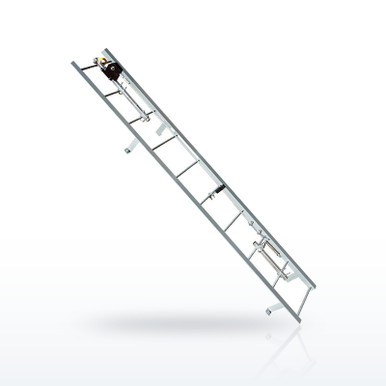 Safewaze 019-12009 Ladder Safety Systems, 100 ft, Complete Kit2-person ladder climb system: 3/8 in cable, top and bottom brackets, ANSI A14.3 (Safewaze data)
Why the cage went away. A cage keeps a climber who slips from falling outward; it does not stop the fall, and a climber who loses grip falls down the inside of the cage, hitting the hoops on the way. The 2017 rule accepted the data on that and moved fixed ladders to the same two answers every other height has: stop the fall with an arrest system, or guide the climber on a rail or cable that locks. The ladder safety system is the one built for climbing: it attaches at the front D-ring so the climber stays upright, the sleeve rides the cable or rail with both hands free, and the lock engages within a short distance. Safewaze’s manual reads the dates the same way the rule prints them: new and replaced ladders at once, existing ladders by 2036, and the cage may stay in place as long as the system is added.
The rule, piece by piece
From 1910.28(b)(9) and 1910.29(i).
What the manufacturer states about its ladder system
From the manual and the flyers:
- The Safewaze Ladder Climb System is a vertical cable with the hardware to install on most fixed ladders; listed to ANSI A14.3, OSHA 1926.1053 and 1910.29, in 20 to 100 ft systems with 3/8 inch galvanized or stainless cable, a pre-swaged termination, a 3,600 lb single-user anchor point, a spring-loaded tension-retaining bottom bracket, an energy-absorbing stainless top bracket, and a product and inspection label; intermediate guides and the cable sleeve are sold separately.
- Capacity: 4 users maximum at ANSI 130–310 lb per user, or 2 users maximum at OSHA up to 420 lb per user, including clothing, tools and equipment; the manual’s Figure 1 gives the maximum per system and the count is based on a cable fall arrester.
- Capacity standard: the systems are designed to meet ANSI Z359.16 when used with a conforming fall arrester (130–310 lb) and OSHA up to 420 lb.
- Anchorage: 5,000 lb per user attached for a non-certified anchorage, or a 2:1 engineered system; the structure withstands 5,000 lb in all directions the system permits; fall clearance accounts for a minimum 2 ft safety factor, deceleration, user height and the lanyard or SRL.
- The manual’s reading of 1910.28: the 2018 update mandated a ladder safety system or personal fall arrest system in place of the previously acceptable cages; new or replaced ladders comply at once; existing ladders have until 2036.
- The SRL ladder anchor is the other answer the manufacturer lists: a post or bracket at the top of the ladder that holds a self-retracting lifeline for a personal fall arrest system on the climb.
Fixed ladder fall protection: the dates in 1910.28(b)(9)
| Ladder | What is required | Paragraph |
|---|---|---|
| Any fixed ladder 24 ft or less above a lower level | No fall protection required on the ladder by this paragraph | 1910.28(b)(9) |
| Over 24 ft, installed before Nov 19, 2018 | Cage, well, ladder safety system or personal fall arrest system (existing cage or well satisfies it) | 1910.28(b)(9)(i)(A) |
| Over 24 ft, installed on or after Nov 19, 2018 | Personal fall arrest system or ladder safety system | 1910.28(b)(9)(i)(B) |
| Over 24 ft, a ladder or section replaced on or after Nov 19, 2018 | Personal fall arrest system or ladder safety system on the replaced section | 1910.28(b)(9)(i)(C) |
| Every fixed ladder over 24 ft from Nov 18, 2036 | Personal fall arrest system or ladder safety system | 1910.28(b)(9)(i)(D) |
| Construction fixed ladders over 24 ft | Ladder safety device, SRL with rest platforms every 150 ft, or cage or well with landings every 50 ft | 1926.1053(a)(18), (19) |
Source: 29 CFR 1910.28(b)(9) and 1926.1053(a) (current e-CFR).
What FallTech states about fixed ladders and the front D-ring
FallTech’s fixed-ladder guide reads 1910.28(b)(9) in three cases: ladders installed on or after November 19, 2018 need a ladder safety system or personal fall arrest system; earlier ladders may keep a cage or well; a replaced ladder or section needs a ladder safety system or PFAS in at least that section, with every covered ladder due for one by November 18, 2036 (FallTech notes OSHA proposed removing that date in April 2026 without changing the current rule). For construction it cites 1926.1053(a)(18) and (19): protection when the climb is 24 ft or more, with ladder safety devices, SRLs with rest platforms no more than 150 ft apart, or cages or wells with offset sections of 50 ft or less. It states that a ladder safety system connects to a front D-ring, that 1910.140(c)(22) permits the chest attachment when free fall is 2 ft or less, that ANSI/ASSE Z359.16 covers climbing ladder fall arrest systems, that an ordinary vertical lifeline is not an automatic substitute, and that an overhead Class 1 SRL connects to the dorsal D-ring with free fall limited to 2 ft. Its sternal D-rings are rated to a 5,000 lb minimum tensile load; side D-rings are for positioning and never for arrest.
FallTech, “Fixed Ladder Fall Protection: Choosing the Right System for the Complete Climb” and “Why Front D-Rings Matter for Ladder Safety” (falltech.com); 29 CFR 1910.28(b)(9), 1910.140(c)(22), 1926.1053(a)(18)–(19).Questions people ask
Is OSHA phasing out ladder cages?
Yes, in general industry: a fixed ladder over 24 feet installed or replaced on or after November 19, 2018 needs a personal fall arrest system or a ladder safety system instead of a cage, and every fixed ladder over 24 feet needs one by November 18, 2036 (1910.28(b)(9)). The cage may stay if it does not interfere.
What is an example of a fall protection system on a ladder?
Safewaze’s ladder climb system: a 3/8 inch galvanized or stainless cable from a top bracket to a tension-retaining bottom bracket with intermediate guides, a cable sleeve that locks on a fall, and a connection to the front D-ring of the harness; listed to ANSI A14.3 for 2 or 4 users at ANSI 130–310 lb (or 2 users at OSHA up to 420 lb). It is a ladder safety system under 1910.29(i); an SRL anchored at the top of the ladder would be the personal fall arrest alternative.
What are the components of a ladder safety system?
A carrier (the rigid rail or flexible cable fixed to the ladder), the safety sleeve that rides the carrier and locks on a fall, a lanyard no longer than 9 inches and a connector to the front D-ring of a full body harness, with top and bottom brackets and intermediate guides holding the carrier to the ladder (1910.29(i); 1910.21(b) definition). Safewaze’s cable system adds a tension-retaining bottom bracket and an energy-absorbing top bracket.
What is a ladder safety system?
A system attached to the ladder that lets the climber use both hands and locks on a fall: a carrier (rail or cable), a sleeve or cable grab that rides it, and the connection to the front D-ring of a full body harness; 1910.29(i) sets its criteria.
What replaced ladder cages?
A ladder safety system (a rigid rail or flexible cable with a locking sleeve, 1910.29(i)) or a personal fall arrest system (an SRL or vertical lifeline anchored at the top). Safewaze’s ladder climb system is the cable type.
At what height does a fixed ladder need fall protection?
When it extends more than 24 feet above a lower level, in both general industry (1910.28(b)(9)) and construction (1926.1053(a)(18)).
How many people can use a ladder safety system?
What the manufacturer rates: Safewaze’s systems carry 2 or 4 users at ANSI 130–310 lb each, and the 4-user system drops to 2 users when users are rated at OSHA up to 420 lb.
Can a cage be used instead of a harness on a fixed ladder?
Only on a ladder installed before November 19, 2018 and only until that ladder or section is replaced, and never after November 18, 2036; a cage never satisfied 1926.1053 alone for construction ladders over 24 feet without landings every 50 feet.
Is the November 2036 fixed ladder deadline still in effect?
Yes, as the rule reads today: 1910.28(b)(9)(i)(D) says that on and after November 18, 2036 all fixed ladders over 24 feet are equipped with a personal fall arrest system or a ladder safety system. On April 6, 2026 OSHA published a proposed rule (91 FR 17165, Docket OSHA-2025-0072) to remove that paragraph and keep the requirements for new and replacement ladders; comments closed June 5, 2026 and no final rule has been published as of this writing. A proposal changes nothing until it is final.
Which fall protection system is passive and which is active on a fixed ladder?
A cage or well is passive: it stands there and the climber does nothing. A ladder safety system and a personal fall arrest system are active: the climber connects the sleeve or SRL to the harness before stepping on. The 2017 rule moved fixed ladders from the passive cage to the active systems because a cage does not arrest a fall (81 FR 82494, November 18, 2016).
What device prevents falls from a fixed ladder and consists of a lanyard connector, carrier, safety sleeve and a body harness?
A ladder safety system: OSHA defines it as a system attached to a fixed ladder designed to eliminate or reduce the possibility of falling, consisting of a carrier (rail or cable), safety sleeve, lanyard, connectors and body harness (1910.21(b)). The sleeve rides the carrier and locks on a fall; the connection to the front D-ring is no longer than 9 inches.
What safety device could be used with a fixed ladder?
A ladder safety system (rigid rail or flexible cable with a locking sleeve, 1910.29(i)) or a personal fall arrest system, in practice an SRL on an anchor at the top of the ladder; a cage or well counts only on ladders installed before November 19, 2018 and only until November 18, 2036.
What is true about safety devices on fixed ladders?
They are required when the ladder extends more than 24 ft above a lower level; the climber must be able to use both hands; the device must lock on a fall; the connection is at the front D-ring and no more than 9 inches long; and in construction the device must activate within 2 ft and limit descent to 7 ft per second (1910.28(b)(9), 1910.29(i), 1926.1053(a)(22)).
What added protection may be required if a fixed ladder does not have a cage?
None beyond what every new ladder over 24 ft needs: a ladder safety system or a personal fall arrest system. Since November 19, 2018 a cage is no longer an accepted form of fall protection on new or replaced ladders, so its absence changes nothing (1910.28(b)(9)(i)(B)).
What do fixed ladders need to be able to support?
Under 1910.23(d)(1), each fixed ladder is capable of supporting its maximum intended load, which 1910.21(b) defines as the total load of the employee and everything carried; the ladder safety system’s anchorage must hold the loads its manufacturer states (Safewaze: 3,600 lb single-user anchor point, 5,000 lb per user for a non-certified anchorage). Construction ladder safety devices must withstand an 18-inch drop of a 500 lb weight (1926.1053(a)(22)(i)).
What are the new OSHA requirements for fixed ladders?
From the 2017 walking-working surfaces rule: ladders over 24 ft installed or replaced on or after November 19, 2018 need a personal fall arrest system or ladder safety system instead of a cage, and every fixed ladder over 24 ft needs one by November 18, 2036 (1910.28(b)(9)). A 2026 proposed rule on the 2036 date is noted above.
The ratings, test results and standards shown here are the manufacturers' published values, reproduced as published. Nothing on this page is a recommendation by Bayshore Safety that any product is suitable for a particular task, hazard or workplace. Selecting safety products and protective equipment is the responsibility of the end user and the employer, based on their own hazard assessment and the regulations that apply to their work. Confirm every value on the manufacturer's own documentation before use.