
Which gases does each job test for? Gas monitors for wastewater, utilities, oil and gas, fire service, marine and construction, with what the rules and RKI Instruments list for each
The rule sets the gases and the job sets the sensors. Every permit-required confined space, in a treatment plant, a vault or a tank, is tested under 29 CFR 1910.146 for oxygen, flammable gas and toxic contaminants in that order, which is the four-gas monitor’s LEL, O2, H2S and CO; construction adds continuous monitoring under 1926 Subpart AA. Wastewater adds hydrogen sulfide and methane from digesters and wet wells, and RKI Instruments’ training names wet wells, dry wells, bar screens, lift stations, digesters, thickeners, clarifiers and pump stations. Utilities meet methane, carbon monoxide and oxygen deficiency in vaults, manholes and gas work, and RKI lists the GX-3R and its Eagle line for them. Oil and gas adds hydrogen sulfide and benzene, and RKI’s hydrogen-compensated CO sensor for refineries where hydrogen fools a standard CO cell. Fire service, RKI states, meets carbon monoxide on routine calls and hydrogen cyanide from burning plastics, which is why it names a GX-3R Pro with an HCN sensor for firefighters. Marine work falls under SOLAS XI-1/7, which RKI summarizes as requiring an explosion-protected, robust, sample-drawing multi-gas detector with calibration records kept aboard; RKI lists the GX-3R and GX-3R Pro with the optional pump among its MED-marked instruments for it.
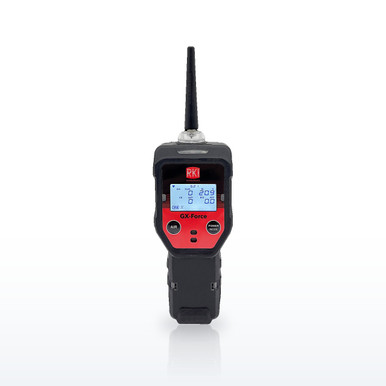 RKI Instruments 72-FA-A-A15 GX-Force 4-Gas Sample-Draw Monitor, LEL/O2/H2S/COPumped four-gas monitor RKI lists for confined spaces, utilities, water and wastewater, oil and gas and fire services (RKI application list)
Why the job list on a manufacturer’s page is the starting point and not the answer. RKI prints the same application list on its GX-3R Pro and GX-Force pages: personal monitoring, confined spaces, refineries and petrochemical, utilities, oil and gas, water and wastewater, fire services, construction. That tells a buyer the instruments are built for those trades; it does not tell the employer which sensors a particular permit space or hot zone needs. The hazard assessment does that, and the standards fix the floor: 1910.146 names oxygen, flammables and toxics; 1910.1000 sets the limit for each toxic; Subpart AA requires monitoring to continue through the entry on a construction site. What follows is each trade’s usual gases as the rules and RKI’s own pages describe them, with the RKI instruments RKI lists for each, so the reader can match a sensor set to a permit. The choice is the employer’s.
Job by job: the gases, the rule, and what RKI lists
Gases are the ones the sources name; the instruments are those RKI lists on its industry and application pages.
The sensor set each trade ends up carrying, as the sources describe it
From 1910.146, Subpart AA and RKI's pages:
- Every confined space entry, any trade: LEL, O2, H2S and CO, tested in that order of the standard (oxygen first, then flammables, then toxics) with a calibrated direct-reading instrument, from outside with a pump or hose before entry, and worn by the entrant during.
- Wastewater: the four, with H2S the channel that alarms first (RKI presets 5, 30 and 100 ppm); a percent-range or infrared sensor where digester or landfill gas is handled (40 to 60 percent CO2 and 45 to 60 percent methane by RKI's landfill figures, beyond a catalytic sensor's range and oxygen).
- Utilities: the four, plus ppm combustible reading for leak surveys (the GX-Force Leak Check mode at 500 to 5,000 ppm display ranges) and NO2 where diesel runs in enclosed work.
- Oil and gas: the four with a hydrogen-compensated CO sensor where hydrogen is present, SO2 as a fifth channel at sour gas plants, benzene by PID with a 10.0 eV lamp and filter tube, and an oxygen reading before any catalytic LEL reading is trusted in an inerted vessel.
- Fire service: CO single-gas on the uniform and a 4-gas plus HCN (or NO2) for overhaul and investigation, as RKI describes; RKI's hazmat page adds phosphine and ammonia for drug-lab entries.
- Marine: a pumped or hose-fed multi-gas with a MED mark and the ship's calibration gas and records; RKI's marine page lists the GX-3R and GX-3R Pro with pump, and the GX-8000 and RX-8000 for inert and percent-volume work.
- Construction: the four, worn continuously under Subpart AA, with CO and NO2 where engines run indoors.
Gases by trade, with the limit and the RKI preset first alarm
| Gas | Trades where it is named | OSHA PEL | NIOSH IDLH | RKI first alarm (preset) |
|---|---|---|---|---|
| Oxygen | All (every confined space) | 19.5 to 23.5% is the 1910.146 range | Below 19.5% is IDLH for respirator selection | 19.5% low, 23.5% high |
| Combustible gas (methane, hydrocarbons) | All; utilities, oil and gas, wastewater, marine | 10% LFL is the 1910.146 line | — | 10% LEL |
| Hydrogen sulfide | Wastewater, oil and gas, marine, utilities | C 20 ppm 50 ppm [10-minute maximum peak] | 100 ppm | 5 ppm |
| Carbon monoxide | All; fire service, utilities, construction | TWA 50 ppm (55 mg/m³) | 1200 ppm | 25 ppm |
| Hydrogen cyanide | Fire service | TWA 10 ppm (11 mg/m³) [skin] | 50 ppm | 5.0 ppm |
| Nitrogen dioxide | Fire service, utilities, construction (diesel) | C 5 ppm (9 mg/m³) | 13 ppm | 2.00 ppm |
| Sulfur dioxide | Oil and gas, utilities (combustion) | TWA 5 ppm (13 mg/m³) | 100 ppm | 2 ppm |
| Ammonia | Wastewater, refrigeration, hazmat | TWA 50 ppm (35 mg/m³) | 300 ppm | 25.0 ppm |
| Carbon dioxide | Wastewater digesters, landfill, marine inerting, breweries | TWA 5000 ppm (9000 mg/m³) | 40,000 ppm | 5,000 ppm (ppm sensor) |
| Benzene (VOC by PID) | Oil and gas, refineries | [1910.1028] TWA 1 ppm ST 5 ppm | Ca [500 ppm] | By instrument |
| Phosphine | Hazmat (drug labs), fumigation | TWA 0.3 ppm (0.4 mg/m³) | 50 ppm | 0.30 ppm |
Source: 29 CFR 1910.1000 Tables Z-1 and Z-2 and 1910.1028 as reproduced in the NIOSH Pocket Guide to Chemical Hazards (current online edition); 29 CFR 1910.146(b); RKI preset alarms from RKI Instruments GX-3R Pro product page and specification table (rkiinstruments.com/product/gx-3r-pro-gas-detector, rkiinstruments.com, fetched Nov 8 2026) and RKI Instruments 04 Series product page and specification table (rkiinstruments.com/product/04-series-single-gas-detectors, rkiinstruments.com, fetched Nov 8 2026), user adjustable.
Questions people ask
What gas detector is used in wastewater treatment?
A four-gas monitor (LEL, O2, H2S, CO): pumped for the pre-entry test of wet wells and manholes from the surface, diffusion on the entrant, with H2S the channel that alarms first (RKI Instruments presets 5, 30 and 100 ppm). RKI’s training names wet wells, dry wells, bar screens, lift stations, digesters, thickeners, clarifiers and pump stations, and lists the GX-3R and the pumped GX-Force.
What is a confined space in oil and gas?
Tanks, separators, vessels, pits and cellars that meet the three criteria of 1910.146(b); the atmosphere adds hydrogen sulfide from sour crude and gas, hydrocarbon vapor above the LEL and oxygen deficiency, and RKI’s oil and gas page adds benzene by PID and a hydrogen-compensated CO sensor for refineries.
What gases do utility workers monitor?
Methane, carbon monoxide and oxygen deficiency in vaults, manholes and gas work, with a ppm combustible reading for leak surveys (RKI’s GX-Force Leak Check mode reads 500 to 5,000 ppm display ranges) and NO2 where diesel runs in an enclosed space; RKI lists the GX-3R for utilities.
What gas monitor is used in oil and gas?
The four-gas set with a hydrogen-compensated CO sensor where hydrogen is present, SO2 as a fifth channel at sour gas plants, and benzene by a 10.0 eV PID, as RKI’s oil and gas page and FAQ describe; the GX-6100 configurations with benzene and VOC are in the band.
What gas detector do firefighters use?
A CO single-gas monitor on the uniform and a four-gas plus HCN (or NO2) for overhaul and investigation, as RKI describes: hydrogen cyanide off-gases from burning plastics (HCN sensor 0 to 30.0 ppm) and nitrogen dioxide from burning fuel (0 to 20.0 ppm); RKI’s hazmat page adds phosphine and ammonia units.
According to SOLAS regulations, which gases should a personal multi-gas detector be able to monitor?
RKI Instruments’ marine page summarizes SOLAS XI-1/7 as a pre-entry test of enclosed spaces for toxic gases, lack of oxygen and flammable or combustible gas, by an instrument with explosion protection certification, a robust IP-rated housing, a means of sampling the space through a hose or probe from a safe area before entry, calibration equipment and testing records kept on board, and electromagnetic compatibility; the instruments RKI certifies for it are four-gas units (LEL, O2, CO, H2S) such as the GX-3R and GX-3R Pro with the optional pump and MED, ABS, ATEX and CSA/IECEx marks.
Does construction need continuous gas monitoring?
Yes. 1926.1204(e) requires atmospheric hazards in a permit space to be monitored continuously unless the employer can show continuous equipment is not commercially available or periodic monitoring is sufficient; the entrant wears the monitor.
Which monitor does the pre-entry test?
A pumped (sample-draw) unit with a hose to the bottom of the space, from outside, before entry (1910.146(d)(5)): RKI’s GX-Force (100 ft range) or a GX-3R Pro with the RP-3R pump; the GX-6100 is RKI’s pumped unit for six gases.
Can one monitor cover every job?
A four-gas monitor covers every confined-space entry; the fifth or sixth sensor is what changes by trade (CO2 for wastewater and brewing, HCN for fire, SO2 for sour gas, PID for solvents and fuels, NO2 for engines). RKI’s GX-3R Pro and GX-6100 take the added sensor; the 04 Series single-gas units cover a worker exposed to one gas.
Which MSA or Honeywell BW monitor is made for a lone worker?
The MSA ALTAIR io 4 (cellular, GPS, cloud-synced logs, as its specification sheet lists) and the ALTAIR 4XR and 5X with MotionAlert (alarms after 30 seconds without movement) and InstantAlert (a manual alarm, hold the down button five seconds), as MSA’s FAQ describes them; Honeywell BW’s Flex and Ultra pages list their own connectivity options.
Related guides
Gas detectors for landfills and wastewaterMethane, H2S and oxygenConfined space gas testing orderOxygen, then flammables, then toxicsConfined spaces in constructionHow Subpart AA differs from 1910.146Single-gas vs multi-gas detectorsWhich the job needsGas monitors for welding and hot workWhat to measureThe ratings, test results and standards shown here are the manufacturers' published values, reproduced as published. Nothing on this page is a recommendation by Bayshore Safety that any product is suitable for a particular task, hazard or workplace. Selecting safety products and protective equipment is the responsibility of the end user and the employer, based on their own hazard assessment and the regulations that apply to their work. Confirm every value on the manufacturer's own documentation before use.