
Bayshore Safety & Industrial Supplies Guide
Which gloves for isopropyl alcohol, acetone, bleach, muriatic acid, caustic soda, gasoline and oil? Chemical by chemical, from the manufacturers’ published permeation data
Isopropyl alcohol does not dissolve nitrile: PIP’s permeation data puts its 11, 15 and 22 mil nitrile chemical gloves and its 18 to 44 mil latex gloves at more than 480 minutes (level 6) against isopropyl alcohol, and OSHA’s PPE booklet rates neoprene, latex, butyl and nitrile all “very good” for it; a 5 mil disposable nitrile glove is a different thing, listed at more than 30 minutes (level 2). Acetone is the opposite case: nitrile fails in under a minute on the PIP table and latex in about 30 minutes, and the only gloves on this site with a 480-minute acetone figure are the butyl styles. Bleach (sodium hypochlorite at 13 to 14 percent) and sodium hydroxide at 40 to 50 percent are held more than 480 minutes by the nitrile, latex and PVC chemical gloves and even by PIP’s 4 and 5 mil disposable nitrile. Muriatic acid depends on strength: at 10 percent every listed glove goes past 480 minutes, at 37 percent the thin nitrile and latex gloves break through in 30 to 210 minutes while the 22 mil nitrile, the 28 mil neoprene and the butyl gloves hold 480. Gasoline, diesel and kerosene are nitrile’s territory (15 and 22 mil nitrile at 413 to more than 480 minutes; butyl 10 minutes on gasoline); so are oils and greases in OSHA’s description of nitrile. Chloroform is the hard one: butyl lasts 10 minutes, OSHA’s table rates nitrile only “fair”, and the glove that lists it is a laminate film glove. The figures below are the manufacturers’ laboratory numbers for named styles; the employer selects the glove from them, the safety data sheet and the task, as 1910.138(b) requires.
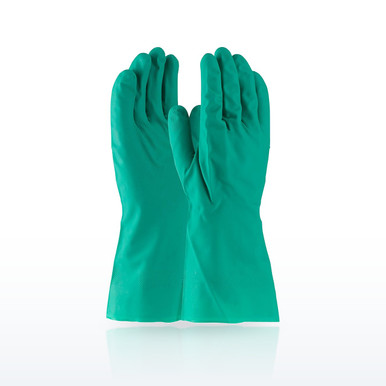 Assurance 50-N110G Chemical Resistant Gloves, Nitrile Coated, UnlinedPIP lists this 11 mil nitrile glove at more than 480 minutes against isopropyl alcohol, sodium hypochlorite, diesel and kerosene, and under 1 minute against acetone (PIP permeation data)
Why the same material gets two different answers. A chemical glove is a sheet of polymer, and a chemical passes through it by permeation, molecule by molecule, with no hole and no visible change. The manufacturer’s laboratory measures how long that takes at a fixed thickness (the breakthrough time, EN 16523-1 or ASTM F739) and reports it as a performance level: level 1 is more than 10 minutes, 2 more than 30, 3 more than 60, 4 more than 120, 5 more than 240, 6 more than 480. The same polymer at a different thickness gives a different time, which is why PIP’s 5 mil disposable nitrile reads level 2 for isopropanol where the 11 mil chemical glove reads level 6, and why a glove’s thickness in mil sits beside every figure below. The second reason for two answers is concentration: hydrochloric acid at 10 percent is held by every glove on the list, at 37 percent most of the thin ones give way. The third is that general tables and specific tables measure different things. OSHA’s PPE booklet reprints a Department of Energy chart that rates each polymer very good, good, fair or poor against about 100 chemicals; it ranks the material, not a glove. PIP’s tables give a time for one style. When the two disagree, the style’s own figure is the one that applies to that style. None of this replaces the rule: 29 CFR 1910.138(b) makes the employer base the selection on the performance characteristics of the glove relative to the tasks, the conditions, the duration of use and the hazards identified, and the hazard assessment in 1910.132(d) is where the chemical gets named. The safety data sheet’s section 8 names the glove material the chemical’s own manufacturer tested; the glove manufacturer’s table says how long its glove holds it.
Chemical by chemical, as the tables read
PIP breakthrough times are for the named style at the thickness shown; the OSHA ratings are the Department of Energy chart in Publication 3151 (VG very good, G good, F fair, P poor). Nothing here is a selection for your task.
What the phrases on the tables mean
The vocabulary on PIP’s permeation tables and the OSHA chart, in order.
- Breakthrough time: the minutes from first contact until the chemical is detected on the inside of the glove in the laboratory test (EN 16523-1 in Europe, ASTM F739 in the United States). It is measured on a flat piece of the glove at room temperature; heat, flexing and a worn glove shorten it.
- Performance level: the EN ISO 374-1 class the breakthrough time falls in. Level 0 is under 10 minutes; 1 more than 10; 2 more than 30; 3 more than 60; 4 more than 120; 5 more than 240; 6 more than 480. A level is not a percentage of protection.
- The letters (A to T): the EN ISO 374-1 test chemicals a glove held for 30 minutes or more. A is methanol, B acetone, J n-heptane, K sodium hydroxide 40%, L sulphuric acid 96%, M nitric acid 65%, N acetic acid 99%, O ammonium hydroxide 25%, P hydrogen peroxide 30%, S hydrofluoric acid 40%, T formaldehyde 37%. Isopropyl alcohol, bleach, hydrochloric acid and gasoline are not EN letters, which is why PIP’s own tables are the source for them.
- Degradation: what the chemical does to the glove itself (swelling, softening, cracking). A glove can hold a chemical for hours and still be ruined by it; the manufacturer’s chart may show both figures.
- VG, G, F, P: the Department of Energy chart OSHA reprints rates a polymer family, not a glove. “Very good” latex against acetone and a 30-minute latex breakthrough on PIP’s table are both true: one is a class, the other a measured time on one glove.
- Disposable vs chemical glove: a 4 to 8 mil nitrile glove is sold for splash and incidental contact and is changed when soiled; a 11 to 44 mil unsupported or supported glove is the one the permeation tables are written for. PIP publishes tables for both, which is why the 5 mil Ambi-dex Chem appears beside the 22 mil Assurance above.
- 1910.138(b): the employer bases the selection on the performance characteristics of the glove relative to the tasks, the conditions present, the duration of use and the hazards identified. Appendix B to Subpart I adds that the chemical, the nature of contact (immersion or splash), the duration and the area to protect are the selection factors.
PIP breakthrough times for the chemicals this page covers, style by style (minutes; EN ISO 374-1 level in brackets)
| Chemical | Disposable nitrile 63-503 (5 mil) | Nitrile 50-N110G (11 mil) | Nitrile 50-N140B / 50-N160B (15 mil) | Nitrile 50-N2272G (22 mil) | Latex 47-L171N / 48-L212Y (18–21 mil) | Neoprene 52-3665 (28 mil) | Butyl BUT03 / BUT05 (12–20 mil) |
|---|---|---|---|---|---|---|---|
| Isopropyl alcohol | >30 (2) | >480 (6) | >480 (6) | >480 (6) | >480 (6) | 142 (4) | not listed |
| Acetone | not listed | <1 (0) | not listed | level 0 | 30 (2) | 11 (1) | 480 (6) |
| Sodium hypochlorite 13–14% | >480 (6) | >480 (6) | >480 (6) | >480 (6) | >480 (6) | not listed | not listed |
| Hydrochloric acid 37% | >480 (6) | 30 (2) | 75 (3) on 50-N140B | >480 (6) | 65 (3) on 48-L212Y | >480 (5) | 480 (6) |
| Hydrochloric acid 10% | not listed | >480 (6) | >480 (6) | not listed | >480 (6) | >480 (6) | not listed |
| Sodium hydroxide 40% | >480 (6) | >480 (6) | >480 (6) | not listed | 176 / 144 (4) | not listed | 480 (6) |
| Sodium hydroxide 50% | not listed | >480 (6) | >480 (6) | >480 (6) | >480 (6) | >480 (6) | not listed |
| Gasoline | >480 (6) petrol | level 3 | 413 (5) / >480 on 50-N160B | >480 (6) white gasoline | not listed | 15 (1) distillates | 10 (1) |
| Diesel fuel | not listed | level 6 | level 6 | not listed | not listed | not listed | not listed |
| Kerosene | not listed | level 6 | level 6 | not listed | not listed | 100 (3) | 120 (4) |
| Chloroform | not listed | not listed | not listed | 44 (2) methyl chloroform | not listed | not listed | 10 (1) |
Breakthrough times are laboratory figures at the stated thickness and at room temperature; PIP prints with each table that the end user decides suitability for any task.
Source: PIP chemical permeation tables as published on the product page of each style on this site (us.pipglobal.com data, November 2026); “not listed” means PIP publishes no figure for that chemical on that style.
OSHA Publication 3151, Table 4: the Department of Energy rating of each glove polymer for the same chemicals
| Chemical | Neoprene | Latex / natural rubber | Butyl | Nitrile |
|---|---|---|---|---|
| Propyl alcohol (iso) | VG | VG | VG | VG |
| Acetone* | G | VG | VG | P |
| Hydrochloric acid | VG | G | G | G |
| Sodium hydroxide | VG | VG | VG | VG |
| Gasoline, unleaded | G | P | F | VG |
| Diesel fuel | G | P | P | VG |
| Kerosene | VG | F | F | VG |
| Petroleum distillates (naphtha) | G | P | P | VG |
| Castor oil | F | P | F | VG |
| Linseed oil | VG | P | F | VG |
| Chloroform* | G | P | P | F |
| Ketones (as a class) | G | VG | VG | P |
| Ethyl alcohol | VG | VG | VG | VG |
| Methyl alcohol | VG | VG | VG | VG |
The chart rates the polymer, not a glove; OSHA’s note with it says to consult the manufacturer, especially if the gloved hand will be immersed. Sodium hypochlorite is not on the chart.
Source: OSHA Publication 3151-12R 2004, Table 4, Chemical Resistance Selection Chart for Protective Gloves (from the U.S. Department of Energy Occupational Safety and Health Technical Reference Manual). VG very good, G good, F fair, P poor; * limited service.
Questions people ask
Are nitrile gloves resistant to isopropyl alcohol?
Chemical-weight nitrile is: PIP lists its 11, 15 and 22 mil nitrile gloves at more than 480 minutes against isopropyl alcohol, and OSHA’s chart rates nitrile very good for it. A 5 mil disposable nitrile glove is listed at more than 30 minutes (level 2).
Does rubbing alcohol dissolve nitrile gloves?
No. None of the tables shows isopropyl alcohol degrading nitrile; PIP’s breakthrough figures for its nitrile chemical gloves run past eight hours. The thin disposable is the only nitrile glove it gets through, and that takes more than 30 minutes.
Are latex gloves acetone resistant?
For a while. PIP measured about 30 minutes (level 2) on an 18 mil latex glove; OSHA’s chart rates latex very good against acetone as a polymer class. Butyl is the material with a 480-minute acetone figure on this site.
What material is resistant to acetone?
Butyl rubber: the Assurance BUT03, BUT03R and BUT05 butyl gloves list 480 minutes, level 6. Nitrile is poor (under 1 minute on the 11 mil glove), neoprene 11 minutes, latex about 30. OSHA’s booklet lists ketones among the chemicals butyl protects against and among those nitrile is generally not used with.
Can nitrile gloves be used with bleach?
PIP lists sodium hypochlorite at 13 to 14 percent at more than 480 minutes on its nitrile chemical gloves and on the 5 mil Ambi-dex Chem disposable; latex reads the same. OSHA’s chart does not list bleach.
What gloves to use with muriatic acid?
The figures depend on strength. At 37 percent: butyl, 22 mil nitrile and 28 mil neoprene hold 480 minutes; the Ambi-dex Chem disposable nitrile and the Grippaz 8 mil nitrile list more than 480; 11 and 15 mil nitrile 30 and 75 minutes; latex 65 to 210 minutes. At 10 percent every listed glove, PVC included, exceeds 480 minutes.
What gloves protect from acid?
It depends on the acid and its strength. Hydrochloric and sodium hydroxide figures are above; sulphuric acid 96% (letter L), nitric acid 65% (M), acetic acid 99% (N) and hydrofluoric acid 40% (S) are EN ISO 374-1 letters, and the chemical resistance chart guide and the MCR Safety matrix guide list which gloves carry them.
What gloves to use with caustic soda?
Sodium hydroxide at 40 percent is held more than 480 minutes by PIP’s nitrile, PVC, neoprene and butyl gloves and by the 14 mil and heavier latex gloves; the 18 to 21 mil latex gloves read 144 to 176 minutes. OSHA’s chart rates all four polymers very good.
What gloves to use when working with cement?
OSHA’s cement booklet (3351) says wet portland cement is caustic and names butyl or nitrile gloves rather than cotton or leather, well-fitting so cement cannot get inside, with the sleeve taped to the glove. The sodium hydroxide figures above are the laboratory measure of alkali resistance for the same gloves.
Does gasoline break down nitrile gloves?
Not on the tables: PIP lists 413 to more than 480 minutes for its 15 and 22 mil nitrile gloves, and OSHA’s chart rates nitrile very good for leaded and unleaded gasoline. Butyl is the material gasoline gets through (10 minutes).
What kind of gloves can be worn when handling oil?
OSHA’s booklet describes nitrile as the glove for oils and greases and rates it very good for castor, linseed and tung oil and the petroleum distillates; PIP’s nitrile figures for diesel and kerosene are level 6. Motor oil itself is not a line on the tables.
What gloves are chloroform resistant?
Few. Butyl lists 10 minutes; OSHA’s chart rates nitrile fair and latex and butyl poor; the glove on this site that lists chloroform among its tested chemicals is the North Silver Shield laminate. The methylene chloride guide covers the chlorinated solvents as a family.
Can chemicals go through nitrile gloves?
Yes, by permeation, with no hole and no visible change; the breakthrough time says how long it takes. For nitrile the fast ones are the ketones (acetone), the esters and the chlorinated and aromatic solvents; the slow ones are alcohols, dilute acids, caustics, fuels and oils.
What are chemically resistant gloves made of?
OSHA’s booklet lists the rubbers (natural latex, butyl, neoprene, nitrile and fluorocarbon) and the plastics (PVC, polyvinyl alcohol and polyethylene), blended or laminated for performance, and notes that the thicker the material the greater the resistance, at the cost of grip and dexterity.
Which gloves offer the highest chemical resistance?
No one glove. Butyl holds acetone and ketones that pass through nitrile in a minute; nitrile holds fuels that pass through butyl in ten. The laminate film gloves list the widest range. The answer is always for one chemical, from that glove’s table.
Does OSHA say which glove to use for a chemical?
No. 1910.138(a) requires hand protection where hands are exposed to skin absorption of harmful substances and chemical burns, and 1910.138(b) requires the employer to base the selection on the glove’s performance characteristics for the task, conditions, duration and hazards. The manufacturer’s table is the performance characteristic.
Related guides
Which gloves protect against chemicals?How to read a chemical resistance chartWhat gloves for methylene chloride?Solvent by solvent, the EN ISO 374-1 lettersWhen should you use neoprene gloves?What neoprene resistsPermeation versus penetrationHow to read a chemical resistance tableNitrile vs latex vs vinyl glovesWhat each material resistsWhat are the downsides of nitrile gloves?By what the standards and the data sayThe ratings, test results and standards shown here are the manufacturers' published values, reproduced as published. Nothing on this page is a recommendation by Bayshore Safety that any product is suitable for a particular task, hazard or workplace. Selecting safety products and protective equipment is the responsibility of the end user and the employer, based on their own hazard assessment and the regulations that apply to their work. Confirm every value on the manufacturer's own documentation before use.
© 2026 Bayshore Safety & Industrial Supplies, Inc. All rights reserved. This guide may not be copied or republished without written permission.