
Halotron I vs Halotron BrX: what is the difference, and which one do you buy?
Halotron I is HCFC-123, a hydrochlorofluorocarbon blend sold since the 1990s as the Halon 1211 replacement in portable extinguishers; Halotron BrX is stabilized 2-BTP (2-bromo-3,3,3-trifluoropropene), the newer agent Amerex builds its HT Series around. Both are halogenated clean agents under NFPA 10 (2026) 3.3.18: non-conductive, no residue, listed for Class C. The practical differences are four. Rating per pound: the 12.5 lb BrX Model 551 carries the same 2A:10B:C as the 15.5 lb Halotron I Model 398. Service: the Amerex BrX units are nonrechargeable, so NFPA 10 7.3.6.3 drops the 6-year internal examination and 12-year hydrostatic test and retires the unit at 12 years; Halotron I units are rechargeable and carry both (Tables 7.3.3.1 and 8.3.1). Environment: Amerex lists BrX at GWP 0.26 and ODP 0.0028. Room size: every halogenated unit carries a nameplate minimum room volume that 5.3.2.6.1 makes a placement rule; the 551 is 2,988 cubic feet.
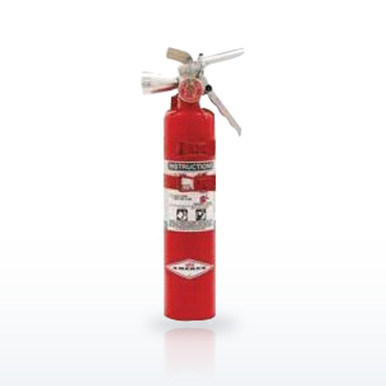
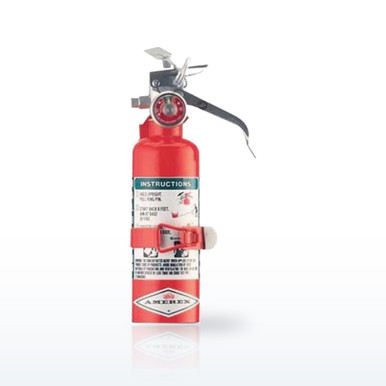
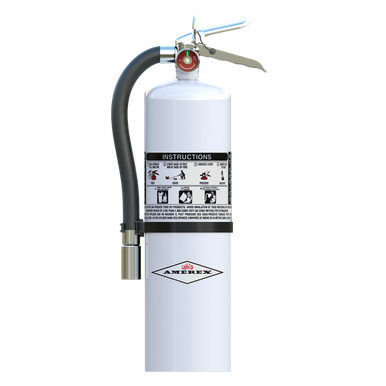 Amerex 28084 Model 551 Halotron BrX Clean Agent Fire Extinguisher, 12.5 lbHalotron BrX, 12.5 lb, 2A:10B:C, nonrechargeable
Why does the agent chemistry change the rating? Halotron I puts out fire mainly by cooling and by displacing oxygen at the flame; the bromine in 2-BTP also interrupts the chemical chain reaction of combustion, which is why Amerex gets a 2-A rating from 12.5 lb of BrX where Halotron I needs 15.5 lb. Less agent, a shorter cylinder, the same UL rating.
How to choose between them
Four questions settle it.
Halotron I and Halotron BrX, as the manufacturers list them
| Item | Halotron I (Amerex 398) | Halotron BrX (Amerex 551) |
|---|---|---|
| Agent | HCFC-123 blend | Stabilized 2-BTP |
| UL rating | 2A:10B:C | 2A:10B:C |
| Capacity | 15.5 lb | 12.5 lb |
| Height | 21.88 in | 20.25 in |
| Discharge range | 12 to 18 ft | 15 to 17 ft |
| Discharge time | 14 sec | 16 sec |
| Rechargeable | Yes | No; 12-year service life |
| NFPA 10 (2026) internal examination | 6 years (Table 7.3.3.1) | Not required (7.3.6.3) |
| NFPA 10 (2026) hydrostatic test | 12 years (Table 8.3.1) | Not required; remove at 12 years (7.3.6.3) |
| Minimum room volume on nameplate | See nameplate | 2,988 cu ft (Amerex) |
| Listing standard | UL 2129 / CAN/ULC-S566 | UL 2129 / CAN/ULC-S566 |
| GWP / ODP (manufacturer) | See Halotron I SDS | 0.26 / 0.0028 |
Source: Amerex product data for each model; NFPA 10 (2026) Tables 7.3.3.1 and 8.3.1, 7.3.6.3, 5.3.2.6.1.
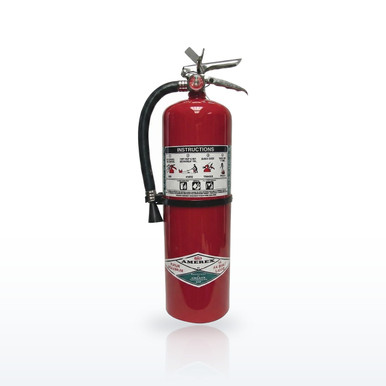
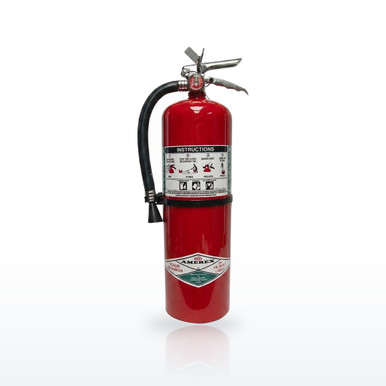
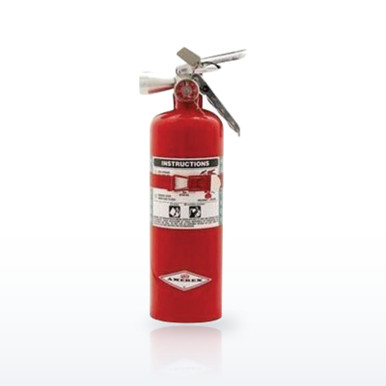
Halotron I and Halotron BrX units
6 items · prices liveEvery unit is listed under its agent; the rating and part number are the manufacturer's. Prices are live.
Cabinets, brackets and signs are in Fire protection accessories.
Questions people ask
Is Halotron BrX the same as Halotron I?
No. Halotron I is HCFC-123; Halotron BrX is stabilized 2-BTP. Both are halogenated clean agents under NFPA 10 (2026) 3.3.18.
Does Halotron BrX carry the same rating as Halotron I?
Model for model, Amerex lists the 12.5 lb BrX 551 and the 15.5 lb Halotron I 398 both at 2A:10B:C.
Can a Halotron BrX unit replace a Halotron I unit on a spec?
Where the spec calls for a rating, yes by rating. Where it names Halotron I, the architect or engineer of record approves equals; the submittal carries the UL listing and data sheet.
Which one needs a hydrostatic test?
Rechargeable Halotron I units: every 12 years, with a 6-year internal examination (NFPA 10 Tables 8.3.1 and 7.3.3.1). The nonrechargeable BrX units: none (7.3.6.3).
Is Halotron I being phased out?
HCFC-123 is a hydrochlorofluorocarbon subject to the EPA's Montreal Protocol phasedown; check the EPA's current rule for production and import limits. Amerex still lists Halotron I units.
What is the minimum room size for a Halotron BrX extinguisher?
Amerex lists 2,988 cubic feet for the 551, 896 for the 547 and 549, 427 for the A537TS; NFPA 10 (2026) 5.3.2.6.1 requires placement to follow the nameplate.
Related guides
Clean agent fire extinguishersEvery clean agent unit, the agents compared, the codeAmerex HT SeriesHalotron BrX units side by sideWhat replaced Halon 1211 and 1301?Halon, the phaseout, and the clean agents that followedMinimum room volume for clean agent extinguishersWhat the nameplate number means and how to check a roomThe ratings, test results and standards shown here are the manufacturers' published values, reproduced as published. Nothing on this page is a recommendation by Bayshore Safety that any product is suitable for a particular task, hazard or workplace. Selecting safety products and protective equipment is the responsibility of the end user and the employer, based on their own hazard assessment and the regulations that apply to their work. Confirm every value on the manufacturer's own documentation before use.