
Clean Agent Fire Extinguishers
Clean agent portable fire extinguishers leave no residue and are listed for Class C, which is what NFPA 10 (2026) points to for delicate electronic equipment (5.5.4.6). Below: every clean agent unit we carry with a live price, the agents compared, the NFPA 10 sections that govern selection, placement and maintenance, and the room pages for data halls, electrical rooms, battery rooms and telecom rooms. Ships in 1–2 business days; most orders arrive in 3–7 business days.
Halotron BrX, nonrechargeable (Amerex HT Series)
| Part number | Item | Version | Price | ||
|---|---|---|---|---|---|
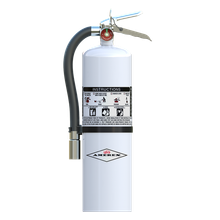 | 28084 | Amerex 28084 Model 551 Halotron BrX Clean Agent Fire Extinguisher, 12.5 lb | 12.5 lb | $1,431.84 |
Family page: Amerex HT Series. Prices are live.
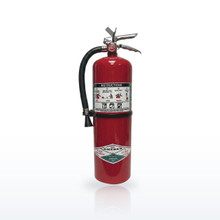
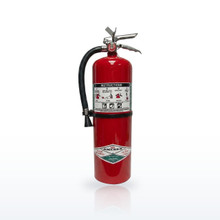
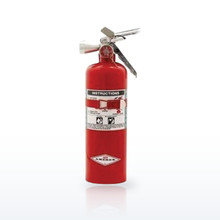
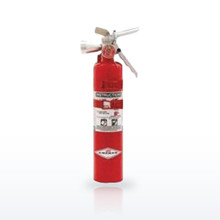
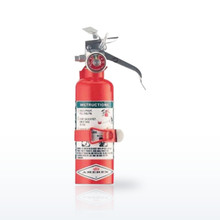
Halotron I, rechargeable
Carbon dioxide
| Part number | Item | Version | Price | ||
|---|---|---|---|---|---|
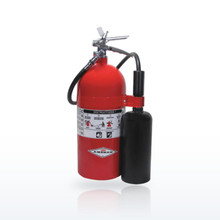 | 01714 | Amerex 01714 Model 330 Carbon Dioxide Fire Extinguisher, 10-B:C, 10 lb | 10-B:C, 10 lb | $459.95 | |
 | 01708 | Amerex 01708 Model 332 Carbon Dioxide Fire Extinguisher, 10-B:C, 20 lb | 10-B:C, 20 lb | $686.96 |
Water mist
| Part number | Item | Version | Price | ||
|---|---|---|---|---|---|
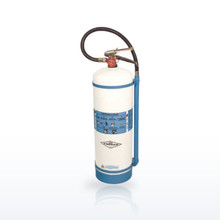 | 27702 | Amerex 27702 Model C272 Water Mist Fire Extinguisher, 2-A:C, 2.5 Gallon | 2-A:C, 2.5 Gallon | $344.59 |
Clean agents in portable extinguishers
| Agent | What it is | Classes (as listed) | Rechargeable | NFPA 10 (2026) interval | Units we carry |
|---|---|---|---|---|---|
| Halotron BrX | Stabilized 2-BTP, a brominated halocarbon; EPA SNAP-accepted; GWP 0.26, ODP 0.0028 (Amerex) | A, B, C (551); B, C (547, 549, A537TS) | No; 12-year service life | No 6-year internal, no hydrostatic test (7.3.6.3) | Amerex HT Series |
| Halotron I | HCFC-123 blend; EPA SNAP-accepted (American Pacific / Amerex) | A, B, C (397, 398); B, C (small units) | Yes | 6-year internal (Table 7.3.3.1), 12-year hydrostatic (Table 8.3.1) | Amerex 398, 397, B386T, B385TS, A384T |
| Carbon dioxide | Inert gas; non-conductive, no residue (3.3.3) | B, C | Yes | 5-year internal and 5-year hydrostatic | Amerex 330, 332 |
| Water mist | De-ionized water in a fine mist; listed Class A and C by the manufacturer | A, C | Yes | 5-year hydrostatic | Amerex C272 |
Source: manufacturer data sheets as linked on each product page; NFPA 10 (2026) 3.3.3, 3.3.5, 3.3.18, Table 7.3.3.1, 7.3.6.3, Table 8.3.1. "Clean agent" in NFPA 10 (3.3.5) is an electrically non-conducting, volatile or gaseous extinguishant that leaves no residue; halogenated (clean) agents (3.3.18) include HCFC, HFC, PFC, FIC and other SNAP-accepted halocarbons, and halons.
What NFPA 10 (2026) says about clean agent portables
| Section | In plain words |
|---|---|
| 5.5.4.6.1 | Extinguishers protecting delicate electronic equipment are selected from types listed and labeled for Class C. |
| 5.5.4.6.2 | Dry chemical extinguishers are not installed for the protection of delicate electronic equipment. |
| 5.3.2.6.1 | Portable extinguishers containing halogenated agents are placed in line with the minimum confined-space volume warning on the nameplate. |
| 5.3.2.6 | Halon agent units are limited to places where a clean agent is needed to avoid damaging equipment or where other agents could endanger people. |
| 6.4.1 to 6.4.3 | Class C-rated units are required where energized electrical equipment can be encountered, and are sized and located on the basis of the Class A or Class B hazard present. |
| 7.3.3.6 and 7.3.6.3 | Nonrechargeable units need no annual or six-year internal examination and no hydrostatic test; they leave service no later than 12 years from the date of manufacture. |
| Tables 7.3.3.1 and 8.3.1 | Rechargeable halogenated agent units: internal examination every 6 years, hydrostatic test every 12 years. |
| 4.1.1 | Halocarbon clean agent units are listed to UL 2129 / CAN/ULC-S566 and rated to UL 711 / CAN/ULC-S508. |
Source: NFPA 10, Standard for Portable Fire Extinguishers, 2026 edition, sections as cited; read it on NFPA's free access. Summaries are ours; the standard governs.
By room
Each room page carries what NFPA 10 asks for in that space, what NFPA 75 or NFPA 76 adds, and which units fit the room volume: data halls and data centers · electrical and switchgear rooms · UPS and battery rooms · telecom, MDF and IDF rooms · control rooms and labs.
Guides: what a clean agent extinguisher is · Halotron I vs Halotron BrX · what replaced Halon 1211 and 1301 · Class C fire extinguishers · minimum room volume · NFPA 10 for nonrechargeable units · do fire extinguishers expire.
Clean agent fire extinguisher questions
What is a clean agent fire extinguisher? Under NFPA 10 (2026) 3.3.5 a clean agent is an electrically non-conducting, volatile or gaseous extinguishant that leaves no residue on evaporation. In portable extinguishers that means halocarbon agents such as Halotron BrX and Halotron I, carbon dioxide, and water mist is often grouped with them for electronics because it is listed for Class C.
Which extinguisher does NFPA 10 point to for electronic equipment? 5.5.4.6.1: a type listed and labeled for Class C; 5.5.4.6.2: not dry chemical. The Class C-listed clean agents are halocarbon, carbon dioxide and water mist units.
Is Halotron BrX the same as Halotron I? No. Halotron I is HCFC-123; Halotron BrX is stabilized 2-BTP. Both are halogenated clean agents under NFPA 10 3.3.18; the BrX units Amerex sells are nonrechargeable with a 12-year service life, the Halotron I units are rechargeable.
What is the minimum room volume on a clean agent extinguisher? The volume below which the manufacturer's nameplate says not to use the unit. NFPA 10 (2026) 5.3.2.6.1 requires placement to follow that warning. Amerex lists 2,988 cubic feet for the 551, 896 for the 547 and 549, 427 for the A537TS.
Do clean agent extinguishers need a hydrostatic test? Rechargeable halogenated agent units: every 12 years (Table 8.3.1), with a 6-year internal examination (Table 7.3.3.1). Nonrechargeable units: none; they are removed from service at 12 years from manufacture (7.3.6.3). Carbon dioxide: every 5 years.
Can I use an ABC dry chemical extinguisher in a server room? NFPA 10 (2026) 5.5.4.6.2 says dry chemical extinguishers are not to be installed for the protection of delicate electronic equipment. The authority having jurisdiction decides what applies to a given room.
The ratings, test results and standards shown here are the manufacturers' published values, reproduced as published. Nothing on this page is a recommendation by Bayshore Safety that any product is suitable for a particular task, hazard or workplace. Selecting safety products and protective equipment is the responsibility of the end user and the employer, based on their own hazard assessment and the regulations that apply to their work. Confirm every value on the manufacturer's own documentation before use.