
Bayshore Safety & Industrial Supplies Guide
How to bandage a wound: the Red Cross steps, the four types of bandaging, the golden rule of bandaging, the rules of wound dressing, butterfly closures vs Steri-Strips, covered vs uncovered, and how often to change a dressing
The Red Cross wounds page gives the sequence: check the scene and put on gloves, place a dressing on the wound, apply direct pressure until the bleeding stops, hold the dressing with a bandage, check circulation beyond it, and call 911 for the signs it lists (continuous or spurting blood, blood equal to half a soda can, signs of shock). The golden rule of bandaging that courses teach is from that page: a bandage holds a dressing and controls bleeding, it is never tight enough to cut off circulation, and a dressing that soaks through gets another on top rather than being taken off. The four types of bandaging are the four ways a roller bandage is wound (circular, spiral, figure-eight and recurrent), and the rules of wound dressing are clean hands, a sterile pad larger than the wound, a bandage firm not tight, and a change when it is wet, dirty or loose.
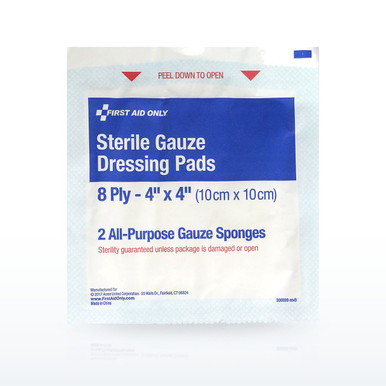 First Aid Only AN206 3 in x 3 in Sterile Gauze Pads, 8 per BoxFirst Aid Only prints 3 x 3 inch sterile gauze pads, 8 per box, packaged in sterile envelopes
Why the sequence is the answer. Most of the questions in this cluster ("how do you wrap a bandage", "what is the golden rule of bandaging", "do wounds heal better covered or uncovered", "how often should I change a bandage") are asked by someone standing over a cut with a kit open, and the honest answer is the first aid sequence the Red Cross publishes, not a product. This page gives that sequence as the Red Cross states it, names the kit item for each step with the figures First Aid Only prints, and answers the technique questions (the four bandaging methods, the circulation check, the bandage-splitting tie when there is no tape, butterfly closures and Steri-Strips) in the Red Cross’s words where it has them. Questions about a wound that is infected, that will not close, or that is more than a first aid wound are for a clinician; the page says so where that is the answer.
How to dress and bandage a wound, as the Red Cross states it
From the Red Cross wounds and external bleeding pages. "Check, Call, Care" is the frame: check the scene and the person, call 911 for life-threatening signs, then give care.
- Check the scene for safety, form an initial impression, obtain consent and put on PPE (gloves at least).
- Check for signs that need emergency care: blood flowing continuously or spurting, blood volume of about half a soda can, a tender, swollen or rigid area, a blue or pale swollen limb, signs of shock. If any, call 911 and get equipment.
- Find the source of the bleeding and place a dressing on the wound: a sterile gauze pad (3 x 3 inch in the Class A kit) or, for a weeping wound, a non-adherent pad. Use a hemostatic dressing if available for life-threatening bleeding.
- Apply steady, firm pressure directly over the wound with the injured part on a firm, flat surface. Hold it until the bleeding stops, until a tourniquet is applied for life-threatening limb bleeding, until someone relieves you, or until you cannot continue.
- If blood soaks through, do not remove the first pad; put another pad on top and replace that one as needed. Do not stack many pads.
- Hold the dressing on with a roller bandage (conforming gauze or cohesive wrap) or tape. Wrap from below the wound upward, overlapping each turn, with enough tension to hold and not so much that the hand or foot beyond it goes pale, cold or numb.
- If you have no tape, split the tail of the bandage: roll out the remaining length, split it into two tails with a finger, pass one under the limb and tie the two in a bow or knot.
- Check circulation beyond the bandage: skin temperature, color and feeling on the side farthest from the heart; ask about numbness or tingling. Loosen and rewrap if it is too tight.
- Watch for shock (rapid weak heartbeat, rapid breathing, pale, gray or cool moist skin, altered responsiveness, excessive thirst) and call 911 if you see it.
The questions, one by one
What is the golden rule of bandaging?
Courses phrase it several ways and all of them come from the same Red Cross care steps: the bandage is there to hold the dressing and keep pressure on, so it is firm but never tight enough to cut off circulation; a dressing that bleeds through is covered, not removed; and you check the fingers or toes beyond the bandage for color, warmth and feeling after you tie it and again later. A bandage that leaves the hand cold, pale, numb or tingling is too tight and is rewrapped.
What are the four types of bandaging?
The four ways a roller bandage is wound. Circular: each turn directly over the last, to anchor the start and finish. Spiral: each turn overlapping the last by half or two thirds up a limb of even width, the usual wrap for a forearm or shin. Figure-eight: alternating turns above and below a joint (ankle, wrist, elbow, knee) so the bandage holds without stopping movement. Recurrent: back-and-forth turns over the end of a stump, a fingertip or the scalp, anchored by circular turns. The Red Cross pages describe the wrap over a dressing and the tie; the four names are the course vocabulary for the same wrap on different shapes.
What are the 5 rules of wound dressing?
Five is one trainer’s count of the principles the Red Cross steps carry: wash or glove your hands first; use a sterile dressing larger than the wound and touch only its edges; put the dressing on once and do not lift it to look; secure it firmly without cutting off circulation; and change it when it is wet, dirty or loose, with clean hands. The "four C’s of wound care" that some courses teach (clean, cover, change, check) are the same list with the circulation check named.
How do you wrap a bandage?
Start two turns below the dressing to anchor, wrap upward with each turn overlapping the last by about half, keep the tension even, cover the dressing by at least an inch on each side, finish with two anchoring turns above it and tape the end or split and tie the tail. Over a joint use the figure-eight. Leave fingertips or toes showing so you can check circulation. With a cohesive wrap no tape is needed: the last turn sticks to the one under it. First Aid Only prints "no clips or tape necessary" on its self-adhering wraps and "for moderate compression" on its conforming gauze rolls.
What are the different types of wound care techniques, and the 3 main types of wound dressings?
For first aid the techniques are the ones above: direct pressure, dressing, bandaging, and for life-threatening bleeding the tourniquet and wound packing the Red Cross and OSHA’s 2019 bleeding-control letter name. The three dressing types in a kit are the plain sterile gauze pad, the non-adherent pad (for burns and weeping wounds) and the absorbent trauma pad (for heavy bleeding); hydrocolloid, foam, alginate and wet-to-dry dressings are clinical wound-care products and their change intervals are the clinician’s instruction, not a kit rule.
Do wounds heal better covered or uncovered?
The Red Cross care step is to cover an open wound with a dressing; that keeps it clean and holds pressure. Whether a healing wound later does better covered or open to the air is a question the Red Cross pages do not answer and a clinician does, because it depends on the wound; a workplace kit covers, and the first aid guide inside it says so. For a chemical burn the Red Cross states the opposite in one case: leave the burn uncovered unless EMS is delayed or the person must be transported.
Are Steri-Strips or butterfly closures better, and what are they used for?
They are the same idea from two makers: thin adhesive strips that bridge the edges of a shallow, clean cut and hold them together while it closes. Steri-Strip is 3M’s brand (a reinforced paper strip, sold with a skin adhesive that is a benzoin-type tincture, not a glue); butterfly closures are the wing-shaped strips First Aid Only sells in medium and large (1-012, G135) and in its SmartCompliance refill. Both are breathable and both come off on their own in a week or so or peel back on themselves. Neither closes a deep cut, a gaping cut, a cut over a joint or a cut that keeps bleeding; the Red Cross wounds page’s signs for emergency care, and a cut that needs stitches, send those to a clinician.
How to use a butterfly closure or wound closure strip
Stop the bleeding with pressure first, clean and dry the skin on both sides, then press one wing down on one side of the cut, draw the edges together and press the other wing down; add strips an eighth to a quarter inch apart along the cut. Cover with a non-adherent pad if it will be rubbed. Leave them until they lift on their own; do not pull them off while the cut is fresh.
How often should you change a bandage or dressing?
When it is wet, dirty or loose, and otherwise once a day with clean hands is the usual first aid practice; the Red Cross pages give the dressing step and do not set an interval. A dressing on an infected wound, a surgical incision, a foam or hydrocolloid dressing, or a wet-to-dry dressing is changed on the clinician’s instruction. A dressing that has dried into the wound is not torn off.
How long can you leave an elastic bandage on?
The Red Cross pages do not set hours; they set the circulation check, which is the rule for any wrap. An elastic bandage is taken off to check the skin and rewrapped, is loosened at once if the limb beyond it is cold, pale, numb or tingling, and is not worn to bed unless a clinician said so. The compression-bandage guide linked below has the rest.
Should a finger wound be covered or uncovered, and what can I cover a wound with that won’t stick?
Covered, with a fingertip or knuckle bandage (the fingertip guide linked below shows the fold) or a non-adherent pad under a cohesive wrap, and a finger cot over it at work to keep it dry. First Aid Only describes its non-adherent pads as "absorbs without adhering to wound" and the A235 pads carry their own hypoallergenic adhesive edges.
Is it good to put Vaseline, honey or antiseptic wipes on an open wound?
The Red Cross wound page does not name an ointment; it names the dressing and pressure. First Aid Only’s antiseptic wipes are labeled "cleanse and prevent infection in minor wounds", for the skin around the wound and minor cuts and scrapes; its antibiotic ointment packets are labeled "helps prevent infection in minor cuts, scrapes and burns". Petrolatum and honey dressings are clinical products; what goes on a wound that is more than minor is a clinician’s call.
How do you dress a wound properly when you are alone, and how do you wrap a knee for support?
Alone: glove, pad, pressure with the free hand, then a cohesive wrap, which can be put on one-handed because it sticks to itself. A knee: a figure-eight with a 3 or 4 inch elastic bandage, starting below the joint, crossing behind it, finishing above, leaving the kneecap free or lightly covered, and checking the foot for circulation. Support wraps for a sprain are a muscle, bone and joint question; the Red Cross page for those injuries is linked in the splints guide below.
In plain words
- Check the scene, glove up, call 911 for spurting or heavy bleeding or shock.
- Sterile pad on the wound, firm direct pressure, add a pad on top if it soaks through.
- Roller bandage or tape to hold it; firm, not tight; fingertips showing.
- The golden rule: a bandage never cuts off circulation. Check color, warmth and feeling beyond it.
- No tape: split the tail of the roll and tie it.
- Four wraps: circular, spiral, figure-eight, recurrent.
- Butterfly closures and Steri-Strips bridge a shallow clean cut; a deep, gaping or bleeding cut goes to a clinician.
- Change a dressing when wet, dirty or loose; a clinician sets the interval for an infected or surgical wound.
Questions people ask
What is the golden rule of bandaging?
A bandage holds the dressing and pressure and is never tight enough to cut off circulation; check color, warmth and feeling beyond it.
What are the four types of bandaging?
Circular, spiral, figure-eight and recurrent turns of a roller bandage.
What are the 5 rules of wound dressing?
Clean or gloved hands, a sterile pad larger than the wound, put on once, secured firm not tight, changed when wet, dirty or loose.
How do you wrap a bandage?
Anchor below the dressing, overlap each turn by half going up, cover the pad by an inch each side, anchor above, tape or tie; figure-eight over a joint.
Do wounds heal better covered or uncovered?
First aid covers an open wound with a dressing; a chemical burn is left uncovered unless EMS is delayed. Beyond first aid it is the clinician’s call.
Are Steri-Strips or butterfly closures better?
They do the same job on a shallow clean cut; Steri-Strip is 3M’s brand, butterfly closures are the wing-shaped strips in a kit.
Will Steri-Strips close a wound?
They hold the edges of a shallow cut together; a deep, gaping or bleeding cut needs a clinician.
How often should I change a bandage?
When wet, dirty or loose, otherwise daily; a clinician sets the interval for infected or surgical wounds.
How long can you leave an elastic bandage on?
Until the next circulation check; loosen at once if the limb beyond it is cold, pale or numb.
What do I do if blood soaks through the dressing?
Leave the first pad on and put another on top, as the Red Cross states.
How do I secure a dressing without tape?
Split the tail of the roller bandage into two tails, pass one under the limb and tie them.
What if the bandage is too tight?
Numbness, tingling, cold or pale skin beyond it means rewrap it looser.
Related guides
Fingertip and knuckle bandagesHow to apply themBleeding control kits and tourniquetsWhat Stop the Bleed and Z308.1 sayWhat should be in a workplace first aid kit?The Z308.1 minimum fillHow to treat a burn at workFirst aid and burn dressingsWhat is first aid under OSHA?When a trained first aid provider is requiredThe ratings, test results and standards shown here are the manufacturers' published values, reproduced as published. Nothing on this page is a recommendation by Bayshore Safety that any product is suitable for a particular task, hazard or workplace. Selecting safety products and protective equipment is the responsibility of the end user and the employer, based on their own hazard assessment and the regulations that apply to their work. Confirm every value on the manufacturer's own documentation before use.
© 2026 Bayshore Safety & Industrial Supplies, Inc. All rights reserved. This guide may not be copied or republished without written permission.