
Is an NRR of 25 enough? What NRR 22, 25, 27, 30 and 33 leave at the ear, worked the OSHA way
It depends on the noise, not the rating alone. OSHA’s method in 29 CFR 1910.95 Appendix B is to subtract 7 from the NRR and take the rest off the A-weighted exposure: an NRR 25 plug at 95 dBA leaves an estimated 77 dBA, at 100 dBA it leaves 82, and at 105 dBA it leaves 87, which is above the 85 dBA action level the standard works from. When OSHA judges whether a protector makes engineering controls unnecessary, its Technical Manual halves the NRR as well (NRR minus 7, then 50 percent), so the same plug at 100 dBA is credited with only 9 dB and the estimate becomes 91 dBA. NIOSH derates by type instead: 25 percent off an earmuff, 50 percent off a formable foam plug, 70 percent off a pre-molded plug. The rule the whole question hangs on is 1910.95(j)(2) and (j)(3): the protector has to bring the 8-hour exposure to 90 dBA or less, and to 85 dBA or less for a worker who has had a standard threshold shift. Gunfire is a different problem: it is impulse noise, and the standard’s Table G-16 footnote says exposure to impulsive or impact noise should not exceed 140 dB peak; a continuous-noise NRR does not describe how a protector handles a 160 dB peak.
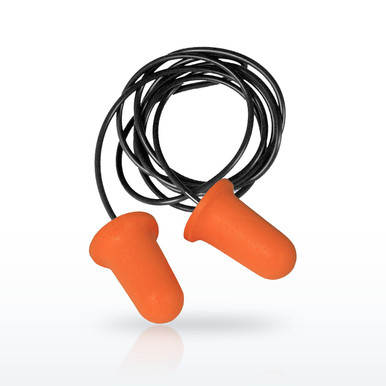 DEWALT DPG65TC2 Ear Plugs, NRR 33, Corded, Disposable FoamDisposable foam plug Radians lists at NRR 33, tested to ANSI S3.19-1974 (Radians data)
Why the question has no single answer. The NRR on the package is a laboratory number under 40 CFR 211: a panel of subjects fitted by an experimenter, nine frequencies, the attenuation written down. OSHA does not accept that number at face value. Appendix B takes 7 dB off to allow for the difference between the C-weighted lab measurement and the A-weighted sound level meter reading you will have on site, and the Technical Manual halves what is left when the agency wants to know whether the protector alone is doing the job, because field studies found workers getting far less than the label. NIOSH went further and tied the derate to the protector type, since a formable plug that is rolled and seated badly loses more than a muff that is simply put on. So an NRR 25 that is “enough” for a 92 dBA grinder is not enough for a 105 dBA chipping hammer by any of the three methods, and the same NRR 33 plug can be enough or not depending on how it is seated. The table below runs the arithmetic so the comparison is in front of you; the dBA reading at the worker’s ear is the input you have to supply.
The three methods, side by side
All three start with the NRR printed on the package. The result is an estimated A-weighted level at the ear for an 8-hour exposure.
What the Radians pages state about their ratings
From the product pages on radians.com, fetched Nov 8 2026:
- Every Radians earplug page prints the NRR with the test standard, ANSI S3.19-1974, and the CSA Z94.2 class where the product carries one; the disposable foam plugs on this site run NRR 31 to 33, the reusable flanged plugs 27 to 28, the banded plugs 23 and 25, the custom molded plug 26, and the earmuffs 19 to 29.
- Radians lists its Resistor II reusable plug as a four-flange tapered thermoplastic rubber plug that is latex-free and washable with soap and water, with a dielectric PVC cord on the corded version; its Detour plugs are metal detectable for food plants.
- The DEWALT DPG660-D and Radians DCMT25 cap-mount muffs are listed at NRR 25 and dielectric, for slotted cap-style hard hats; the DEWALT DPG18 headband muff at NRR 28.
- Radians prints no field-attenuation or shooting figures; the NRR is the EPA label value, and the derating above is the user’s to apply.
What each NRR leaves at the ear, by the OSHA Appendix B method and with the 50 percent safety factor (estimated dBA for an 8-hour exposure)
| Noise at the ear | NRR 22 | NRR 25 | NRR 27 | NRR 30 | NRR 33 |
|---|---|---|---|---|---|
| 90 dBA | 75 / 82.5 | 72 / 81 | 70 / 80 | 67 / 78.5 | 64 / 77 |
| 95 dBA | 80 / 87.5 | 77 / 86 | 75 / 85 | 72 / 83.5 | 69 / 82 |
| 100 dBA | 85 / 92.5 | 82 / 91 | 80 / 90 | 77 / 88.5 | 74 / 87 |
| 105 dBA | 90 / 97.5 | 87 / 96 | 85 / 95 | 82 / 93.5 | 79 / 92 |
| 110 dBA | 95 / 102.5 | 92 / 101 | 90 / 100 | 87 / 98.5 | 84 / 97 |
A figure above 90 fails 1910.95(j)(2); above 85 fails (j)(3) for a worker with a standard threshold shift. NIOSH’s by-type derating gives lower credit still for pre-molded plugs.
Source: 29 CFR 1910.95 Appendix B (first figure: TWA − (NRR − 7)); OSHA Technical Manual III-5 (second figure: TWA − (NRR − 7) × 0.5). Arithmetic only; the dBA reading is yours.
Questions people ask
Is an NRR of 25 enough?
By OSHA’s Appendix B method an NRR 25 protector takes 18 dB off the A-weighted exposure: enough to bring 100 dBA to an estimated 82, not enough for 105 dBA, which comes to 87. With OSHA’s 50 percent safety factor the credit is 9 dB. The target is 90 dBA or less under 1910.95(j)(2), 85 or less for a worker with a standard threshold shift.
Is 30 dB noise cancellation good?
An NRR 30 is near the top of the range sold for industry (foam plugs run to 33). OSHA credits it with 23 dB by Appendix B and 11.5 dB with the safety factor, so at 100 dBA the estimate is 77 or 88.5 dBA.
Is 23 dB reduction enough for shooting?
The NRR is a continuous-noise rating. Gunfire is impulse noise, and 1910.95 Table G-16 limits it to 140 dB peak; the protector manufacturer’s own literature is the only place an impulse figure would appear. Radians prints none, so this site cannot answer the shooting question from the label.
Why subtract 7 from the NRR?
Appendix B subtracts 7 dB when the exposure was measured with an A-weighted meter, to account for the C-weighted basis of the laboratory NRR.
Why does OSHA halve the NRR?
The Technical Manual applies a 50 percent safety factor to the NRR (after the 7 dB) when evaluating whether the protector removes the need for engineering controls, because field attenuation is lower than the label.
Does wearing plugs and muffs double the protection?
No. OSHA’s Technical Manual credits the combination with 5 dB more than the higher single NRR.
Which Radians plug has the highest NRR?
The disposable foam plugs Radians lists at NRR 33: Deviator, Deflector, Evader and the DEWALT DPG63 and DPG65, all tested to ANSI S3.19-1974 as the pages state.
Is 50 dB noise cancellation good?
No hearing protector is labeled at 50. The EPA label NRR on earplugs tops out at 33, and the highest earmuffs are around 30; the 50 dB figures in advertising describe electronic noise cancelling in consumer headphones, which is a different measurement and not a hearing protector rating under 40 CFR 211. For industrial noise the OSHA method is NRR minus 7 off the exposure, and the way to get beyond a single protector is plugs and muffs together, which OSHA credits with about 5 dB more than the higher of the two.
What is the highest noise reduction rating for earplugs?
NRR 33, on single-use foam plugs; the EPA label method does not produce higher values for plugs, and the reusable flanged plugs run 25 to 28. On this site the Howard Leight Max and the Radians disposable foam plugs are the NRR 33 styles, and the product pages print the EPA label figure. Remember the OSHA arithmetic: NRR 33 minus 7 is 26 dB of credited reduction, or 13 dB when the 50 percent factor is applied.
Is NRR 22 enough for shooting?
The question is impulse noise, and the NRR was not derived for it. Gunfire peaks are 140 to 170 dB, above the 140 dB peak OSHA Table G-16 sets as the limit for any impulsive exposure, and the sources on this page give no shooting credit for an NRR figure. The practice the hearing conservation sources describe for impulse noise is plugs and muffs together; an NRR 22 banded plug on its own is an industrial protector for steady noise.
How much is 25 dB noise reduction?
On the OSHA Appendix B method, an NRR 25 protector is credited with 18 dB (25 minus 7): 95 dBA at the ear becomes an estimated 77, 100 becomes 82 and 105 becomes 87, which is above the 85 dBA action level. With the Technical Manual's 50 percent factor the credit is 9 dB. The table above runs the arithmetic for each NRR.
What does NRR 33 mean for earplugs?
The highest Noise Reduction Rating sold on a foam plug; OSHA credits it with 26 dB (NRR minus 7) against an A-weighted level, and NIOSH derates a formable plug by half for field fit, which is why a deep, rolled fit is what makes 33 real.
What does NRR 23 dB mean, and is 23 dB noise reduction good?
A protector labeled NRR 23 is credited with 16 dB by OSHA’s Appendix B method; at a 95 dBA exposure that leaves 79 dBA, which passes the 90 and 85 dBA targets. At 105 dBA it leaves 89 and does not meet the 85 target.
Is 32 dB noise reduction good for concerts?
An NRR 32 plug is credited with 25 dB by OSHA’s method; a concert at 100 to 110 dBA would leave 75 to 85 at the ear, which is why high-NRR foam plugs are what people take to loud venues, seated deep.
The ratings, test results and standards shown here are the manufacturers' published values, reproduced as published. Nothing on this page is a recommendation by Bayshore Safety that any product is suitable for a particular task, hazard or workplace. Selecting safety products and protective equipment is the responsibility of the end user and the employer, based on their own hazard assessment and the regulations that apply to their work. Confirm every value on the manufacturer's own documentation before use.