
Is there a detector for high levels of carbon dioxide? Portable CO2 monitors with an infrared sensor, colorimetric CO2 tubes, CO2 apps, how accurate a CO2 detector is, how to check one works, where to put one, how to calibrate it
Yes. A portable CO2 monitor with an infrared (NDIR) sensor reads carbon dioxide directly in parts per million or percent by volume, alarms at a set point, and is the instrument for breweries, wineries, dry-ice handling, fermentation rooms, confined spaces and any place CO2 is stored or made; the MSA ALTAIR 5X takes an IR CO2 sensor (0.5 percent low and 1.5 percent high alarms as MSA ships it) and the Honeywell BW Solo is sold in a CO2 version. The other ways people ask about, colorimetric tubes, badge-style color indicators and phone apps, measure something different or nothing at all, and this page sorts them out. The NIOSH limits for CO2 are a 5,000 ppm TWA with a 30,000 ppm STEL and a 40,000 ppm IDLH.
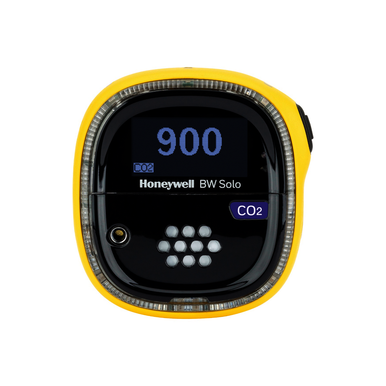 BW Technologies BWS1-BL-Y Solo CO2 Monitor, WirelessHoneywell BW sells the Solo single-gas detector in a CO2 version; the datasheet gives a 2-month typical battery for the 1S CO2 sensor
Why the CO2 question is different from the CO question. Carbon monoxide is a trace toxic gas measured in parts per million with a cheap electrochemical cell, which is why every hardware store sells a CO alarm. Carbon dioxide is present in all air at about 400 ppm, harms at thousands of ppm and kills at a few percent, and an electrochemical cell cannot read it well; MSA’s ALTAIR 5X FAQ puts it plainly: "CO2 is a toxic gas that is difficult to detect with electrochemical sensors", which is why the CO2 sensor in a portable monitor is an infrared one. That difference drives most of the questions below: whether a detector exists, whether a phone can do it, what the colorimetric indicator is, and why a "CO2 reading" from a home device may be an estimate rather than a measurement. The exposure limits themselves are on the CO2 limits guide linked below; this page is about the instruments.
The questions, one by one
Figures are from the NIOSH Pocket Guide, the MSA ALTAIR 5X FAQ and manual, and the Honeywell BW Solo datasheet and colorimetric tube pages.
CO2 detection in plain words
- A CO2 detector exists: a portable or fixed monitor with an infrared (NDIR) sensor. The MSA ALTAIR 5X and the Honeywell BW Solo CO2 are the ones in these two lines.
- A CO alarm does not read CO2; the gases, sensors and scales are different.
- A phone cannot measure CO2; an app only displays a separate sensor or an estimate.
- A colorimetric CO2 detector is a breath indicator (medical) or a hand-pump tube (industrial); neither is a continuous alarm.
- Limits: 5,000 ppm 8-hour (NIOSH REL and OSHA PEL), 30,000 ppm STEL (NIOSH), 40,000 ppm IDLH. MSA ships the 5X at 0.5 and 1.5 percent.
- Mount fixed sensors low and near the source; wear personal monitors in the breathing zone; calibrate with CO2 gas and bump test daily.
Questions people ask
Is there a detector for high levels of carbon dioxide?
Yes: a monitor with an infrared CO2 sensor, portable (MSA ALTAIR 5X, Honeywell BW Solo CO2, the RKI units in the band) or fixed; it reads CO2 directly and alarms at a set point.
Is there a CO2 detector app?
No app measures CO2 by itself; a phone has no gas sensor. An app can only show a connected sensor’s reading or an estimate.
What is a colorimetric CO2 detector?
A reagent that changes color with CO2: a medical breath indicator that turns yellow, or an industrial hand-pump tube that stains along its length. Neither alarms continuously.
Do they make CO2 detectors?
Yes; the infrared ones in the band, and fixed transmitters for rooms where CO2 is stored or made.
Do carbon dioxide detectors really work?
An infrared sensor measures CO2 directly by light absorption and is bump tested with known gas, so yes; what people doubt is usually a CO alarm or an app that cannot read CO2 at all.
What is the difference between a CO2 detector and a carbon monoxide detector?
Different gases (CO2 from complete burning and breathing, CO from incomplete burning), different sensors (infrared against electrochemical) and different scales (percent against ppm).
What is the most accurate CO2 detector?
We do not rank them; a calibrated infrared monitor reads within the specification its manufacturer prints, and the ALTAIR 5X manual prints that specification.
How many CO2 detectors do you need?
One personal monitor per worker in the atmosphere plus a pumped unit for testing before entry; for a fixed system, one sensor per room or zone where CO2 can collect, placed low.
Where should you not put a CO2 detector?
High on a wall, in a draft, by a door or vent, or where it gets wet; CO2 pools low, so the sensor goes low and near the source.
Why doesn’t the colorimetric CO2 detector turn yellow?
No exhaled CO2 is reaching it, or the indicator is spent or wet; it reads breath, not room air.
Are CO2 detectors accurate?
Infrared monitors are, to the printed specification, when zeroed and spanned with CO2 gas; tubes and low-cost indoor monitors carry wider tolerances.
How to check if a CO2 detector is working?
Bump test it with CO2 calibration gas and watch the reading and the alarm; a fixed sensor gets the same test through its calibration port on the schedule its manual sets.
What is the color of CO2?
None; it is colorless and odorless, which is why a detector is needed. Dry-ice fog is condensed water.
How do I calibrate my CO2 detector?
Zero it in clean air (or nitrogen where the manual says), then span it with a CO2 cylinder through the calibration cap or pump inlet; the ALTAIR 5X procedure is in its manual, and the CO2 kits are in the band.
What is a good CO2 reading in ppm?
About 400 ppm outdoors and a few hundred above that in a ventilated room; 5,000 ppm is the 8-hour limit and 40,000 ppm is IDLH.
What level sets off a CO2 detector?
The set point: MSA ships the ALTAIR 5X CO2 sensor at 0.5 percent low and 1.5 percent high; indoor-air monitors flag 1,000 to 2,000 ppm as a ventilation warning.
How long does a CO2 monitor last?
The IR sensor has no consumable chemistry; the Solo CO2’s typical battery is 2 months and the ALTAIR 5X runs at least 20 hours per charge, as their pages state.
Does humidity affect CO2 levels?
Not the amount of CO2, but water vapor can affect an uncompensated IR reading, which is why manuals give a humidity range.
What batteries do CO2 detectors take?
The Solo CO2 has a replaceable battery; the ALTAIR 5X a rechargeable pack; fixed transmitters are line powered.
Related guides
Carbon dioxide exposure limits and CO2 monitorsPEL, REL, IDLH and the ppm scaleCarbon monoxide exposure limit at workOSHA, NIOSH and the alarm pointsThe four types of gas detector sensorsAnd how to read a 4-gas meterHow to calibrate and bump test an MSA ALTAIR 5XZero, span, the pump test and the sensor-life warningWhat are the alarm set points on a gas monitor?H2S, CO, O2 and LEL defaults as BW and MSA ship themWhat is a confined space?The OSHA definition and permit spacesThe ratings, test results and standards shown here are the manufacturers' published values, reproduced as published. Nothing on this page is a recommendation by Bayshore Safety that any product is suitable for a particular task, hazard or workplace. Selecting safety products and protective equipment is the responsibility of the end user and the employer, based on their own hazard assessment and the regulations that apply to their work. Confirm every value on the manufacturer's own documentation before use.