
Carbon dioxide exposure limits: the OSHA PEL, the NIOSH STEL and IDLH, whether a CO2 detector is required, and what 1,500 ppm means
OSHA’s permissible exposure limit for carbon dioxide is 5,000 ppm as an 8-hour time-weighted average (29 CFR 1910.1000 Table Z-1, 9,000 mg/m³), the same figure as NIOSH’s REL, with a NIOSH short-term limit of 30,000 ppm for 15 minutes and an IDLH of 40,000 ppm (4 percent). Outdoor air is about 300 ppm by the NIOSH Pocket Guide’s note (closer to 420 ppm today), so 1,500 ppm is well below any occupational limit; it is a figure from indoor ventilation practice, where CO2 is used as a marker of how much exhaled air is in a room, not a health limit. No general OSHA standard requires a CO2 detector; the duty is to keep exposure below the PEL, and in a permit-required confined space 1910.146 requires the atmosphere to be tested for toxic contaminants, which in a brewery cellar, a digester or a landfill well means CO2. The fire code is different: the International Fire Code section 5307 requires a gas detection system where a beverage-dispensing CO2 system holds more than 100 pounds, where the local jurisdiction has adopted it. RKI Instruments reads CO2 with an infrared sensor on the GX-3R Pro in two ranges, 0 to 10,000 ppm with a preset alarm at 5,000 ppm and 0 to 10.0 percent by volume with alarms at 0.50, 3.00 and 4.00 percent.
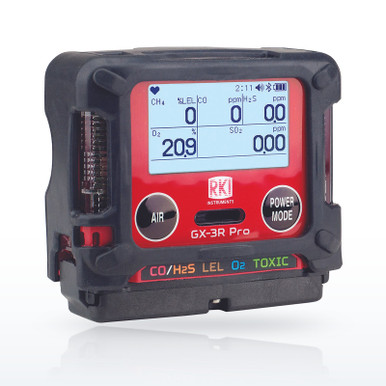 RKI Instruments 72-PXB-B GX-3R Pro Single-Gas Monitor, CO2, Alkaline and Li-ionSingle-gas infrared CO2 monitor, RKI preset at 5,000 ppm on the ppm range (RKI data)
Why CO2 gets its own sensor and its own alarm. A four-gas monitor does not read carbon dioxide; the LEL sensor ignores it (it is nonflammable), the oxygen sensor only notices it once enough CO2 has displaced air to pull oxygen below 19.5 percent, and by then a worker in a fermentation cellar or a dry-ice room is already above the 5,000 ppm PEL by a wide margin, because 1 percent CO2 (10,000 ppm) displaces only 0.2 percent of the oxygen. That is why the monitor for CO2 is an infrared sensor reading CO2 itself, and why RKI builds it in two ranges: ppm for workplace exposure against the PEL and STEL, percent for process gas such as landfill and digester gas, which RKI’s landfill page gives as 40 to 60 percent CO2. The gas is heavier than air (relative density 1.53 in the NIOSH entry), so it collects in pits, cellars, tank bottoms and the low end of a sloping floor.
The numbers
From Table Z-1, the NIOSH Pocket Guide and RKI’s GX-3R Pro page.
What RKI Instruments publishes about CO2 detection
From RKI's pages and manual:
- The GX-3R Pro's fourth slot takes an infrared CO2 sensor: IRR-0433 for 0 to 10,000 ppm and IRR-0409 for 0 to 10.0 percent by volume; RKI states the infrared sensor is immune to poisoning and works without oxygen.
- Run time with the infrared sensor fitted: 16 hours on the Li-ion pack, 7 on alkaline (15 and 6 with Bluetooth on), against 25 and 16 with an electrochemical fifth sensor.
- Calibration: the CO2 sensor has its own zero step (CO2 ZERO CAL, with nitrogen as the zero gas, since outdoor air already carries about 400 ppm) and accepts span gas of 3,000 to 9,000 ppm on the ppm sensor or 1.00 to 4.00 percent on the percent sensor; RKI's 81-PP calibration kits pair a CO2 cylinder with a nitrogen cylinder.
- Shelf life: CO2 is a non-reactive gas in RKI's table, 3 years in a steel cylinder.
- Where it is found, in RKI's pages: landfill gas 40 to 60 percent CO2 beside 45 to 60 percent methane; digester gas with high methane, CO2 and H2S and little oxygen (RKI's Digester Gas Monitor is the fixed system for it); CO2 blanketing and dry ice in food and beverage work; concrete and inerting applications.
- The CX-04 and the oxygen channel of any 4-gas monitor read displacement, not CO2; RKI's oxygen alarms at 19.5 and 18.0 percent come long after the CO2 PEL has been passed.
RKI Instruments CO2 ranges and preset alarms (GX-3R Pro infrared sensors)
| Gas and sensor | Measuring range (increment) | Accuracy statement | Preset gas alarms (user adjustable) | TWA and STEL alarms |
|---|---|---|---|---|
| Carbon dioxide (CO2), infrared, percent | 0 to 10.0% vol (0.01%) | ± 5% of reading | A1 0.50% vol, A2 3.00% vol, A3 4.00% vol | TWA 0.50% vol, STEL 3.00% vol |
| Carbon dioxide (CO2), infrared, ppm | 0 to 10,000 ppm (20 ppm) | — | A1 5,000 ppm | — |
Source: RKI Instruments GX-3R Pro product page and specification table (rkiinstruments.com/product/gx-3r-pro-gas-detector, rkiinstruments.com, fetched Nov 8 2026); RKI Instruments 04 Series product page and specification table (rkiinstruments.com/product/04-series-single-gas-detectors, rkiinstruments.com, fetched Nov 8 2026)
Carbon dioxide limits and properties
| Figure | Value | Source |
|---|---|---|
| OSHA PEL, general industry and construction | TWA 5,000 ppm (9,000 mg/m³) | 29 CFR 1910.1000 Table Z-1; 1926.55 Appendix A |
| NIOSH REL | TWA 5,000 ppm; ST 30,000 ppm | NIOSH Pocket Guide to Chemical Hazards (current online edition) |
| NIOSH IDLH | 40,000 ppm | NIOSH Pocket Guide to Chemical Hazards (current online edition) |
| Flammability | Nonflammable gas | NIOSH Pocket Guide to Chemical Hazards (current online edition) |
| Relative gas density | 1.53 (heavier than air) | NIOSH Pocket Guide to Chemical Hazards (current online edition) |
| Normal air | About 300 ppm (NIOSH note); nearer 420 ppm today | NIOSH Pocket Guide to Chemical Hazards (current online edition) |
| 1% CO2 in air | 10,000 ppm; displaces about 0.2% of the oxygen | Arithmetic |
| RKI preset alarms | 5,000 ppm (ppm sensor); 0.50 / 3.00 / 4.00% (percent sensor) | RKI Instruments GX-3R Pro product page and specification table (rkiinstruments.com/product/gx-3r-pro-gas-detector, rkiinstruments.com, fetched Nov 8 2026) |
Source: NIOSH Pocket Guide to Chemical Hazards (current online edition); 29 CFR 1910.1000 Table Z-1; RKI Instruments GX-3R Pro product page and specification table (rkiinstruments.com/product/gx-3r-pro-gas-detector, rkiinstruments.com, fetched Nov 8 2026).
How a CO2 sensor works, how long it lasts, and what it does not read
- Infrared absorption: carbon dioxide absorbs infrared light at its own wavelength, the sensor measures the loss across the sample path and converts it to ppm (RKI’s IRR-0433, 0 to 10,000 ppm) or percent by volume (IRR-0409, 0 to 10.0 percent). No oxygen is needed and the sensor is not poisoned, which is why RKI also uses infrared sensors for methane in landfill and digester gas.
- Life: an infrared sensor is not consumed by the gas; RKI warrants its infrared sensors 2 years on the GX-6100 and the instrument 3 years. The bump test, with a CO2 span gas, is what proves it.
- Zero: outdoor air already holds about 400 ppm CO2, so RKI’s CO2 channel is zeroed with nitrogen (CO2 ZERO CAL) rather than fresh air.
- What it does not read: methane or natural gas (a combustible sensor), carbon monoxide (an electrochemical sensor), or oxygen. A CO2 reading of 400 to 1,500 ppm indoors is ventilation information; 5,000 ppm averaged over a shift is the OSHA limit.
- Alarm presets, as RKI prints them: 5,000 ppm on the ppm sensor; 0.50, 3.00 and 4.00 percent on the percent sensor, with TWA 0.50 and STEL 3.00 percent.
More questions people ask
What are safe CO2 levels in a home or office, and what level causes headaches?
The occupational limits are far above anything an occupied room reaches: OSHA’s PEL and NIOSH’s REL are 5,000 ppm as an 8-hour average, NIOSH’s short-term limit is 30,000 ppm and the IDLH is 40,000 ppm (4 percent), as the cards above table. Indoor air guidance works at a different scale, where CO2 is a marker of how much exhaled air has built up: outdoor air is about 300 to 420 ppm, and the 1,000 to 1,500 ppm figures used in ventilation practice flag a stuffy room, not a health limit. The headache, drowsiness and poor concentration people report in crowded rooms are associated in that guidance with the stale air those readings indicate; the symptoms the NIOSH Pocket Guide lists for carbon dioxide itself (headache, dizziness, restlessness, paresthesia, dyspnea, sweating, malaise, increased heart rate) belong to exposures at or above the occupational limits, in a brewery cellar, a silo or a dry-ice room, not an office at 1,200 ppm.
Answers from the sources named above and in the byline.Questions people ask
Is it a legal requirement to have a CO2 detector?
No general OSHA standard names one; the duty is to keep exposure under the 5,000 ppm PEL (1910.1000 Table Z-1), and in a permit-required confined space 1910.146 requires the atmosphere to be tested for toxic contaminants, which in a brewery cellar, digester or landfill well means CO2. Fire codes differ: the International Fire Code section 5307, where adopted, requires gas detection for beverage CO2 systems over 100 pounds.
What is the OSHA PEL for carbon dioxide?
5,000 ppm (0.5 percent, 9,000 mg/m³) as an 8-hour time-weighted average, in general industry and construction; NIOSH’s REL is the same, with a 30,000 ppm 15-minute STEL and an IDLH of 40,000 ppm.
How long do CO2 monitors last?
An infrared CO2 sensor is not consumed by the gas the way an electrochemical cell is; RKI Instruments warrants its infrared sensors 2 years on the GX-6100 and lists the IRR-0433 and IRR-0409 sensors for the GX-3R Pro with the instrument’s 3-year warranty. The instrument lasts as long as it is serviced; the sensor is proven by the bump test.
How does a CO2 sensor work?
By infrared absorption: CO2 absorbs infrared light at its wavelength, the sensor measures the loss across a sample path and converts it to ppm or percent. It needs no oxygen and cannot be poisoned, which is why RKI uses infrared sensors for CO2 and for methane in landfill and digester gas.
Does a CO2 monitor detect natural gas?
No. An infrared CO2 sensor is tuned to carbon dioxide’s wavelength; methane needs a catalytic LEL sensor or an infrared sensor tuned to hydrocarbons. A multi-gas monitor can carry both.
What should a CO2 monitor read?
About 400 ppm outdoors (the NIOSH Pocket Guide’s note says about 300 ppm in normal air; current outdoor air is closer to 420), which is why RKI’s CO2 channel is zeroed with nitrogen rather than outdoor air. Indoors a reading above 1,000 to 1,500 ppm shows poor ventilation; 5,000 ppm is the OSHA limit.
What causes a CO2 sensor to go off?
CO2 reaching the alarm set point: RKI presets 5,000 ppm on its ppm sensor and 0.50, 3.00 and 4.00 percent on its percent sensor. Sources are fermentation, dry ice, CO2 beverage systems, fire suppression, combustion, decay in digesters and landfills, and breathing in a closed space.
How much ppm CO2 is ok?
Below 5,000 ppm averaged over the shift keeps the OSHA PEL; 1,000 to 1,500 ppm is the ventilation marker used indoors, not a health limit; 30,000 ppm for 15 minutes is the NIOSH STEL and 40,000 ppm is immediately dangerous to life or health.
Does a 4-gas monitor detect CO2?
No. The oxygen channel reads displacement, and RKI’s oxygen alarms at 19.5 and 18.0 percent come long after the CO2 PEL has been passed; CO2 needs its own infrared sensor, which RKI fits in the GX-3R Pro’s fourth slot and the GX-6100.
What is the difference between a gas detector and a CO2 detector?
A CO2 detector reads one gas by infrared; a gas detector in the trade is a multi-gas or single-gas monitor for whichever gases are fitted. A home carbon dioxide meter is not a workplace monitor.
Is carbon dioxide heavier than air?
Yes, relative gas density 1.53 (NIOSH Pocket Guide), so it collects low: cellars, pits, wells and the bottoms of tanks are tested first.
What are the safe CO2 levels in a home, and what should my carbon dioxide level be in my house?
There is no home exposure limit; outdoor air is about 300 to 420 ppm and ventilation guidance treats 1,000 to 1,500 ppm as a stuffy room. The occupational limits are 5,000 ppm (8-hour), 30,000 ppm (15 minutes) and 40,000 ppm (IDLH).
What level of CO2 causes headaches?
Indoor-air guidance associates headaches and drowsiness with the stale air that 1,000 to 2,000 ppm indicates; the NIOSH Pocket Guide lists headache among the symptoms of carbon dioxide exposure itself at the occupational levels, which start at 5,000 ppm.
Can I check my CO2 levels at home, and what monitors CO2 levels?
An infrared (NDIR) CO2 sensor, which is what consumer indoor-air monitors and RKI’s GX-3R Pro IRR-0433 (0 to 10,000 ppm) and IRR-0409 (0 to 10 percent) sensors use. A four-gas monitor without that sensor does not read CO2.
Can a CO2 detector detect methane, and does a CO2 alarm detect gas?
No. An infrared CO2 sensor reads carbon dioxide at its own wavelength; methane and propane need a combustible (LEL) sensor, and carbon monoxide an electrochemical CO cell.
What kind of instrument is used to measure carbon dioxide?
An infrared gas analyzer or monitor with an NDIR CO2 sensor; RKI offers it as the fourth sensor in the GX-3R Pro and in fixed detectors. Detector tubes for CO2 are the manual alternative.
Are CO2 monitors worth it, and is it worth getting a CO2 monitor?
Where CO2 is a process gas or a byproduct (breweries, beverage systems, digesters, landfills, dry ice, inerting) a CO2 monitor is the instrument the confined-space testing duty calls for, because the oxygen channel alarms long after the CO2 PEL is passed; for ventilation checks in an office a consumer indoor-air monitor serves.
What are the acceptable exposure limits for CO2 in the workplace?
5,000 ppm as an 8-hour TWA (OSHA PEL and NIOSH REL), 30,000 ppm as a NIOSH 15-minute STEL, 40,000 ppm IDLH (29 CFR 1910.1000 Table Z-1; NIOSH Pocket Guide).
What are the symptoms of elevated CO2, and what happens if carbon dioxide levels are too low?
NIOSH lists headache, dizziness, restlessness, paresthesia, dyspnea, sweating, malaise and increased heart rate for exposure at the occupational levels, with unconsciousness at the IDLH. Too little CO2 in air is not a hazard; the gas is a normal constituent at about 300 to 420 ppm.
How much does a CO2 detector cost?
The prices are in the band on this page for the RKI sensors and GX-3R Pro configurations; the gas detector cost guide linked below covers the ranges by instrument type.
Is there a detector for high levels of carbon dioxide?
Yes: a portable monitor with an infrared CO2 sensor. In these two lines the MSA ALTAIR 5X takes an IR CO2 sensor (0.5 percent low and 1.5 percent high alarms as MSA ships it) and the Honeywell BW Solo is sold in a CO2 version; the CO2 detector guide linked below covers tubes, apps and accuracy.
Is there a CO2 detector app?
A phone has no CO2 sensor, so an app can only read a separate Bluetooth sensor; the carbon dioxide detector guide explains what the apps do and do not measure.
Related guides
Oxygen deficiency and enrichmentThe 19.5 and 23.5 percent limitsGas detectors for landfills and wastewaterMethane, H2S and oxygenTWA, STEL and ceilingWhat each limit meansWhat does a 4-gas monitor measure?And why those fourBump test vs calibrationWhat each does and how oftenIs there a detector for high levels of carbon dioxide?Portable CO2 monitors, colorimetric tubes and appsThe ratings, test results and standards shown here are the manufacturers' published values, reproduced as published. Nothing on this page is a recommendation by Bayshore Safety that any product is suitable for a particular task, hazard or workplace. Selecting safety products and protective equipment is the responsibility of the end user and the employer, based on their own hazard assessment and the regulations that apply to their work. Confirm every value on the manufacturer's own documentation before use.