Home › Guides › Gas detection › Alarm set points by gas
Guide · Gas detection · Alarm set points

What are the alarm set points on a gas monitor? The low, high, TWA and STEL alarms for H2S, CO, O2, LEL, SO2 and NO2 as Honeywell BW and MSA ship them, the OSHA and NIOSH limits behind them, the low oxygen alarm level, and how to change a set point

A gas monitor has a low alarm and a high alarm for every gas it reads, and on the serviceable units a TWA and a STEL alarm for the toxic gases. As Honeywell BW and MSA ship them: H2S 10 ppm low and 15 ppm high; CO 35 and 200 ppm (Honeywell BW) or 25 and 100 ppm (MSA); oxygen 19.5 percent low and 23.5 (Honeywell BW) or 23.0 percent (MSA) high; combustible gas 10 and 20 percent LEL; SO2 5 and 10 ppm on the BW Clip and 2 and 5 ppm on the MSA ALTAIR; NO2 2.5 and 5 ppm on the ALTAIR. Every manual says the set points are user adjustable and vary by region, so these are printed defaults, not a rule: the rule is the employer’s hazard assessment against the OSHA and NIOSH limits, which this page puts beside the defaults.
Bayshore Safety. Industrial safety and PPE supplier since 2017. · Current as of November 2026 · Honeywell BW Clip datasheet (Rev A, 07/23) and quick reference guide; GasAlertMicroClip XT/XL/X3 user manual (Factory Gas Alarm Setpoints); BW MaxXT II user manual (Resetting Gas Alarm Setpoints); MSA ALTAIR 4X operating manual (10128754, Factory-set Alarm Thresholds and Setpoints), ALTAIR 5X operating manual (10150945 r02) and ALTAIR 2X bulletin (0802-96-MC); NIOSH Pocket Guide to Chemical Hazards (hydrogen sulfide, carbon monoxide, carbon dioxide); 29 CFR 1910.146(b) definitions of hazardous atmosphere (current eCFR)
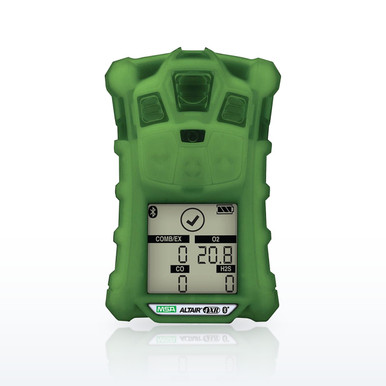
MSA 10178558 ALTAIR 4XR 4-Gas Monitor, LEL/O2/H2S/CO, Glow-in-the-Dark CaseMSA 10178558 ALTAIR 4XR 4-Gas Monitor, LEL/O2/H2S/CO, Glow-in-the-Dark CaseMSA’s factory set points for the ALTAIR 4X and 5X: O2 19.5 and 23.0 percent, CO 25 and 100 ppm, H2S 10 and 15 ppm, 0.5 and 1 percent CH4

Why the set points confuse people. Two monitors from two manufacturers alarm at different CO levels in the same room, a Clip bought with "5/10" on the label alarms before the one next to it, and a new ALTAIR shows a high oxygen alarm at 23.0 where the old MicroClip waited for 23.5. None of that is an error; it is the manufacturers’ printed defaults, which differ, plus the configured versions each one sells for buyers whose written procedure calls for a particular number. This page lists the defaults as the data sheets and manuals print them, explains the OSHA and NIOSH figures they sit under, and says how each line changes them. The alarm-reading guide linked below explains what the alarm patterns mean; the exposure-limit guides give the limits in depth.

Set points, gas by gas

The figures are the printed factory defaults; the table in the plain-words section has all of them with their sources.

What are the factory-set alarm levels for a 4-gas monitor?Honeywell BW (MicroClip and MAX XT II manuals, "sample factory alarm setpoints as defined by OSHA", varying by region): O2 19.5 percent low and 23.5 percent high; LEL 10 percent low and 20 percent high; CO 35 ppm low, 200 ppm high, 35 ppm TWA, 50 ppm STEL; H2S 10 ppm low, 15 ppm high, 10 ppm TWA, 15 ppm STEL. MSA (ALTAIR 4X and 5X manuals, "factory-set alarm thresholds and setpoints"): O2 19.5 and 23.0 percent; combustible 0.5 and 1 percent CH4, which is 10 and 20 percent of methane’s 5 percent LEL; CO 25 ppm low, 100 ppm high, 25 ppm TWA, 100 ppm STEL; H2S 10 ppm low, 15 ppm high, 10 ppm TWA, 15 ppm STEL. The MSA manuals also print the minimum and maximum each threshold can be set to (CO 10 to 1,700 ppm, H2S 5 to 175 ppm, O2 5 to 24 or 29 percent).
What is the alarm level for H2S?10 ppm low and 15 ppm high on every Honeywell BW and MSA unit in the band as shipped, with the TWA alarm at 10 ppm and the STEL alarm at 15 ppm where the instrument computes them; the low-concentration H2S-LC sensor on the ALTAIR 2X and 5X ships at 5 and 10 ppm. Behind the numbers: the NIOSH REL for hydrogen sulfide is a 10 ppm ceiling (10-minute), and the OSHA general-industry PEL is a 20 ppm ceiling with a 50 ppm 10-minute maximum peak, so the 10 ppm low alarm is at the NIOSH ceiling and under OSHA’s. Honeywell BW sells the Clip H2S with other printed defaults (5/10 and 5/15 ppm, listed in the band) for sites whose procedure sets a lower trigger; the 1910.146(b) definition of a hazardous atmosphere for a confined space is any concentration above a substance’s PEL, which is the figure that matters at the entry permit.
At what ppm does a carbon monoxide monitor go off?As shipped, 35 ppm low and 200 ppm high on the Honeywell BW Clip, MicroClip and MAX XT II (with a 35 ppm TWA and 50 ppm STEL), and 25 ppm low and 100 ppm high on the MSA ALTAIR, 2X, 4X and 5X (with a 25 ppm TWA and 100 ppm STEL). The NIOSH REL for carbon monoxide is 35 ppm as an 8-hour TWA with a 200 ppm ceiling, which the Honeywell BW defaults track exactly; the OSHA PEL is 50 ppm TWA; 1,200 ppm is IDLH. MSA’s lower defaults are a manufacturer’s choice. Honeywell BW also sells the Clip CO with 25/100 and 50/200 printed defaults, both in the band. Home CO alarms follow a different standard (UL 2034) and are not on this page.
At what level does a low oxygen alarm go off, and what are oxygen sensors set to?19.5 percent by volume, on every unit in both lines, which is the figure 29 CFR 1910.146(b) uses for an oxygen-deficient atmosphere; the enrichment (high) alarm is 23.5 percent on the Honeywell BW units and 23.0 percent on the MSA ALTAIR 4X and 5X, against 1910.146(b)’s 23.5 percent definition of oxygen-enriched. Normal air is 20.9 percent; the Honeywell BW Clip O2 and MicroClip zero and auto-calibrate the O2 sensor in 20.9 percent air at start-up, and the MSA ALTAIR’s Fresh Air Setup spans the O2 sensor to 20.8 percent, which is why a fresh instrument may read 20.8 or 20.9. There is no TWA or STEL alarm for oxygen.
What is the LEL alarm, and what does 10 percent LEL mean?Both lines ship the combustible channel at 10 percent LEL low and 20 percent LEL high; MSA prints the same thresholds as 0.5 and 1 percent methane by volume on the ALTAIR 4X and 5X. Ten percent LEL is a tenth of the way to the lower explosive limit of the calibration gas (for methane, 5 percent by volume, so 0.5 percent), and it is the point at which 1910.146(b) defines a confined-space atmosphere as hazardous ("flammable gas, vapor, or mist in excess of 10 percent of its lower flammable limit"). The LEL guides linked below cover the reading itself and why it drops in oxygen-poor air.
What are the SO2, NO2, NH3, Cl2 and other toxic set points?Honeywell BW Clip SO2: 5 ppm low and 10 ppm high (a 2/4 ppm version is also sold). MSA ALTAIR 2X and 5X: SO2 2 and 5 ppm; NO2 2.5 and 5 ppm (2.0 and 5.0 on the 5X’s non-XCell NO2 sensor); NH3 25 and 50 ppm (TWA 25, STEL 35 on the 5X); Cl2 0.5 and 1.0 ppm; and on the 5X ClO2 0.1 and 0.3 ppm, HCN 4.5 and 10 ppm, PH3 0.3 and 1.0 ppm, IR CO2 0.5 and 1.5 percent by volume. The Honeywell BW Solo’s defaults are printed on each gas’s product page. The exposure-limit guides for SO2, NO2, ammonia, chlorine and CO2 linked from the gas selector give the OSHA and NIOSH figures behind each.
What is a STEL alarm and a TWA alarm, and how are they calculated?The TWA alarm trips when the running 8-hour average of a toxic gas exceeds the TWA set point; the STEL alarm when the short-term average does. Honeywell BW: "The detector calculates the TWA value based on OSHA standards and the STEL value based on a user-defined 5 to 15 minute period", the OSHA method being "a moving average that accumulates over an 8-hour average" in which, past eight hours, the oldest hour is replaced by the newest. MSA: the STEL "is calculated over a 15-minute exposure" and the TWA over eight hours, each with its own display page. Both lines’ manuals warn to leave the area when a STEL alarm sounds and to confirm with a supervisor before clearing TWA and STEL readings, because clearing them erases the exposure record for the shift. The Clip and Clip4 have no TWA or STEL alarms.
Why do the two manufacturers ship different numbers?Because the set points are a manufacturer’s default and not a regulatory value. Honeywell BW’s CO defaults follow the NIOSH REL (35 ppm TWA, 200 ppm ceiling); MSA’s 25 and 100 ppm sit lower. Honeywell BW’s oxygen high alarm follows the 1910.146 figure of 23.5 percent; MSA’s 23.0 percent is tighter. Both manuals say the same thing about it: Honeywell BW, "standard factory alarm setpoints may vary by region" and the points are "user defined"; MSA, "alarm setpoints can be changed manually through the Setup menu or the MSA Link software". The employer’s written program sets the numbers its workers use, and both lines are sold configured to order for that reason.
How do I change the alarm set points?Honeywell BW Clip: before activation as a configured version (the 5/10 H2S, 25/100 and 50/200 CO and 2/4 SO2 versions in the band are examples), or during its life through an IntelliDoX station with Fleet Manager II, which the datasheet lists under "configuration of alarm set points"; not on the detector itself. Honeywell BW MicroClip and MAX XT II: in Safety Suite Device Configurator through the IR link (GA-USB1-IR) or the IntelliDoX dock, where each sensor’s low, high, TWA and STEL set points are entered, and setting a point to zero disables that alarm. MSA ALTAIR 4XR and 5X: in the instrument’s own Options Setup (hold the up and power buttons at start-up, then Sensor Alarm Setup) or in MSA Link; the ALTAIR 2X through MSA Link. Both manufacturers caution that the set points are displayed at every start-up so the wearer can see what the instrument is set to.
What are the default alarm levels for a 4-gas detector in a confined space?The defaults above are what the permit space test is read against, but the permit is written to 1910.146(b): oxygen below 19.5 or above 23.5 percent, flammable gas above 10 percent of its LFL, and any toxic above its PEL (or, where OSHA has none, above the published dose or limit) make the atmosphere hazardous and bar entry. Honeywell BW’s and MSA’s low alarms sit at or below those lines for O2 and LEL and at or below the NIOSH ceilings for H2S and CO, which is why the printed defaults are used as shipped on most permit programs and lowered where a site’s program says so.
Does the alarm clear by itself, and what is a latching alarm?The low and high gas alarms on both lines stop when the concentration falls below the set point; if the alarms are configured to latch (Honeywell BW) they stay on until the button is pressed, and on an MSA ALTAIR the up button acknowledges a latched, STEL, TWA or sensor-life alarm. A TWA or STEL alarm on a Honeywell BW unit clears only by turning the detector off and on or clearing the exposure readings. The alarm-reading guide linked below walks through the patterns (one beep a second for low, two for high on the Clip; the symbols on the MicroClip and ALTAIR screens).

Set points in plain words

  • H2S: 10 ppm low, 15 ppm high, both lines; NIOSH ceiling 10 ppm, OSHA ceiling 20 ppm. 5/10 and 5/15 ppm versions of the BW Clip are sold.
  • CO: 35/200 ppm (Honeywell BW, the NIOSH REL) or 25/100 ppm (MSA); OSHA PEL 50 ppm TWA; IDLH 1,200 ppm.
  • Oxygen: 19.5 percent low on every unit; high 23.5 (Honeywell BW) or 23.0 (MSA); 1910.146 uses 19.5 and 23.5.
  • LEL: 10 percent low, 20 percent high; 10 percent LFL is the 1910.146 hazardous-atmosphere line.
  • SO2 5/10 ppm (BW Clip) or 2/5 (MSA); NO2 2.5/5; NH3 25/50; Cl2 0.5/1; CO2 0.5/1.5 percent on the ALTAIR 5X.
  • TWA and STEL alarms run on the toxic channels of the serviceable units only; the Clip and Clip4 have low and high alarms.
  • All set points are adjustable: IntelliDoX and Fleet Manager II for the Clip, Safety Suite Device Configurator for the MicroClip and MAX XT II, the setup menu or MSA Link for the ALTAIR.
Manufacturer data sheets and manuals as named in the byline; NIOSH Pocket Guide; 29 CFR 1910.146(b).
Factory alarm set points as Honeywell BW and MSA print them (low, high, TWA, STEL)
Model (source)O2LELCOH2SOther
Honeywell BW Clip (datasheet, most common defaults; user adjustable)Low 19.5%, high 23.5%—Low 35 ppm, high 200 ppmLow 10 ppm, high 15 ppmSO2 low 5 ppm, high 10 ppm
Honeywell BW MicroClip XL / X3 (user manual, sample factory set points "as defined by OSHA"; vary by region)Low 19.5%, high 23.5%Low 10% LEL, high 20% LELLow 35, high 200; TWA 35, STEL 50 ppmLow 10, high 15; TWA 10, STEL 15 ppm—
Honeywell BW MAX XT II (user manual, sample factory set points)Low 19.5%, high 23.5%Low 10% LEL, high 20% LELLow 35, high 200; TWA 35, STEL 50 ppmLow 10, high 15; TWA 10, STEL 15 ppm—
MSA ALTAIR 4X (operating manual, MSHA version, factory-set thresholds)Low 19.5%, high 23.0%Low 0.5% CH4, high 1% CH4Low 25, high 100; TWA 25, STEL 100 ppmLow 10, high 15; TWA 10, STEL 15 ppmNO2 low 2.5, high 5.0 ppm
MSA ALTAIR 5X (operating manual, factory-set thresholds)Low 19.5%, high 23.0%Low 0.5% CH4, high 1% CH4Low 25, high 100; TWA 25, STEL 100 ppmLow 10, high 15; TWA 10, STEL 15 ppm; H2S-LC low 5, high 10SO2 2.0 / 5.0; NO2 2.0 / 5.0; NH3 25 / 50; Cl2 0.5 / 1.0; HCN 4.5 / 10.0; PH3 0.3 / 1.0; CO2 0.5% / 1.5% vol
MSA ALTAIR 2X (bulletin, low and high alarm in ppm by sensor)——CO 25 / 100; CO-H2 25 / 100H2S 10 / 15; H2S-LC 5 / 10SO2 2 / 5; NO2 2.5 / 5; NH3 25 / 50; Cl2 0.5 / 1

Every manufacturer states that set points are user adjustable and vary by region; the figures above are the printed defaults, not a rule. OSHA and NIOSH limits are in the exposure-limit guides linked below.

Source: Honeywell BW Clip datasheet (Rev A, 07/23), GasAlertMicroClip XT/XL/X3 user manual and BW MaxXT II user manual (129541-L3 Rev G); MSA ALTAIR 4X operating manual (10128754, MSHA version), ALTAIR 5X operating manual (10150945 r02) and ALTAIR 2X bulletin (0802-96-MC).

Questions people ask

What is the alarm level for H2S?

10 ppm low and 15 ppm high as Honeywell BW and MSA ship it (TWA 10, STEL 15), at the NIOSH 10 ppm ceiling and under OSHA’s 20 ppm ceiling; 5/10 and 5/15 ppm Clip versions are sold.

What are the factory-set alarm levels for the MSA 4 gas monitor?

O2 19.5 and 23.0 percent, combustible 0.5 and 1 percent CH4 (10 and 20 percent LEL), CO 25 and 100 ppm, H2S 10 and 15 ppm, per the ALTAIR 4X and 5X manuals, all adjustable.

What are the default alarm levels for a 4-gas detector?

Honeywell BW: O2 19.5/23.5, LEL 10/20 percent, CO 35/200 ppm, H2S 10/15 ppm; MSA: O2 19.5/23.0, LEL 10/20 percent, CO 25/100 ppm, H2S 10/15 ppm; both state they vary by region and are user set.

At what low level are oxygen sensors set to alarm?

19.5 percent by volume on every Honeywell BW and MSA unit, the 1910.146 oxygen-deficiency figure.

At what level will a low oxygen alarm go off?

19.5 percent; the high alarm is 23.5 percent (Honeywell BW) or 23.0 percent (MSA).

At what level does a carbon monoxide monitor go off?

35 ppm low and 200 ppm high on Honeywell BW units, 25 and 100 ppm on MSA units, as shipped; both adjustable.

At what ppm do carbon monoxide detectors go off?

Work monitors at 35 or 25 ppm low as above; home CO alarms follow UL 2034 and are a different product.

What is the STEL for H2S?

NIOSH sets a 10 ppm ceiling rather than a STEL and OSHA a 20 ppm ceiling; the monitors ship with a 15 ppm STEL alarm, a manufacturer default.

What is the LEL alarm set point?

10 percent LEL low and 20 percent LEL high on both lines (0.5 and 1 percent methane on the MSA display).

How do I change the alarm set points on a BW Clip?

Through IntelliDoX with Fleet Manager II, or by buying the configured version; not on the detector.

How do I change the set points on an ALTAIR 4XR?

In Options Setup (up and power at start-up, Sensor Alarm Setup) or in MSA Link; the set points show at every start-up.

Why is the MSA CO alarm lower than the BW one?

A manufacturer default: Honeywell BW follows the NIOSH REL (35/200 ppm) and MSA ships 25/100 ppm; neither is a rule.

What is a TWA alarm?

An alarm on the running 8-hour average of a toxic gas (OSHA method), set at 35 ppm CO and 10 ppm H2S by Honeywell BW and 25 and 10 by MSA.

Does OSHA set gas monitor alarm levels?

No. OSHA sets exposure limits (PELs) and the 1910.146 atmosphere definitions; the alarm levels are the manufacturer’s defaults adjusted by the employer’s program.

The ratings, test results and standards shown here are the manufacturers' published values, reproduced as published. Nothing on this page is a recommendation by Bayshore Safety that any product is suitable for a particular task, hazard or workplace. Selecting safety products and protective equipment is the responsibility of the end user and the employer, based on their own hazard assessment and the regulations that apply to their work. Confirm every value on the manufacturer's own documentation before use.

Need monitors matched to the gases on your permit?Call (925) 215-7337 or email us the gases in your hazard assessment and where people work, and we will quote the monitors, calibration gas and docks with the manufacturer figures listed. We service and calibrate portable gas instruments and sell nationwide.
Gas detection selector
How to buyCard, purchase order or invoice terms; quotes on request; agencies and institutions welcome.
Live Service & SupportReal people who know the products, Monday to Friday 7:30am to 4pm Pacific. 925-215-7337
We DeliverWe ship nationwide. Parcel and LTL freight to job sites and businesses across the U.S.