
Bayshore Safety & Industrial Supplies Guide
Oxygen monitors for work: wearable single-gas O2 monitors, how to measure the oxygen level in a confined space, how to read one, and what the 19.5 and 23.5 percent alarms mean
An oxygen monitor for work is a single-gas or multi-gas instrument with an electrochemical oxygen sensor that reads percent oxygen by volume, 20.9 in clean air, and alarms at the lines OSHA draws: 19.5 percent for an oxygen-deficient atmosphere and 23.5 percent for an oxygen-enriched one (29 CFR 1910.146(b)). Yes, you can buy one and yes, it is wearable: RKI Instruments’ GX-3R Pro and GX-Force single-gas oxygen configurations and the other manufacturers’ single-gas O2 units in the band clip to a collar or belt, and the oxygen channel of every four-gas monitor does the same job. It is not a pulse oximeter: the medical device reads oxygen in your blood, the workplace monitor reads oxygen in the air. To measure the oxygen level in a confined space, the space is tested from outside before anyone enters, oxygen first, with a monitor lowered on a line or a pumped unit whose hose reaches the top, middle and bottom (1910.146(d)(5)); RKI’s GX-Force draws through up to 100 ft of hose. Below 19.5 percent the respirator standard treats the air as immediately dangerous to life or health, and only a supplied-air respirator or SCBA may be worn (1910.134(d)(2)(iii)).
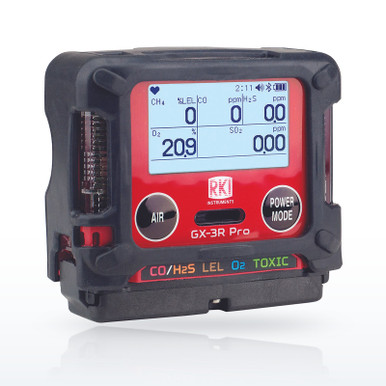 RKI Instruments 72-PPX-B GX-3R Pro Single-Gas Monitor, O2, Alkaline and Li-ionWearable single-gas oxygen monitor: 0 to 40.0 percent, alarms at 19.5, 18.0 and 23.5 percent as RKI states
Why oxygen is the first reading. Normal air is 20.9 percent oxygen and the body gives no useful warning as that falls: OSHA’s respirator preamble, quoted in its 2007 letter of interpretation, lists faster breathing and impaired thinking during exertion at 16 to 19.5 percent, the same at rest at 12 to 16, faulty judgment and exhaustion at 10 to 14, nausea and possible unconsciousness at 6 to 10, and convulsions and death below 6, and notes these symptoms occur immediately. A space loses oxygen by displacement (nitrogen or argon purge, carbon dioxide, methane in a sewer), by consumption (rust, rotting organic matter) or by absorption (wet activated carbon, fresh concrete), with no smell and no color. The oxygen sensor is read first in a confined space for a second reason: a catalytic LEL sensor needs oxygen to work, so the LEL number cannot be trusted until the oxygen number is known (the testing order in 1910.146(d)(5)(iii)).
How to read an oxygen monitor
How to measure the oxygen level in a confined space
- From outside, before anyone enters, with a calibrated direct-reading instrument (1910.146(d)(5)(i)): lower a diffusion monitor on a line, or use a pumped monitor with enough hose to reach the bottom (RKI’s GX-Force draws at 0.5 L/min through up to 100 ft).
- At every level the entrant will reach, top, middle and bottom, holding at each long enough for the reading to settle (RKI’s T90 is within 30 seconds); heavy gases displace oxygen low, light gases high.
- Oxygen first, then combustibles, then toxics (1910.146(d)(5)(iii)), because the LEL sensor needs oxygen to read.
- Accept 19.5 to 23.5 percent, and only with the other readings inside their limits; outside it, ventilate and retest, and under the alternate procedure of (c)(5) keep the forced-air ventilation running and keep testing.
- Write the readings on the permit with the time and the tester’s initials (1910.146(f)(10)) and let the entrant watch (d)(5)(iv).
- During the entry the entrant wears a monitor and the attendant watches the readings; any oxygen alarm is a leave-the-space event (h)(5).
- Fixed oxygen monitors for rooms: RKI’s FAQ on sensor placement notes there is no standard for placement and that for nitrogen, which is about the density of air, the sensor goes at breathing height, 4 to 6 feet above the floor, with the gas source, ventilation and room layout considered; RKI’s nitrogen storage article describes its OX-600 wall unit for rooms holding nitrogen containers, a fixed product outside the portable line on this site.
RKI Instruments oxygen range and preset alarms
| Gas and sensor | Measuring range (increment) | Accuracy statement | Preset gas alarms (user adjustable) | TWA and STEL alarms |
|---|---|---|---|---|
| Oxygen (O2) | 0 to 40.0% vol (0.1%) | ± 0.5% O2 | Low 19.5%, low-low 18.0%, high 23.5%, over 40.0% | — |
Source: RKI Instruments GX-3R Pro product page and specification table (rkiinstruments.com/product/gx-3r-pro-gas-detector, rkiinstruments.com); RKI Instruments 04 Series product page and specification table (rkiinstruments.com/product/04-series-single-gas-detectors, rkiinstruments.com)
Questions people ask
Can I buy an oxygen level monitor?
Yes. The wearable single-gas oxygen monitors, two-gas and four-gas monitors with an oxygen channel and the replacement oxygen sensors are in the band on this page with their prices; we sell nationwide.
Is there a wearable oxygen monitor?
Yes: a single-gas O2 monitor clips to a collar or belt and alarms at 19.5 and 23.5 percent; RKI Instruments’ GX-3R Pro and GX-Force single-gas oxygen configurations and the other manufacturers’ clips in the band are that instrument. It reads the air, not your blood.
How much does an oxygen meter cost?
The prices are in the band on this page, lowest first in each group; a single-gas oxygen monitor is at the low end and the four-gas monitors with an oxygen channel above it. The cost guide on this site compares the line.
How to measure oxygen level in confined space?
From outside, before entry, with a calibrated monitor lowered or pumped to the top, middle and bottom of the space, oxygen first; accept 19.5 to 23.5 percent, write it on the permit, and keep a monitor on the entrant during the work (1910.146(d)(5)).
How to read an oxygen level monitor?
The display shows percent oxygen by volume: 20.9 in clean air, below 19.5 deficient (low alarm), above 23.5 enriched (high alarm); RKI adds a low-low alarm at 18.0 percent and reads 0 to 40.0 percent in 0.1 percent steps.
What does OSHA consider an oxygen deficient atmosphere?
Below 19.5 percent oxygen by volume (1910.146(b)), which the respirator standard treats as IDLH: only a supplied-air respirator or SCBA may be worn (1910.134(d)(2)(iii)).
What are the dangers of a lack of oxygen in a confined space?
By OSHA’s respirator preamble: faster breathing and impaired thinking at 16 to 19.5 percent during exertion, the same at rest at 12 to 16, faulty judgment and exhaustion at 10 to 14, nausea and possible unconsciousness at 6 to 10, convulsions and death below 6, with no warning a person can feel in time.
What is a primary hazard of an oxygen-enriched atmosphere?
Fire: above 23.5 percent, materials ignite more easily and burn faster and hotter; a spark that would not catch in normal air will. 1910.252 prohibits ventilating with oxygen for that reason.
What is the safe oxygen range for confined space entry?
19.5 to 23.5 percent, held for the whole entry, with flammables under 10 percent LEL and toxics under their limits (1910.146(b)).
What happens when an O2 sensor goes bad?
It drifts, reads low or high in clean air, responds slowly or will not calibrate; RKI lists its oxygen sensor at a 3 to 5 year life and notes heat damage. The bump test finds it; the sensor is replaced, not adjusted around.
How should your oxygen level be?
In the air, 20.9 percent in clean air and never below 19.5 or above 23.5 in a space people enter. A pulse oximeter reading of blood oxygen is a different measurement answered by a clinician, not by this instrument.
How long does a BW Clip O2 last?
Two years of continuous operation from activation (there is no 3-year O2 version), with a 6-month shelf life before activation, as Honeywell BW’s datasheet and guide state; the O2 model asks for a zero every 24 hours.
Related guides
Oxygen deficiency and enrichmentThe 19.5 and 23.5 percent limitsConfined space gas testing orderOxygen, then flammables, then toxicsWhat does a 4-gas monitor measure?And why those fourRespiratory protection in confined spaces1910.146 and 1910.134 togetherSingle-gas vs multi-gas detectorsWhich the job needsHow much does a gas detector cost?Single-gas, 4-gas, PID, sensors and calibration gasThe ratings, test results and standards shown here are the manufacturers' published values, reproduced as published. Nothing on this page is a recommendation by Bayshore Safety that any product is suitable for a particular task, hazard or workplace. Selecting safety products and protective equipment is the responsibility of the end user and the employer, based on their own hazard assessment and the regulations that apply to their work. Confirm every value on the manufacturer's own documentation before use.
© 2026 Bayshore Safety & Industrial Supplies, Inc. All rights reserved. This guide may not be copied or republished without written permission.