
PEL vs REL vs TLV vs WEL: who sets each exposure limit, what STEL and 8-hour TWA stand for, and which number a gas monitor’s TWA alarm uses
A PEL is OSHA’s permissible exposure limit, the enforceable federal number in 29 CFR 1910.1000 Tables Z-1, Z-2 and Z-3. A REL is NIOSH’s recommended exposure limit, published in the NIOSH Pocket Guide, usually lower and not itself enforceable. A TLV is the threshold limit value of the ACGIH, a private professional body whose values are copyrighted and licensed, and are often the basis of state and company limits. A WEL is the United Kingdom’s workplace exposure limit, published by the HSE in EH40, and does not apply in the United States. STEL stands for short-term exposure limit, a 15-minute average, and an 8-hour TWA is a time-weighted average over an 8-hour shift, the form most PELs take. A gas monitor’s TWA alarm uses whatever value the employer loads: RKI Instruments presets a TWA of 25 ppm and a STEL of 200 ppm for CO and 1.0 and 5.0 ppm for H2S, which are its factory numbers, not OSHA’s, and are user adjustable.
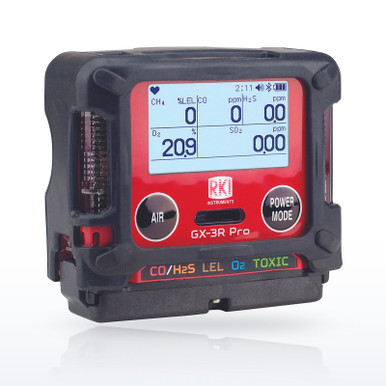 RKI Instruments 72-PRX-C GX-3R Pro Single-Gas Monitor, CO, Li-ionSingle-gas CO monitor RKI presets with a TWA alarm at 25 ppm and a STEL alarm at 200 ppm (RKI data)
Why there are four numbers for one gas. Carbon monoxide has an OSHA PEL of 50 ppm as an 8-hour TWA, a NIOSH REL of 35 ppm TWA with a 200 ppm ceiling, an ACGIH TLV that is lower again, and a UK WEL of its own. They come from different bodies with different jobs. OSHA writes law and must defend each number in rulemaking, so most PELs date from the 1971 adoption of the 1968 TLVs and have not moved. NIOSH is the research institute under the CDC and publishes what it thinks the limit should be. ACGIH is a private association that revises its TLVs every year and sells them. The HSE regulates British workplaces. A gas monitor knows none of this: its TWA alarm is a number in memory. The manufacturer loads a preset, the employer changes it to match the limit its program follows, and the monitor integrates the reading over the shift and alarms when the running average reaches the set point. OSHA’s 1910.1000(d) gives the formula an employer uses to compute an 8-hour TWA by hand from the concentrations and the times at each.
The terms, defined
From 1910.1000 and the NIOSH Pocket Guide introduction; the acronyms spelled out as people ask them.
What a gas monitor does with these numbers
From RKI's product pages and manuals:
- The instantaneous alarms (RKI calls them first, second and third) are plain concentrations: for CO, 25, 50 and 1,200 ppm on RKI's GX-3R Pro, GX-3R, GX-Force and CO-04.
- The TWA alarm is a running 8-hour average the instrument computes from its readings; RKI's preset for CO is 25 ppm and for H2S 1.0 ppm. These are factory presets and user adjustable; they are not OSHA's PELs (CO 50 ppm, H2S 20 ppm ceiling) or NIOSH's RELs (CO 35 ppm, H2S 10 ppm ceiling), and the employer sets them to the limit its program follows.
- The STEL alarm is a 15-minute running average; RKI presets CO 200 ppm and H2S 5.0 ppm.
- Where RKI's two pages print different TWA and STEL presets for the same gas (SO2: 0.25 and 0.25 ppm on the GX-3R Pro page, 2.00 and 5.00 ppm on the 04 Series page; NO2 TWA 0.20 against 0.50 ppm), both are reproduced in the table below as printed.
- A TWA alarm cannot be silenced by switching the unit off and on in the field on most instruments; RKI's manuals set TWA and STEL values in User Mode, and the GX-Force's alarms can be latching or self-resetting.
- A monitor reading is an exposure record under 1910.1020 when it measures a worker's exposure to a toxic substance; the records guide covers what to keep.
The limits by body, for the gases portable monitors read
| Gas | Formula | OSHA PEL (Table Z-1 or Z-2) | NIOSH REL | NIOSH IDLH |
|---|---|---|---|---|
| Carbon monoxide | CO | TWA 50 ppm (55 mg/m³) | TWA 35 ppm (40 mg/m³) C 200 ppm (229 mg/m³) | 1200 ppm |
| Hydrogen sulfide | H₂S | C 20 ppm 50 ppm [10-minute maximum peak] | C 10 ppm (15 mg/m³) [10-minute] | 100 ppm |
| Sulfur dioxide | SO₂ | TWA 5 ppm (13 mg/m³) | TWA 2 ppm (5 mg/m³) ST 5 ppm (13 mg/m³) | 100 ppm |
| Nitrogen dioxide | NO₂ | C 5 ppm (9 mg/m³) | ST 1 ppm (1.8 mg/m³) | 13 ppm |
| Ammonia | NH₃ | TWA 50 ppm (35 mg/m³) | TWA 25 ppm (18 mg/m³) ST 35 ppm (27 mg/m³) | 300 ppm |
| Carbon dioxide | CO₂ | TWA 5000 ppm (9000 mg/m³) | TWA 5000 ppm (9000 mg/m³) ST 30,000 ppm (54,000 mg/m³) | 40,000 ppm |
| Hydrogen cyanide | HCN | TWA 10 ppm (11 mg/m³) [skin] | ST 4.7 ppm (5 mg/m³) [skin] | 50 ppm |
| Chlorine | Cl₂ | C 1 ppm (3 mg/m³) | C 0.5 ppm (1.45 mg/m³) [15-minute] | 10 ppm |
| Benzene | C₆H₆ | [1910.1028] TWA 1 ppm ST 5 ppm | Ca TWA 0.1 ppm ST 1 ppm | Ca [500 ppm] |
RKI Instruments preset TWA and STEL alarms, user adjustable: CO 25 and 200 ppm; H2S 1.0 and 5.0 ppm; HCN 4.7 and 10 ppm; NH3 25.0 and 35.0 ppm (04 Series page); SO2 and NO2 as printed on each page (see the table on the TWA, STEL and ceiling guide).
Source: 29 CFR 1910.1000 Tables Z-1 and Z-2 and 1910.1028 (benzene), as reproduced in the NIOSH Pocket Guide to Chemical Hazards (current online edition). TWA is an 8-hour (OSHA) or up-to-10-hour (NIOSH) time-weighted average; ST a 15-minute short-term limit; C a ceiling; Ca a NIOSH potential occupational carcinogen. ACGIH TLVs are licensed and not reproduced.
RKI Instruments measuring ranges and preset alarms (GX-3R Pro, GX-3R, GX-Force and 04 Series, as printed)
| Gas and sensor | Measuring range (increment) | Accuracy statement | Preset gas alarms (user adjustable) | TWA and STEL alarms |
|---|---|---|---|---|
| LEL (CH4 or HC), catalytic | 0 to 100% LEL (1% LEL) | ± 5% of reading or ± 2% LEL | 1st 10% LEL, 2nd 25% LEL, 3rd 50% LEL, over 100% LEL | — |
| Oxygen (O2) | 0 to 40.0% vol (0.1%) | ± 0.5% O2 | Low 19.5%, low-low 18.0%, high 23.5%, over 40.0% | — |
| Hydrogen sulfide (H2S) | 0 to 200.0 ppm (0.1 ppm) | ± 5% of reading or ± 2 ppm | A1 5 ppm, A2 30 ppm, A3 100 ppm | TWA 1.0 ppm, STEL 5.0 ppm |
| Carbon monoxide (CO) | 0 to 2,000 ppm (1 ppm) | ± 5% of reading or ± 5 ppm (± 2 ppm, hydrogen-compensated sensor) | A1 25 ppm, A2 50 ppm, A3 1,200 ppm | TWA 25 ppm, STEL 200 ppm |
| Carbon dioxide (CO2), infrared, percent | 0 to 10.0% vol (0.01%) | ± 5% of reading | A1 0.50% vol, A2 3.00% vol, A3 4.00% vol | TWA 0.50% vol, STEL 3.00% vol |
| Carbon dioxide (CO2), infrared, ppm | 0 to 10,000 ppm (20 ppm) | — | A1 5,000 ppm | — |
| Sulfur dioxide (SO2) | 0 to 100.0 ppm (0.05 ppm) | — | A1 2 ppm, A2 5 ppm, A3 100 ppm | GX-3R Pro page: TWA 0.25 ppm, STEL 0.25 ppm; 04 Series page: TWA 2.00 ppm, STEL 5.00 ppm |
| Hydrogen cyanide (HCN) | 0 to 30.0 ppm (0.1 ppm) | ± 10% of reading or ± 5% of full scale | A1 5.0 ppm, A2 10.0 ppm, A3 30.0 ppm | TWA 4.7 ppm, STEL 10 ppm |
| Nitrogen dioxide (NO2) | 0 to 20.00 ppm (0.05 ppm) | — | A1 2.00 ppm, A2 4.00 ppm, A3 20.00 ppm | GX-3R Pro page: TWA 0.20 ppm, STEL 1.00 ppm; 04 Series page: TWA 0.50 ppm, STEL 1.00 ppm |
| Ammonia (NH3) | 0 to 400.0 ppm (0.5 ppm) | ± 10% of reading or ± 5% of full scale | A1 25.0 ppm, A2 35.0 ppm, A3 300.0 ppm | 04 Series page: TWA 25.0 ppm, STEL 35.0 ppm |
Source: RKI Instruments GX-3R Pro product page and specification table (rkiinstruments.com/product/gx-3r-pro-gas-detector, rkiinstruments.com); RKI Instruments GX-3R product page and specification table (rkiinstruments.com/product/gx-3r-gas-detector, rkiinstruments.com); RKI Instruments GX-Force product page and specification table (rkiinstruments.com/product/gx-force-portable-4-gas-monitor, rkiinstruments.com); RKI Instruments 04 Series product page and specification table (rkiinstruments.com/product/04-series-single-gas-detectors, rkiinstruments.com). The GX-3R and GX-Force pages print the same LEL, O2, H2S and CO ranges and set points as the GX-3R Pro page. Where the GX-3R Pro page and the 04 Series page print different TWA and STEL values for the same gas, both are shown.
Factory set points beside the PEL and REL
A monitor’s default alarms are a manufacturer’s choice, not a limit; Honeywell BW’s CO defaults track the NIOSH REL (35 ppm TWA, 200 ppm ceiling) and MSA’s sit lower (25 and 100 ppm), and both H2S defaults sit at the NIOSH ceiling of 10 ppm.
Factory alarm set points as Honeywell BW and MSA print them (low, high, TWA, STEL)
| Model (source) | O2 | LEL | CO | H2S | Other |
|---|---|---|---|---|---|
| Honeywell BW Clip (datasheet, most common defaults; user adjustable) | Low 19.5%, high 23.5% | — | Low 35 ppm, high 200 ppm | Low 10 ppm, high 15 ppm | SO2 low 5 ppm, high 10 ppm |
| Honeywell BW MicroClip XL / X3 (user manual, sample factory set points "as defined by OSHA"; vary by region) | Low 19.5%, high 23.5% | Low 10% LEL, high 20% LEL | Low 35, high 200; TWA 35, STEL 50 ppm | Low 10, high 15; TWA 10, STEL 15 ppm | — |
| Honeywell BW MAX XT II (user manual, sample factory set points) | Low 19.5%, high 23.5% | Low 10% LEL, high 20% LEL | Low 35, high 200; TWA 35, STEL 50 ppm | Low 10, high 15; TWA 10, STEL 15 ppm | — |
| MSA ALTAIR 4X (operating manual, MSHA version, factory-set thresholds) | Low 19.5%, high 23.0% | Low 0.5% CH4, high 1% CH4 | Low 25, high 100; TWA 25, STEL 100 ppm | Low 10, high 15; TWA 10, STEL 15 ppm | NO2 low 2.5, high 5.0 ppm |
| MSA ALTAIR 5X (operating manual, factory-set thresholds) | Low 19.5%, high 23.0% | Low 0.5% CH4, high 1% CH4 | Low 25, high 100; TWA 25, STEL 100 ppm | Low 10, high 15; TWA 10, STEL 15 ppm; H2S-LC low 5, high 10 | SO2 2.0 / 5.0; NO2 2.0 / 5.0; NH3 25 / 50; Cl2 0.5 / 1.0; HCN 4.5 / 10.0; PH3 0.3 / 1.0; CO2 0.5% / 1.5% vol |
| MSA ALTAIR 2X (bulletin, low and high alarm in ppm by sensor) | — | — | CO 25 / 100; CO-H2 25 / 100 | H2S 10 / 15; H2S-LC 5 / 10 | SO2 2 / 5; NO2 2.5 / 5; NH3 25 / 50; Cl2 0.5 / 1 |
Every manufacturer states that set points are user adjustable and vary by region; the figures above are the printed defaults, not a rule. OSHA and NIOSH limits are in the exposure-limit guides linked below.
Source: Honeywell BW Clip datasheet (Rev A, 07/23), GasAlertMicroClip XT/XL/X3 user manual and BW MaxXT II user manual (129541-L3 Rev G); MSA ALTAIR 4X operating manual (10128754, MSHA version), ALTAIR 5X operating manual (10150945 r02) and ALTAIR 2X bulletin (0802-96-MC).
Questions people ask
What is the difference between TLV and STEL?
A TLV is who sets it (the ACGIH’s threshold limit value); a STEL is what kind of limit it is (a 15-minute short-term exposure limit). ACGIH publishes TLV-TWA, TLV-STEL and TLV-C values; OSHA’s equivalents are the PEL, the STEL in some standards (benzene 5 ppm) and the ceiling.
What does STEL stand for in OSHA?
Short-term exposure limit: a 15-minute time-weighted average that may not be exceeded at any time during the shift. OSHA writes STELs into its substance-specific standards (benzene 5 ppm in 1910.1028); the Table Z-1 limits are mostly 8-hour TWAs and ceilings.
What are workplace exposure limits (WELs)?
The United Kingdom’s occupational limits, published by the HSE in EH40; they do not apply in the United States, where the enforceable number is OSHA’s PEL.
How does OSHA define occupational exposure?
The Hazard Communication Standard, 29 CFR 1910.1200(c), defines exposure or exposed as an employee being subjected in the course of employment to a hazardous chemical, including potential (accidental or possible) exposure, by any route of entry: inhalation, ingestion, skin contact or absorption. The exposure limits in 1910.1000 apply to the airborne part of that.
What is the occupational exposure to hazardous chemicals standard?
Two OSHA standards carry that phrase: 1910.1200, Hazard Communication, which covers labels, safety data sheets and training for every hazardous chemical, and 1910.1450, Occupational exposure to hazardous chemicals in laboratories. The airborne limits themselves are in 1910.1000 and the substance-specific standards.
Are PELs legally enforceable?
Yes. 29 CFR 1910.1000 requires employers to keep employee exposure within the Table Z limits, and OSHA cites violations; NIOSH RELs and ACGIH TLVs are not enforceable by themselves, though a state plan or an employer’s program may adopt them, and OSHA can cite under the general duty clause.
What is the TLV exposure limit?
The ACGIH threshold limit value, a guideline from a private professional body, published in a licensed book and not reproduced here. For many gases it is lower than the PEL: for H2S 1 ppm TWA and 5 ppm STEL, which RKI Instruments uses as its factory TWA and STEL alarm presets.
What is TWA in a gas detector?
The running 8-hour time-weighted average the instrument computes from its own readings on each toxic channel; it alarms when the average reaches the value loaded (RKI: 25 ppm for CO, 1.0 ppm for H2S as shipped). It is the employer’s value, not necessarily OSHA’s.
What does 8hr TWA mean?
The average concentration over an 8-hour shift, computed by 1910.1000(d)(1): each concentration times the hours at it, summed and divided by 8. Short peaks are allowed if the average stays under the limit, unless a ceiling or STEL also applies.
How do I calculate the TWA exposure?
E = (C1 T1 + C2 T2 + … + Cn Tn) ÷ 8, with C in ppm and T in hours (1910.1000(d)(1)). Two hours at 100 ppm CO and six at 20 ppm: (200 + 120) ÷ 8 = 40 ppm, under the 50 ppm PEL.
Is a NIOSH REL enforceable?
Not by itself; it is NIOSH’s recommendation to OSHA and employers. It becomes binding where a state standard or a contract adopts it, and many monitor presets follow it (the common 35 ppm CO low alarm is the NIOSH REL).
Which limit does California use?
Cal/OSHA’s own PELs in Title 8 section 5155, which for several gases are lower than the federal Table Z values; the section is named here as the state source and its table is the reference for California workplaces.
The ratings, test results and standards shown here are the manufacturers' published values, reproduced as published. Nothing on this page is a recommendation by Bayshore Safety that any product is suitable for a particular task, hazard or workplace. Selecting safety products and protective equipment is the responsibility of the end user and the employer, based on their own hazard assessment and the regulations that apply to their work. Confirm every value on the manufacturer's own documentation before use.