
Bayshore Safety & Industrial Supplies Guide
What are the parts of a safety harness, how does a harness work, and how do you clean and store it? Webbing, D-rings, buckles, keepers, the sub-pelvic strap and the label, as the manufacturers’ manuals describe them
A full body harness is five things stitched into one: polyester webbing that wraps the shoulders, chest, hips and thighs; a sub-pelvic strap under the seat that takes the load in a fall; a dorsal D-ring between the shoulder blades (the ring on the back) where the lanyard or self-retracting lifeline connects, with optional side, shoulder or chest D-rings for positioning, retrieval and climbing; buckles and adjusters at the chest and legs; and the label and keepers. It works by spreading the arrest force, limited by OSHA to 1,800 pounds, across the thighs, pelvis, chest and shoulders instead of the waist, and by holding the body upright after the fall. The manufacturers’ care instructions are short: wash the webbing with water and mild detergent, wipe the hardware with mild soap and a damp rag, dry without heat, never use solvents or petroleum products, never repair or modify it, and hang it to store out of direct sunlight and away from chemicals, vapors, debris and water. Inspect it before every use and have a competent person inspect it at least once a year.
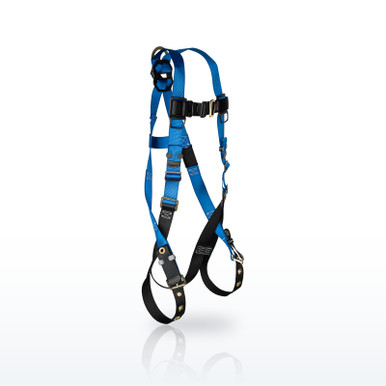 FallTech 7016 Harnesses, Contractor 1D Standard Non-belted Full Body HarnessFallTech 7016 Contractor 1D full body harness: polyester webbing, dorsal D-ring, tongue-buckle legs, ANSI Z359.11, 130 to 310 lb
This site already covers how to put a harness on and check the fit, what each D-ring is for, how much weight a harness holds, how often it is inspected and how long it lasts (linked below). This page answers the questions that come before and after those: what the parts are called, what the webbing is, how the harness actually works in a fall, what a vest harness is, whether harnesses come in sizes, and how to clean, dry and store one so it passes its next inspection. The answers are from the FallTech full body harness manual and sizing charts and the Safewaze product pages and data sheets carried on this site, with the OSHA paragraphs that set the strength figures.
The parts of a harness, and what each one does
Named as FallTech’s manual and the Safewaze data sheets name them, with the OSHA paragraph behind each strength figure.
FallTech MFBH04 Rev E, Figure 1 (connection points), Figure 4 (donning), Figure 3 (impact indicator), Section 5.4.
29 CFR 1926.502(d)(14); FallTech MFBH04 Rev E, Table 1 (webbing materials and strength); FallTech and Safewaze product data on this site.
29 CFR 1926.502(d) (body belts, (16), (17)); FallTech MFBH04 Rev E, Sections 2.1, 5.2 and 5.5.
FallTech and Safewaze product data on this site (vest and reflective harnesses; roof kit contents); FallTech roofer’s kit sell sheet PN 480-00005.
Safewaze PRO harness data sheets (sizes) and FallTech product data on this site; FallTech harness sizing charts (men, women, 2026); FallTech MFBH04 Rev E, Section 5.5 (fit) and 4.1 (capacity).
FallTech MFBH04 Rev E, Sections 5.5 (fit), 5.5.1 to 5.5.2 (buckles) and 6.2 (no repair or modification).
FallTech MFBH04 Rev E, Sections 6.1 (maintenance), 6.2 (proper care) and 5.4 (pre-use inspection).
FallTech MFBH04 Rev E, Section 6.3 (storage); FallTech MVLL01 Rev D, Section 6.2.
FallTech MFBH04 Rev E, Sections 5.4 and 7.2; 29 CFR 1926.502(d)(19) and (21); FallTech MVLL01 Rev D, Section 7.3.
FallTech MFBH04 Rev E, Section 8 (labels) and product data on this site; Safewaze data sheets; 29 CFR 1926.502(d)(1) to (4) and (18).
A safety harness in plain words
- Webbing: the woven polyester (or Nomex and Kevlar on arc flash models) strap the harness is made of; OSHA requires synthetic fiber; 5,000 lb minimum.
- Dorsal D-ring: the ring on the back between the shoulder blades, where the lanyard or SRL hooks for fall arrest. Side D-rings are for positioning, shoulder D-rings for retrieval, a chest D-ring for ladder climbing.
- Sub-pelvic strap: the strap under the seat; it is what you sit in after a fall and the strap that takes the load.
- Chest strap and leg straps with buckles (tongue, pass-through or quick-connect); torso adjusters; keepers for the loose ends; the label pack; load-indicator pleats that tear if the harness has caught a fall.
- How it works: the lanyard or SRL slows the fall, the harness spreads the force (1,800 lb maximum) over thighs, pelvis, chest and shoulders and keeps you upright.
- Sizes: Safewaze XS, S/M, L/XL, 2XL, 3XL; FallTech UniFit, XS to 4XL, with men’s and women’s charts. Capacity is 130 to 310 lb (ANSI) on every size.
- Cleaning: water and mild detergent on the webbing, mild soap on a damp rag for the hardware, wipe dry, no heat, no solvents or petroleum, no repairs.
- Storage: hang it, out of sunlight, away from chemicals, vapors, debris and water; tag and segregate anything unusable; inspect after long storage.
- Inspection: by the user before every use (webbing, stitching, indicator pleats, labels); by a competent person at least yearly, logged.
Harness parts and the figures behind them
| Part | What it does | Figure or rule |
|---|---|---|
| Webbing | The straps; carries the load | Synthetic fiber required (1926.502(d)(14)); FallTech 5,000 lb minimum |
| Dorsal D-ring | Fall arrest and restraint connection, center of the back | Attachment at center back near shoulder level (1926.502(d)(17)); 5,000 lb tensile, 3,600 lb proof (d)(3), (4) |
| Side (hip) D-rings | Work positioning with a positioning lanyard, used with a separate fall arrest system | FallTech Figure 1, Class P |
| Shoulder D-rings | Confined space entry and retrieval with a spreader bar | FallTech Figure 1, Class E |
| Sternal (front) D-ring | Ladder climbing systems, controlled descent | FallTech Figure 1, Class L and D |
| Sub-pelvic strap | Seat strap the leg straps attach to; takes the body’s weight after arrest | FallTech donning instructions |
| Chest strap | Keeps shoulder straps in place | Mid-chest, below the pectorals, above the solar plexus (FallTech 5.5) |
| Leg straps and buckles | Hold the thighs; tongue, mating or quick-connect buckles | Flat hand passes, fist does not (FallTech 5.5); buckles 3,372 lb minimum (FallTech) |
| Keepers | Hold the loose strap ends | All loose ends tucked (FallTech 5.5.2) |
| Impact indicator pleats | Tear open when the harness arrests a fall | Torn pleats: remove from service (FallTech 5.4) |
| Labels | Manufacturer, model, size, date, standards, capacity, warnings | Must be present and legible (FallTech 8.0) |
Source: FallTech MFBH04 Rev E (Figure 1, Sections 5.4, 5.5, 8.0, Table 1); 29 CFR 1926.502(d); FallTech product data on this site.
Questions people ask
What are the parts of a harness?
Shoulder straps, chest strap, leg straps, the sub-pelvic strap under the seat, the dorsal D-ring on the back (plus optional side, shoulder or chest D-rings), buckles and torso adjusters, webbing keepers, the label pack and, on FallTech harnesses, two load-indicator pleats below the dorsal D-ring.
What are the five parts of the harness?
Counted the way the trade teaches it: webbing, D-ring(s), buckles and adjusters, the sub-pelvic strap, and the label. The chest strap, leg straps and keepers are parts of the webbing assembly.
What is the ring at the back of a harness called?
The dorsal D-ring. It is the fall arrest attachment point, and OSHA requires the attachment to be at the center of the back near shoulder level (1926.502(d)(17)).
What is webbing in a harness?
The woven strap the harness is made of: polyester on most models, Nomex or Kevlar on arc flash and welding harnesses. OSHA requires synthetic fiber; FallTech lists 5,000 lb minimum breaking strength.
How does a safety harness work?
The lanyard or SRL slows the fall and the harness spreads the arrest force (limited to 1,800 lb by OSHA) from the dorsal D-ring through the shoulder straps to the sub-pelvic and leg straps, so thighs and pelvis take the load and the body stays upright.
How does a roof safety harness work?
The same way; on a roof the harness connects through a rope grab on a vertical lifeline or an SRL to a roof anchor, and the system keeps free fall under 6 feet. The roof tie-off guide covers the setup.
What is a vest harness?
A full body harness whose shoulder and chest straps are built into a hi-vis vest panel, so one garment does both jobs. The leg straps and sub-pelvic strap underneath are standard.
What does a roofing harness look like?
Like a contractor harness: polyester webbing, a dorsal D-ring, chest and leg buckles. The roof kits on this site use standard 1D harnesses; the roof-specific parts are the lifeline, rope grab and anchor.
Do safety harnesses have sizes, and what size is a small harness?
Yes: Safewaze XS, S/M, L/XL, 2XL, 3XL; FallTech UniFit plus XS to 4XL, with men’s and women’s sizing charts. A small harness has the same 130 to 310 lb rating; the size sets the adjustment range.
How to assemble a full-body harness?
You do not. It is one stitched unit and the manufacturers prohibit repair or modification. You adjust it: dorsal D-ring between the shoulder blades, chest strap mid-chest, leg straps flat-hand snug, tails in the keepers.
How can you tell if your harness is properly adjusted?
FallTech’s checks: D-ring centered between the shoulder blades, chest strap below the pectorals and above the solar plexus, a flat hand but not a fist under the leg straps, no pressure on the shoulders, no sagging leg straps, all loose ends in the keepers.
How to properly clean a harness?
Water and mild detergent on the webbing; a damp rag with mild soap on the D-rings, buckles and adjusters; wipe dry with a soft cloth. No heat, no solvents, no petroleum products (FallTech MFBH04).
How to properly store a safety harness?
Hang it, out of direct sunlight, away from chemicals, vapors, airborne debris and water. Tag and segregate anything unusable. Inspect after long storage. Damp storage breeds mold and mildew that shorten the service life.
What is the maximum weight a fall protection harness can support?
The ANSI user capacity is 130 to 310 lb including clothing and tools; FallTech lists an OSHA rated capacity of 425 lb and Safewaze up to 420 lb. The harness weight guide linked below explains the two figures.
Who inspects a harness and how often?
The user before each use; a competent person other than the user at least once a year, logged (FallTech). OSHA requires inspection before each use and removal from service after any impact load until a competent person clears it.
When does a harness come out of service?
When it has arrested a fall (torn indicator pleats), fails any inspection point (cut or frayed webbing, damaged stitching, cracked or corroded hardware, missing labels), or has contamination that will not wash out.
Related guides
How to put on a safety harnessAnd check the fitWhat are the D-rings on a harness for?Dorsal, side, front, sternal and shoulderHow much weight can a safety harness hold?The 310 lb and 420 lb figures and sizingHow often must a harness be inspected?And what to look forHow long is a safety harness good for?Service life and retirementWhat are the types of safety harnesses?Fall arrest, positioning, climbing, retrieval and arc-ratedThe ratings, test results and standards shown here are the manufacturers' published values, reproduced as published. Nothing on this page is a recommendation by Bayshore Safety that any product is suitable for a particular task, hazard or workplace. Selecting safety products and protective equipment is the responsibility of the end user and the employer, based on their own hazard assessment and the regulations that apply to their work. Confirm every value on the manufacturer's own documentation before use.
© 2026 Bayshore Safety & Industrial Supplies, Inc. All rights reserved. This guide may not be copied or republished without written permission.