
What are the types of fall protection lanyards, and what is the maximum lanyard length?
Fall protection lanyards come in two families: energy-absorbing lanyards, built with an internal or external absorber for fall arrest under ANSI/ASSP Z359.13, and positioning and restraint lanyards, built without an absorber under Z359.3 to hold a worker in place or keep them from reaching the edge. Within those, the manufacturer’s own list runs by construction (6-foot free fall for anchorage at or above the D-ring, 12-foot free fall for foot-level anchorage with a larger absorber, single leg or dual leg for 100 percent tie-off), by material (webbing, rope, cable for heat and edges, coated webbing for grease and oil, aramid for arc flash and welding) and by connector (soft loop, snap hook, carabiner, rebar hook, tie-back hook). There is no maximum lanyard length in OSHA’s rules; what the rule limits is the free fall, 6 feet, and the deceleration distance, 3.5 feet (1926.502(d)(16)), which is why lanyards are typically 6 feet and the manufacturer directs the shortest lanyard that lets the work be done. A positioning device is rigged for no more than 2 feet of free fall (1926.502(e)).
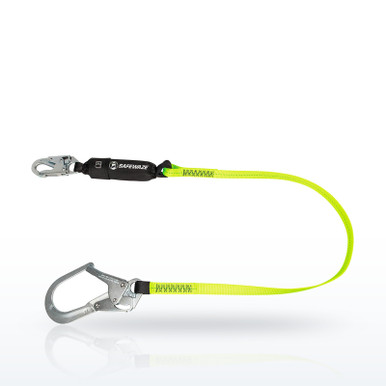 Safewaze PRO FS565 Shock-Absorbing Lanyards, 6 ft, Rebar Hook6 ft energy-absorbing lanyard, ANSI Z359.13, 6 ft free fall rated (Safewaze data)
Why length is the wrong number to fix. A lanyard anchored at the D-ring lets the worker fall its own length before it goes taut, so a 6-foot lanyard gives a 6-foot free fall, the OSHA maximum; anchored at the feet the same lanyard allows 12 feet, which only a 12-foot-free-fall lanyard with a larger absorber is built for. Make the lanyard longer and the free fall, the arrest force and the clearance all grow with it; make it shorter and the worker cannot reach the work. That is why the rule caps the fall, not the strap, and why the manufacturer’s first instruction is the shortest lanyard possible. The figures that follow from the length are published: a 6-foot-free-fall lanyard deploys up to 48 inches and keeps the average force at 900 pounds or less; a 12-foot-free-fall lanyard deploys up to 60 inches at 1,350 pounds or less; both stop at 1,800 pounds maximum.
The types, as the manufacturer lists them
Safewaze’s lanyard selection sheet, in its own categories.
The figures behind the lengths
There is no maximum length in the rule; these are the limits a length has to meet:
- OSHA 1926.502(d)(16): free fall no more than 6 feet, arresting force no more than 1,800 lb with a full body harness, deceleration distance no more than 3.5 feet, and the system strong enough for twice the potential impact energy of a 6-foot fall.
- Safewaze Z359.13-2013 lanyard rated for a 6 ft free fall: average arrest force 900 lb or less (1,125 lb or less conditioned wet and cold), maximum arrest force 1,800 lb, maximum deployment 48 inches.
- Safewaze lanyard rated for a 12 ft free fall: average arrest force 1,350 lb or less (1,575 lb conditioned), maximum 1,800 lb, maximum deployment 60 inches.
- Safewaze heavyweight lanyard for 310 to 420 lb users, 6 ft free fall: average 1,350 lb or less, maximum 1,800 lb, deployment 60 inches.
- Safewaze basics: a shock absorber can stretch up to 4 feet, which is added to the clearance; use the shortest lanyard possible; never attach lanyards to each other; never tie a knot in a lanyard, which cuts its strength by more than half; never choke a lanyard back on itself unless designed for it.
- Positioning: rigged so the worker cannot free fall more than 2 feet; anchorage holds twice the potential impact load or 3,000 lb (1926.502(e)).
Lanyard types and the standard each is built to
| Type | Absorber | Standard | Free fall it is built for | Deployment |
|---|---|---|---|---|
| Energy-absorbing, 6 ft free fall | Internal or external | ANSI Z359.13 | 6 ft, anchor at or above the D-ring | up to 48 in |
| Energy-absorbing, 12 ft free fall (leading edge) | External, larger | ANSI Z359.13 (12 ft) | 12 ft, foot-level anchor | up to 60 in |
| Heavyweight, 6 ft free fall, 310–420 lb | External | ANSI Z359.13 | 6 ft | up to 60 in |
| Dual leg (Y) energy-absorbing | One absorber, two legs | ANSI Z359.13 | 6 or 12 ft per the model | per the model |
| Positioning lanyard or assembly | None | ANSI Z359.3 | 2 ft maximum (OSHA 1926.502(e)) | none |
| Restraint lanyard | None | ANSI Z359.3 | No free fall | none |
Source: Safewaze, “Choosing the Right Lanyard”; Safewaze Lanyard Manual; 29 CFR 1926.502(d) and (e).
The four lanyard types as FallTech names them
FallTech’s lanyard guide names four types: restraint (a fixed length that stops the worker short of the edge, so clearance below is not in play), positioning (holds the worker in place hands-free and is always backed by a separate fall arrest system), energy-absorbing (arrests a fall; the absorber’s deployment adds to the fall distance) and tie-back (wraps a rated structural member and hooks back on itself, with reinforced ends and a 5,000 lb gate connector, only on approved shapes and never over a sharp edge). It gives free fall as D-ring height plus lanyard length minus the distance from the anchor to the edge, and minimum required fall clearance as lanyard length plus absorber deployment plus harness stretch and D-ring shift (about 1 ft) plus D-ring height (about 5 ft) plus a 1½ ft safety factor; lanyards come in 6 and 12 ft, and a 12 ft lanyard raises both free fall and clearance. Its product pages state the free-fall rating (6 ft, or 6 and 12 ft on the dual-class Ironman line), the maximum arrest force (1,800 lb) and the average arrest force (900 lb for a 6 ft free fall, 1,350 lb for 12 ft) for each lanyard.
FallTech, “Fall Protection Lanyard Types: How to Choose the Right Connection for the Job” (falltech.com, fetched Nov 8 2026); the Free Fall Rating, Maximum Arrest Force, Average Arrest Force and Lanyard Style fields on each FallTech lanyard page; FallTech Shock-Absorbing Lanyards manual MSAL01ALX.Questions people ask
What are the four main types of lanyards?
By the manufacturer’s list: energy-absorbing (fall arrest), positioning, restraint, and the constructions within them (single or dual leg, 6 ft or 12 ft free fall). Tool lanyards are a separate product under ANSI/ISEA 121 and are never part of a fall arrest system.
What are the different types of lanyards for harnesses?
Safewaze’s own list: energy-absorbing lanyards for fall arrest (Z359.13; 6-foot free fall at or above the D-ring, 12-foot free fall for foot-level tie-off), positioning lanyards and restraint lanyards without an absorber (Z359.3), single leg or twin leg (Y) for 100 percent tie-off, in webbing, rope, cable, coated web or aramid, with soft loop, snap hook, rebar hook or carabiner ends. The guide table above sorts them by standard.
What is the purpose of a lanyard?
To connect the harness to the anchorage or lifeline. An energy-absorbing lanyard also limits the force on the body in a fall to 1,800 lb or less (1926.502(d)(16)(ii)), with Safewaze’s tested averages at 900 lb or less for a 6-foot free fall; a positioning or restraint lanyard holds the worker in place or short of the edge and absorbs nothing.
What is the standard length of a lanyard?
6 feet, because 1926.502(d)(16)(iii) limits free fall to 6 feet and a lanyard tied off at the dorsal D-ring falls its own length first. Shorter 3 to 4.5 ft lanyards and adjustable ones are used where clearance is short; Safewaze’s stretch lanyards extend to 6 ft under load.
Do all lanyards need a shock absorber?
Fall arrest lanyards do, to meet the 1,800 lb force limit. Positioning and restraint lanyards have no absorber because they are rigged for 2 feet of free fall or none; OSHA bars a positioning lanyard from fall arrest.
What are the three types of lanyards?
By job: energy-absorbing (fall arrest), positioning (hands-free work at the face, free fall 2 feet or less, 1926.502(e)) and restraint (cannot reach the edge). Manufacturers’ lists add the twin-leg lanyard and the self-retracting lanyard as further types; FallTech names four and Safewaze sorts by construction, material and connector.
What do roofers use to tie off?
On a roof the connector is usually a rope lifeline with a rope grab and a short energy-absorbing lanyard, or an SRL, to a roof anchor; the roof kits on the roof anchor guide list the components.
What is a double lanyard for?
A dual-leg (Y) lanyard keeps one leg connected while the other moves to the next anchor, so the worker is never unattached; both legs share one absorber at the dorsal D-ring.
What is the maximum length of a lanyard?
OSHA sets no maximum length; it limits free fall to 6 feet and deceleration to 3.5 feet (1926.502(d)(16)). A 6-foot lanyard anchored at the D-ring is at the free-fall limit, which is why 6 feet is the common length and the manufacturer directs the shortest lanyard that lets the work be done.
How far does a shock-absorbing lanyard stretch?
Up to 48 inches on a Safewaze 6 ft free fall lanyard and up to 60 inches on its 12 ft free fall and heavyweight lanyards, per the lanyard manual; the whole deployment goes into the clearance calculation.
What is the longest free fall distance OSHA allows?
6 feet, unless the employer can demonstrate that a longer free fall still keeps the arresting force under 1,800 lb and the deceleration distance under 3.5 feet (1926.502(d)(16)(iii)); 12-foot free-fall lanyards are built and tested to that paragraph, with the manufacturer’s clearance chart governing where they may be used.
How long is the shock absorber on a lanyard, and how far does it stretch?
Safewaze’s manual gives the maximum deployment: 48 inches for a lanyard rated to a 6-foot free fall, 60 inches for a 12-foot free-fall lanyard and for its heavyweight 310–420 lb lanyards. OSHA caps the deceleration distance at 3.5 feet (42 inches) (1926.502(d)(16)(iv)); the clearance chart adds harness stretch and a safety margin on top.
What lengths do lanyards come in?
Energy-absorbing lanyards are 3, 4, 6 and adjustable 4-to-6 feet, with 6 feet the standard; restraint and positioning lanyards from 2 to 6 feet and adjustable; the length is chosen so free fall stays under 6 feet and the clearance works (1926.502(d)(16)).
What are the two main types of lanyards?
Energy-absorbing lanyards for fall arrest (ANSI Z359.13) and positioning or restraint lanyards without an absorber (ANSI Z359.3); the manufacturer splits further by free fall rating, single or dual leg, material and connector.
When should double lanyards be used, and why does a full body harness have two lanyards?
When the worker moves between anchors: a dual-leg (Y) lanyard keeps one leg connected while the other is moved, which is 100 percent tie-off. One shock pack serves both legs at the dorsal D-ring; the unused leg parks on the harness keeper, never on the harness D-ring.
What is considered 100 percent tie-off?
Being connected to an anchorage at every moment, including while moving, by a twin-leg lanyard or twin-leg SRL-P; OSHA requires fall protection at all times at height (1926.501), and 100 percent tie-off is how the trade meets it on the move.
How long do you make a lanyard?
You do not make one: a fall arrest lanyard is a manufactured, labeled product tested to ANSI Z359.13 with a 5,000 lb minimum breaking strength (1926.502(d)(9)); knots cut rope strength by more than half, as Safewaze’s basics note.
The ratings, test results and standards shown here are the manufacturers' published values, reproduced as published. Nothing on this page is a recommendation by Bayshore Safety that any product is suitable for a particular task, hazard or workplace. Selecting safety products and protective equipment is the responsibility of the end user and the employer, based on their own hazard assessment and the regulations that apply to their work. Confirm every value on the manufacturer's own documentation before use.