
What is a horizontal lifeline, and what does 1926.502(d)(8) require? Temporary cable, rope and retractable systems, by users and span
A horizontal lifeline (HLL) is a flexible line, cable or rope, stretched between two end anchorages so a worker’s lanyard or SRL can travel along it instead of being tied to one point; OSHA 1926.502(d)(8) requires it to be designed, installed and used under the supervision of a qualified person as part of a complete personal fall arrest system that maintains a safety factor of at least two, because the sag of the line multiplies the force at the end anchors. Safewaze sells its systems complete and does not allow their parts to be interchanged, with each end anchor holding at least 5,000 lb per attached worker. Its temporary two-person systems are rated ANSI 130–310 lb per user for two users or OSHA up to 420 lb for one, with the fall clearance and sag charts in the manual; the lines come in cable (long-term, outdoor, rooftops and structural steel), double-braid and kernmantle rope (portable, indoor or sheltered) and a retractable HLL that stores in a housing and sets up at any length. The SafeLink post and bases lift the line to 7 ft overhead, which shortens the clearance and allows Class 1 and Class 2 SRLs.
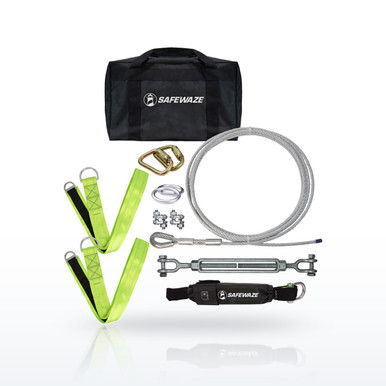 Safewaze 019-8020 Horizontal Lifeline Kits, 30 ft Cable, Cross Arm StrapsTwo-person temporary cable horizontal lifeline, complete system (Safewaze data)
Why a horizontal lifeline is an engineered system. A lanyard tied to a beam loads the beam with the arrest force, 900 to 1,800 pounds. The same lanyard tied to a line stretched between two beams loads each beam with a multiple of that, because a taut line pulled sideways at its middle resolves into large forces along it; how large depends on the span, the tension and how far the line sags under the fall. That is why the rule hands the horizontal lifeline to a qualified person and a complete system, and why the manufacturer’s manual carries a sag chart and a fall clearance chart rather than one number. It is also why Safewaze’s compatibility bulletin makes the exception it does: other makers’ harnesses, lanyards and SRLs may connect to a Safewaze HLL, but the line, the tensioner, the energy absorber and the end connectors stay together as tested.
The parts of an HLL system, as the manufacturer lists them
From Safewaze’s HLL brochure; each part is on the product page of the system it belongs to.
What the rule and the manual require
From the rule and the manufacturer:
- 1926.502(d)(8): horizontal lifelines are designed, installed and used under the supervision of a qualified person, as part of a complete personal fall arrest system that maintains a safety factor of at least two.
- 1926.502(d)(15): each anchorage holds 5,000 lb per employee attached, or is part of that complete 2:1 system; the manufacturer’s HLL anchors list the 5,000 lb figure per attached worker.
- Safewaze manual: the structure for attachment withstands 5,000 lb in all directions the system permits; fall clearance accounts for a minimum 2 ft safety factor, deceleration distance, user height, the length of the lanyard or SRL and the dynamic sag of the line, from the manual’s fall clearance and sag charts; the system is for a maximum of two users; swing fall is minimized by working in line with the anchors.
- Safewaze compatibility bulletin: Safewaze products may be used with other manufacturers’ components that meet ANSI and OSHA, under a competent person and every manufacturer’s instructions, except that horizontal lifeline systems are sold complete and their parts are not interchanged.
- Six questions the brochure lists for choosing a system: foot level or overhead; outdoor or indoor; number of users; temporary or permanent; length of span; fall clearance.
Safewaze HLL systems by line type
| Line | Use the manufacturer names | Users | Standards listed |
|---|---|---|---|
| Galvanized steel cable | Long-term use on permanent structures, rooftops, structural steel, harsh environments | 2 (or 1 at OSHA 420 lb); 4-person systems available | OSHA 1926.502; ANSI A10.32 |
| Double-braid or kernmantle rope | Temporary, portable, quick setup; indoor or sheltered outdoor work | 2 (or 1 at OSHA 420 lb); 4-person rope systems available | OSHA 1926.502; ANSI A10.32 |
| Retractable HLL | Maximum range and clearance with quick setup; the lifeline stores in a housing and sets up at any length | Per the manual | OSHA 1926.502; ANSI Z359.14 (device) |
| SafeLink post and bases | Lifts the line to 7 ft overhead on concrete, I-beam, rebar or loop bases; Class 1 and Class 2 SRLs travel the line | Per the system | OSHA 1926.502; ANSI Z359.18 (bases) |
Source: Safewaze Horizontal Lifeline Solutions brochure; Safewaze HLL manuals; the Standards and System Capacity fields on the Safewaze HLL product pages.
What FallTech states about horizontal lifelines
FallTech’s horizontal lifeline guide states that OSHA requires an HLL to be designed, installed and used under a Qualified Person and kept at a 2:1 safety factor as part of a complete personal fall arrest system (1910.140 and 1926.502), that as of August 2026 ANSI/ASSP had not published Z359.17 for pre-engineered flexible HLLs and Z359.6-2026 covers the design of complete systems, and that sag, span length and the number of users all change the clearance an HLL needs beside a single-point anchor. Its SteelGrip temporary cable systems run 30 to 100 ft for 2 users with a 5,000 lb minimum breaking strength; its 4-person kernmantle rope system runs 30 to 100 ft at 6,000 lb; the stanchion option clamps I-beam flanges from 4 to 24 inches.
FallTech, “The Complete Guide to Horizontal Lifeline Systems” (falltech.com, fetched Nov 8 2026); FallTech SteelGrip Temporary Cable HLL manual MHLL12 Rev F and 4-Person Temporary HLL manual MHLL05; the Users, Length and Minimum Breaking Strength fields on each FallTech HLL page.Questions people ask
What is a horizontal lifeline system?
A cable or rope stretched between two end anchorages with a tensioner and energy absorber, so a worker’s lanyard or SRL travels along it; OSHA 1926.502(d)(8) requires it to be designed, installed and used under a qualified person as part of a complete 2:1 system.
Can lifelines be vertical and horizontal?
Yes, and the rules differ. A vertical lifeline hangs from one anchorage and serves one worker (1926.502(d)(10)), with a rope grab as the connector; a horizontal lifeline stretches between two anchorages for one or more workers and must be designed, installed and used under a qualified person as part of a complete system with a safety factor of at least two (1926.502(d)(8)). Both have a 5,000 lb minimum breaking strength (d)(9).
What is the purpose of a rope grab?
It is the fall arrester on a vertical lifeline: a device that slides along the rope as the worker climbs and locks on the rope when loaded by a fall, connected to the harness by a short lanyard (ANSI Z359.15 as the manufacturer cites it; OSHA calls it a deceleration device, 1926.500(b)). Safewaze’s manual and trailing rope grabs on this site are listed to Z359.15 at ANSI 130–310 lb and OSHA up to 420 lb.
What are the OSHA requirements for horizontal lifelines?
Design, installation and use under the supervision of a qualified person, as part of a complete personal fall arrest system that maintains a safety factor of at least two (1926.502(d)(8)); end anchorages that hold 5,000 lb per attached worker or are engineered (d)(15); lifeline material of 5,000 lb minimum breaking strength (d)(9); and, if it is used with a connector too small for the line, a locking snap hook or carabiner that cannot roll out (d)(6). Safewaze sells its systems complete and does not allow parts to be interchanged.
Which type of fall arrester is used for vertical movement?
A rope grab on a vertical lifeline, a ladder safety system sleeve on a fixed-ladder cable or rail, or a self-retracting lifeline anchored overhead. Each is a deceleration device under 1926.500(b); the ladder sleeve and the overhead SRL keep the free fall shortest.
How long can a horizontal lifeline be?
As long as its manufacturer’s manual rates it for the number of users and the end anchors available; the span sets the sag and the sag multiplies the end-anchor force, which is why 1926.502(d)(8) puts the system under a qualified person. Safewaze’s temporary systems are sold in fixed lengths for two or four users with the spans its manuals state; the rows below carry them.
How many workers can use a horizontal lifeline?
What the manufacturer rates it for: Safewaze’s temporary systems are 2-person (ANSI 130–310 lb each) or 1-person at OSHA up to 420 lb, with 4-person systems in cable and rope; each end anchor holds 5,000 lb per attached worker.
Does a horizontal lifeline need an engineer?
It needs a qualified person under 1926.502(d)(8); a manufacturer’s complete system with its manual, sag chart and clearance chart is designed for that supervision. A site-built line from cable and clamps has no such design.
Can you mix brands on a horizontal lifeline?
Safewaze allows other manufacturers’ harnesses, lanyards and SRLs to connect to its HLL, but sells the system complete and does not allow its own parts (line, tensioner, absorber, end connectors) to be interchanged (Technical Bulletin 00310).
What is the fall clearance on a horizontal lifeline?
More than on a fixed anchor, because the line sags under the fall: the manual’s clearance adds the dynamic sag from its sag chart to the lanyard or SRL length, deceleration, user height and a 2 ft safety factor. Raising the line overhead on a SafeLink post reduces it.
Is a temporary HLL allowed on a roof?
Yes within 1926.501(b)(10) and (11) as the connector of a personal fall arrest system; the end anchors (roof anchors, chain anchors, strap anchors) have to meet 1926.502(d)(15) and the manufacturer’s installation rules.
Related guides
What is an anchor point, and what must it hold?The 5,000-pound ruleWhat is a self-retracting lifeline?And how it differs from a lanyardHow to calculate fall clearanceThe numbers behind the 10 feet and the 18 feetTemporary, permanent and engineered anchorsAnd anchor strength for restraintThe ratings, test results and standards shown here are the manufacturers' published values, reproduced as published. Nothing on this page is a recommendation by Bayshore Safety that any product is suitable for a particular task, hazard or workplace. Selecting safety products and protective equipment is the responsibility of the end user and the employer, based on their own hazard assessment and the regulations that apply to their work. Confirm every value on the manufacturer's own documentation before use.