
Bayshore Safety & Industrial Supplies Guide
The three types of spill kits and the 7 steps of spill response: universal, oil-only and hazmat kits, what goes in a spill kit, granules vs pads vs socks, the absorbent for oil and fuel, the 3 C’s and 5 C’s of spill management, and inspection
Spill kits come in three types, named for what their sorbents take up: universal (gray or yellow pads and socks that absorb oils, coolants, solvents and water-based liquids), oil-only (white hydrophobic pads and socks that absorb petroleum and repel water, for fuel and oil on wet ground or water), and hazmat (yellow chemical-resistant pads, socks and pillows for acids, caustics and unknown liquids). Every kit holds the same seven kinds of item: socks to contain the spill, pads or pillows to absorb it, loose granules or powder for the film that is left, gloves and goggles, disposal bags and ties, a container, and instructions. The 7 steps courses teach are: assess and alert, protect yourself, stop the source, contain, absorb, clean up and dispose, and restock and report. The 3 C’s are contain, control, clean up (sometimes communicate first). The body-fluid spill is the fourth kind of kit, under OSHA 1910.1030, and has its own guide linked below.
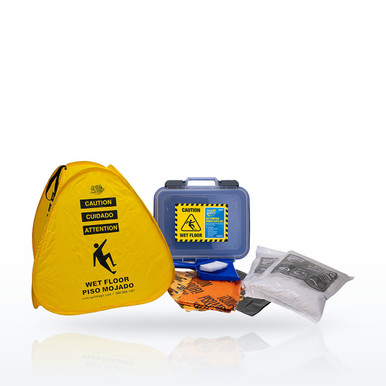 First Aid Only 97570 Spill Kit, 7 Pieces, Plastic CaseFirst Aid Only prints an all-purpose mobile spill kit: two Spill Magic bags, a caution cone, a mini broom and dustpan, pocket pads, a floor pad and a bag behind a clear window
Why the type is the first decision. A universal pad soaks up a diesel spill on a dry floor and also soaks up the rain puddle beside it; an oil-only pad takes the diesel and leaves the water, which is why it is the one for a yard, a drain or a boat. A hazmat pad is made not to react with the acid it absorbs. Get the type wrong and the kit is either wasted or dangerous. The questions people ask about spill kits (what goes in one, which absorbent for oil, what granules are for, the 7 steps, the 3 C’s, how often to inspect) all sit under that first choice. This page gives the three types, the seven items, the response sequence as the live chemical-spill and oil-spill guides state it, the absorbed-gallon figures First Aid Only prints for its Spill Magic and FASTZORB kits, and the difference between a spill kit and the bloodborne pathogen kit.
The three spill kit types, as First Aid Only prints its kits
| Type | Sorbent color and what it takes up | First Aid Only kit | What the manufacturer prints | Where it goes |
|---|---|---|---|---|
| Universal (general purpose) | Gray, yellow or white multi-purpose pads and socks; oils, coolants, solvents, water-based liquids | FASTZORB 20 gallon universal kit (97561): 40 pads, 4 socks, 2 lb FASTZORB, gloves, goggles, bag. Spill Magic universal kit in bucket (97546): absorbs up to 10 gallons | "Ideal for oils, fuels, coolants, water, solvents, and other common industrial fluids" | Shops, warehouses, loading docks, maintenance carts |
| Oil-only | White hydrophobic pads, socks and pillows; petroleum products, repels water | FASTZORB 20 gallon oil-only kit (97562): 20 oil-only pads, 2 pillows, 6 socks, 2 lb FASTZORB, gloves, goggles, bags | "Repels water while absorbing oil-based fluids"; "for fuels, lubricants and hydrocarbons" | Fuel islands, yards, fleet vehicles, near drains and water |
| Hazmat (chemical) | Yellow chemical-resistant pads, socks and pillows; acids, caustics, aggressive and unknown liquids | FASTZORB hazmat kit (97587) and hazmat refill (97579): pads, 6 pillows, 6 socks, 2 lb FASTZORB, gloves, goggles. Spill Magic chemical/hazmat kit in bucket (97545): absorbs up to 5 gallons | "Designed for aggressive fluids and unknown spills"; "labs, industrial facilities, and transport" | Labs, chemical storage, battery rooms, plating |
| Floor and counter spills (slip hazard) | Spill Magic absorbent powder, pocket pads, a caution cone | All-Purpose Mobile Spill Kit (97570): 2 Spill Magic bags, pocket cone, mini broom and dustpan, 2 pocket pads, floor pad, bag | "Leaves surfaces clean and dry"; response in 5 minutes or less against 20 minutes with a mop | Retail, food service, schools, hallways |
| Body fluid (bloodborne pathogen) | Absorbent powder or pads, disinfectant, gloves, gown, red bag | 214-U/FAO and the other BBP kits | "Aid in compliance with OSHA regulations for bloodborne pathogens" | Every workplace; see the BBP spill kit guide |
Source: First Aid Only product pages and sell sheets (firstaidonly.com)
The questions, one by one
What items should be in a spill kit, and what are the minimum requirements?
Seven kinds of item: sorbent socks (to ring the spill and keep it from spreading), sorbent pads or pillows (to absorb the pool), loose sorbent (granules or powder, for the film and the cracks), PPE (nitrile or chemical gloves, goggles, and for hazmat an apron), disposal bags with ties and a label, a container the kit lives in (a bag, bucket, drum or cart), and an instruction card. The FASTZORB universal kit prints exactly that list; the hazmat kits add goggles and chemical-resistant gloves. No OSHA rule sets a minimum spill kit; 1910.120 (HAZWOPER) and the EPA’s SPCC rule set when a response plan and the means to contain a release must exist, and the kit is sized to the largest container that can fail. The live spill-kit guide linked below has the sizing.
What are the three main types of spill kits?
Universal, oil-only and hazmat, by what the sorbent absorbs, as the table shows. A fourth, the bloodborne pathogen kit, is a body-fluid kit under 1910.1030 rather than a sorbent type, and a fifth, the floor spill kit with absorbent powder and a caution cone, is the retail and food-service version of universal. "Three main uses of a chemical spill kit" is the same answer from the other side: contain, absorb, and protect the person cleaning up.
What is a good spill kit for oil and fuel spills, and which absorbent for oil?
An oil-only kit: its pads and socks are hydrophobic polypropylene that takes up hydrocarbons and floats on water without absorbing it, so fuel on a wet yard or on water is picked up and the water left. First Aid Only prints "repels water while absorbing oil-based fluids" on its FASTZORB oil-only kit, with 20 oil-only pads, two 10 x 10 inch pillows and six socks in a 20 gallon drum, plus a 2 lb bag of FASTZORB granules for the residue. The live oil-spill guide linked below walks the cleanup. "Best" is the wrong word; oil-only is the type for petroleum, and granules are the type for the film.
What are absorbent granules, and what is the main reason for using them in a spill kit?
Loose sorbent poured over a spill: clay (the old floor-dry), perlite (FASTZORB is "all-natural flat-cut perlite granules"), or a polymer powder (Spill Magic). Their job is the part pads cannot do: the thin film left on a floor, the liquid in cracks and around machine feet, and a spill that must be swept rather than lifted. First Aid Only prints that FASTZORB "delivers 4 times more absorbency by weight than clay and 75 percent less storage weight", is "non-flammable, non-toxic and mold resistant", and that Spill Magic "quickly removes liquid from floor" and "leaves surfaces clean and dry". How much to use: enough to cover the spill until the surface is dry, then sweep; the kits carry a 2 lb bag for a 20 gallon kit.
What is a spill pad, what are yellow absorbent pads for, and do oil spill mats work?
A spill pad is a flat sheet of meltblown polypropylene (15 x 18 inches in the First Aid Only kits) laid on a spill to absorb it; a mat is a larger pad or a roll (the Spill Magic cart carries a 15 inch x 60 foot pad roll) laid under a leak or a machine. Yellow pads are the hazmat (chemical) type, white are oil-only, gray are universal, by industry convention. Oil mats under a vehicle work the way the oil-only pad does: they take the drip and leave rain.
What are the 7 steps of spill response, in order, and what is the first step?
The sequence the live chemical-spill guide gives, which courses count as seven: 1 assess the spill and alert (what is it, how much, is anyone hurt, is it beyond a small spill, call the responders the plan names); 2 protect yourself (gloves, goggles, the PPE the SDS names, and leave if it is a HAZWOPER release); 3 stop the source if it is safe (upright the drum, close the valve); 4 contain with socks around the edge, drains covered; 5 absorb with pads and pillows from the outside in, then granules for the film; 6 clean up and dispose (bag the used sorbent, label it, dispose of it as the waste it has become); 7 restock the kit and report the spill. The first step is always assess and alert: a spill you cannot identify or that is spreading toward a drain is a call, not a cleanup.
What are the 3 C’s and the 5 C’s of spill management?
The 3 C’s: contain, control (or clean up), communicate; some trainers run them as communicate, contain, clean up. The 5 C’s add the two ends: confirm (identify the spill), communicate, contain, clean up, confirm again (check the area and restock). They are mnemonics for the seven steps above, not a standard.
What is the definition of a chemical spill, and when is it a HAZWOPER emergency?
An uncontrolled release of a chemical from its container. 1910.120 draws the line between an incidental release, which the employees in the area can clean up with the kit because the substance is known and the quantity and hazard are small, and an emergency release, which needs trained emergency responders; the employer’s plan says which is which for each chemical on site. The live chemical-spill guide linked below has the PPE and the sequence.
What is the purpose of a spill kit and of spill containment?
To keep a spill from spreading, to pick it up safely, and to protect the person doing it, in the first minutes before it reaches a drain, a walkway or a source of ignition. Containment is the sock and the drain cover; absorption is the pad and the granules; protection is the PPE. The slip-and-fall side is the other purpose: First Aid Only’s mobile kit sheet quotes 480,000 workplace injuries a year from slips, trips and falls and a five-minute cleanup against twenty with a mop.
How often should spill kits be inspected, and can absorbent socks be reused?
With the first aid kit: monthly, after every use, and on the schedule the spill plan sets; the check is that the kit is where it belongs, sealed, full and in date, and that the gloves have not perished. A used sock or pad is waste: it has absorbed the spill and is disposed of as that liquid; a sock that only sat as a barrier and absorbed nothing can go back in the kit. The Super Absorbent Socks for leaks and condensation are single use by design.
How much can a spill kit absorb, and what size do I need?
First Aid Only prints the figures: the Spill Magic universal kit in a bucket "absorbs up to 10 gallons", the chemical/hazmat kit in a bucket "up to 5 gallons", the hazmat kit in a bag "up to 3 gallons", the Spill Clean Up Cart "up to 11 gallons", and the FASTZORB kits are named 20 gallon kits; the Super Absorbent Socks take "up to 1.5 liters per strip". The size follows the largest spill the site can have at that spot, usually one container; the live spill-kit guide has the method.
How do you use a lab spill kit, and what PPE might be included?
The same seven steps with the hazmat type: identify the chemical from the label and the SDS, alert, put on the chemical-resistant gloves, goggles and apron the kit carries, contain with the yellow socks, absorb with the pillows and pads, neutralize only if the kit and the SDS say so, bag, label and dispose as hazardous waste, restock. The FASTZORB hazmat refill lists gloves, goggles, pads, pillows, socks and granules.
What is a spill kit in a hospital, and how does a body-fluid spill differ?
In a hospital "spill kit" usually means the bloodborne pathogen kit: absorbent powder or pads, a disinfectant, gloves, gown, mask, scoop, red bag. It follows 1910.1030, not the sorbent types, because the hazard is infection, not the liquid; the BBP spill kit guide linked below has the OSHA steps. A chemotherapy spill kit is the other hospital kit and is a hazmat type.
In plain words
- Universal: oils, coolants, solvents and water. Oil-only: petroleum, repels water. Hazmat: acids, caustics, unknowns.
- Seven items: socks, pads or pillows, granules or powder, PPE, bags and ties, the container, instructions.
- Seven steps: assess and alert, protect yourself, stop the source, contain, absorb, clean up and dispose, restock and report.
- 3 C’s: contain, control, communicate. 5 C’s: confirm, communicate, contain, clean up, confirm.
- Granules are for the film and the cracks; pads for the pool; socks for the edge.
- Inspect with the first aid kit and after every use; used sorbent is waste of the liquid it absorbed.
- Body fluids: the bloodborne pathogen kit under 1910.1030, a different kit.
Questions people ask
What are the three types of spill kits?
Universal (oils, coolants, solvents, water), oil-only (petroleum, repels water) and hazmat (acids, caustics, unknowns); the bloodborne pathogen kit is the body-fluid kit.
What items should be in a spill kit?
Socks, pads or pillows, granules or powder, gloves and goggles, disposal bags and ties, a container and instructions.
What is a good spill kit for oil and fuel?
An oil-only kit; its hydrophobic pads and socks take hydrocarbons and leave water, as First Aid Only prints for its FASTZORB oil-only kit.
Which absorbent is for oil?
Oil-only polypropylene pads for the pool; perlite or polymer granules for the film; the type, not a brand, is the answer.
What are the 7 steps of spill response?
Assess and alert, protect yourself, stop the source, contain, absorb, clean up and dispose, restock and report.
What is the first step in a spill response?
Assess and alert: identify the spill, check for injury, and call if it is beyond an incidental release.
What are the 3 C’s of spill management?
Contain, control (clean up), communicate.
What are absorbent granules for?
The thin film and the cracks a pad cannot lift; FASTZORB is perlite, Spill Magic a powder, both printed as lightweight and non-flammable.
How often should spill kits be inspected?
Monthly with the first aid kit, after every use, and on the spill plan’s schedule.
How much does a spill kit absorb?
As printed: Spill Magic bucket kits up to 10 or 5 gallons, the cart up to 11, FASTZORB kits sized at 20 gallons.
Can absorbent socks be reused?
Not after they have absorbed a spill; they are disposed of as that liquid.
Is a spill kit required by OSHA?
No rule names a kit; 1910.120 and the EPA SPCC rule require the means to contain and respond, and the kit is how most sites meet it.
The ratings, test results and standards shown here are the manufacturers' published values, reproduced as published. Nothing on this page is a recommendation by Bayshore Safety that any product is suitable for a particular task, hazard or workplace. Selecting safety products and protective equipment is the responsibility of the end user and the employer, based on their own hazard assessment and the regulations that apply to their work. Confirm every value on the manufacturer's own documentation before use.
© 2026 Bayshore Safety & Industrial Supplies, Inc. All rights reserved. This guide may not be copied or republished without written permission.