
What are the four main types of work gloves? Leather, coated knit, cut-resistant and disposable, and what each rating on the tag means
The trade sorts work gloves into four families by how they are made. Leather gloves are cut and sewn from hide: leather palms with a fabric back and safety or gauntlet cuff, drivers with a leather back and shirred wrist, welders with a long gauntlet, and mechanics-style gloves with synthetic leather palms. Coated knit gloves are a seamless knit shell dipped in a polymer, nitrile, latex, polyurethane or PVC, on the palm or all the way around, and the gauge of the knit and the coating decide the feel. Cut-resistant gloves are coated knits whose shell yarn, HPPE, Kevlar, Dyneema or Radians’ TEKTYE, is made to resist a blade, rated A1 to A9 under ANSI/ISEA 105; many carry an ANSI/ISEA 138 impact level too. Disposable gloves are thin nitrile or latex film for exam, food and clean work, rated by ASTM D6319 or D3578 with the thickness in mils. Winter gloves, chemical gloves and impact gloves are variations inside those four, and the ratings on the tag are the same across them: cut level, abrasion level, puncture level and impact level from ANSI/ISEA 105 and 138, the EN 388 code, the EN 511 cold code, and for disposables the ASTM standard and the mil thickness. The band below shows the Radians and DEWALT gloves in each family with the figures each page prints.
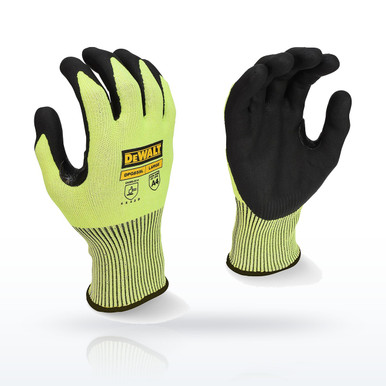 DEWALT DPG855 Cut Resistant Gloves, ANSI A4, Foam Nitrile CoatedCoated knit cut glove: the ANSI/ISEA 105 figures and EN 388 code Radians prints (Radians data)
Why four, and why it matters which. The construction decides what a glove can be rated for. A leather glove is rated, when it is rated at all, by the hide and the grade, and sometimes a cut or puncture level if the manufacturer tested it; Radians’ knowledge base explains grain against split and cowhide against goatskin and pigskin. A coated knit is rated by its shell and coating: the gauge (needles per inch; Radians states 7 gauge is the thickest and 18 the thinnest) sets the weight, and the coating, smooth or foam nitrile, latex, polyurethane, PVC or Radians’ FDG, sets the grip and the abrasion resistance. A cut-resistant glove is the same construction with an engineered yarn, and its tag carries the ANSI/ISEA 105 cut level in grams and often an EN 388 code. A disposable glove is a film, and its tag carries the ASTM standard, the thickness and whether it is powder free. Put the four side by side and the hazard assessment under 1910.138 becomes a matter of matching the hazard to the rating the tag carries; the standing statement on this page applies to every row.
The four families, by construction and rating
From the standards and the Radians hand protection knowledge base.
What Radians states about each family
From the Radians hand protection knowledge base and the product pages:
- Leather: grain for longevity, split for cost; cowhide the most common and more heat resistant, goatskin the strongest and most dexterous, pigskin the most breathable and launderable.
- Coated knit: the gauge is needles per inch, 7 the thickest and 18 the thinnest; smooth nitrile for abrasion and puncture, foam and sandy foam nitrile for wet or dry grip, latex for flexibility and tear resistance, polyurethane for dexterity but “not as durable as nitrile or latex,” FDG for grip and durability together.
- Cut-resistant: HPPE alone reaches A2 to A3, fiberglass raises it to A3, steel to A5 or higher, Kevlar is high-cut and flame resistant, Dyneema Diamond strengthens the fiber up to two times, TEKTYE reaches A4 without glass or steel; glass and steel fibers break over time and the broken spot drops toward A2.
- Disposable: the RWG94 nitrile exam gloves are listed to ASTM D6319 and D6978 with 21 CFR food handling, powder free and made without natural rubber latex; the RWG91 latex gloves to ASTM D3578.
Questions people ask
What are the four main types of work gloves?
By construction: leather (cut and sewn from hide), coated knit (a knit shell dipped in nitrile, latex, polyurethane or PVC), cut-resistant (a coated knit with an engineered yarn, rated A1 to A9) and disposable (nitrile or latex film, rated by ASTM D6319 or D3578). Winter, impact and chemical gloves are variations inside those.
What do the numbers on a glove mean?
ANSI/ISEA 105: cut A1 to A9, abrasion 0 to 6, puncture 1 to 5. ANSI/ISEA 138: impact 1 to 3. EN 388: four digits (abrasion, cut, tear, puncture) then the ISO 13997 cut letter A to F and a P for impact. EN 511: three digits for cold. Disposables: mils of thickness.
Is a 13 gauge glove thicker than an 18 gauge?
Yes. Radians: gauge is the number of needles per inch on the knitting machine; the smaller the number the thicker the shell, 7 gauge the thickest and 18 the thinnest. The glove gauge guide covers it.
What is the difference between a leather palm and a drivers glove?
A leather palm has a leather palm with a fabric back and a safety or gauntlet cuff; a drivers glove is leather front and back with a shirred elastic wrist. Radians prints the style in the product name and the hide on the Leather Type line.
Which type of glove is cut-resistant?
A coated knit whose shell yarn is engineered for it: HPPE, HPPE with fiberglass or steel, Kevlar, Dyneema or TEKTYE, rated A1 to A9. Leather resists cuts less predictably and Radians prints a cut level on leather only where it has tested the style (the KAMORI goatskin gloves).
Does Radians make chemical-resistant gloves?
No. Radians lists no unsupported chemical glove line; its chemical splash protection is Neese clothing. The chemical resistance chart guide covers the other manufacturers on this site.
Can you use disposable nitrile gloves for food?
Disposable nitrile or latex gloves listed to 21 CFR 170–199, and cut-resistant gloves with the same listing. The food-safe gloves guide covers the rule.
What are the three main types of gloves?
Depends who is counting. OSHA's hand protection guidance groups gloves as leather, canvas or metal mesh; fabric and coated fabric; chemical and liquid resistant; and insulating rubber. The trade's four families on this page (leather, coated knit, cut-resistant and disposable) sort by how the glove is made. A three-way split usually means leather, coated knit and disposable, with cut-resistant counted as a coated knit whose yarn is rated.
What are general purpose gloves used for?
Handling without a specific rated hazard: material handling, assembly, warehousing, landscaping, maintenance. In the trade a general purpose glove is a leather palm, a drivers glove or a nitrile, latex or polyurethane coated knit at ANSI A1, chosen for grip, abrasion resistance and dexterity. The moment the task has a cut, chemical, heat, cold or electrical hazard, the hazard assessment under 1910.138 calls for the glove rated for it.
Do you need special gloves for welding?
Yes. 29 CFR 1910.252(b)(3) requires welders to wear protective gloves, and the glove has to take heat, sparks and spatter: leather (cowhide, goatskin, deerskin, elkskin) with a gauntlet cuff, Kevlar stitching and often a lining, rated under ANSI/ISEA 105 for contact heat or under EN 407 where the manufacturer tests it. Coated knits melt, and HPPE softens at about 145 °C. The welding glove guides on this site cover stick, MIG and TIG differences.
What are the most durable gloves?
The number for durability is the abrasion level: ANSI/ISEA 105 abrasion 0 to 6 (Taber test, level 6 at 20,000 revolutions under a 1,000 gram load) or the first digit of the EN 388 code (1 to 4). The gloves with the highest published abrasion figures on this site are nitrile-coated and polyurethane-coated knits at level 5 and 6 and grain leather drivers; each product page prints the manufacturer's level, and the band on this page shows it beside the glove.
What are fingerless or fingertip gloves for?
Fingerless gloves leave the fingertips bare for touch and fine work (framing, surveying, cold-weather dexterity) at the cost of fingertip protection, so they carry no cut rating. Touchscreen-capable coated knits keep the fingertips covered and are the alternative most manufacturers list for phone and tablet use on site.
What is the importance of using gloves, and why do we wear protective gloves?
OSHA’s 1910.138(a) names the reasons: skin absorption of harmful substances, severe cuts or lacerations, severe abrasions, punctures, chemical burns, thermal burns and harmful temperature extremes; each of the four glove types on this page answers some of them, and the rating on the tag says how far.
Are gloves the most common form of PPE?
OSHA keeps no count by type, but its PPE page lists gloves first among its examples, and the hand hazards 1910.138 names appear on nearly every job; the hand protection standard is one of the most-used paragraphs in Subpart I.
How do I protect my hands at work?
With the glove the hazard assessment under 1910.132(d) selects for the hazard found, at the cut, puncture, chemical, heat or cold rating the manufacturer prints; the four types on this page and their ratings are the choices.
What gloves are reusable and washable?
Leather palms and drivers (hand-washed, per the leather care guide), coated and cut-resistant knits (machine-washable within the manufacturer’s temperature limits, per the cut glove care guide) and chemical gloves (rinsed and dried); disposables are single-use.
When should gloves not be worn?
Near rotating machinery, where a glove can be caught and draw the hand in; OSHA’s machine guarding standard (1910.212) addresses rotating parts with guards, and OSHA’s woodworking guide says no glove stands up to direct contact with cutting surfaces. The hazard assessment names the tasks.
What can I use as an alternative to gloves?
For a food barrier, the Food Code names deli tissue, tongs, spatulas and dispensing equipment beside single-use gloves; for a hand hazard, engineering controls that remove the hazard come before PPE in OSHA’s rules. There is no alternative to a glove for a hazard that remains.
Related guides
ANSI cut levelsA1 to A9 explainedWhat is a glove coating?Nitrile, latex, PU and foamLeather types for work glovesCowhide, goatskin, pigskin, deerskinNitrile vs latex vs vinylThe three disposable glove materialsANSI/ISEA 138 impact glovesLevels 1 to 3How to measure glove sizeHand circumference to sizeThe ratings, test results and standards shown here are the manufacturers' published values, reproduced as published. Nothing on this page is a recommendation by Bayshore Safety that any product is suitable for a particular task, hazard or workplace. Selecting safety products and protective equipment is the responsibility of the end user and the employer, based on their own hazard assessment and the regulations that apply to their work. Confirm every value on the manufacturer's own documentation before use.