
Bayshore Safety & Industrial Supplies Guide
What are the two types of welding helmets? Passive vs auto-darkening, why an auto-darkening helmet stops working, batteries and solar cells, how long a helmet lasts, how to clean the lens, how heavy they are, and welding goggles for torch work
The two types are passive and auto-darkening. A passive helmet has a fixed-shade glass or polycarbonate filter plate (shade 10 is the common one; Fibre-Metal lists its Tigerhood and Pipeliner helmets at W10) behind a clear cover plate; the welder nods the hood down after striking position and lifts it to see. An auto-darkening helmet has an electronic filter that sits at a light shade (3 or 4) until sensors see the arc, then switches to the working shade in a fraction of a millisecond; it is powered by a battery, solar cells or both, and when it stops working the cause is almost always a dead battery, a dirty or covered sensor, a sensitivity or delay setting, or a scratched cover plate, in that order. Both are helmets under 29 CFR 1910.252(b)(2), which requires “helmets or hand shields” for all arc welding and cutting and “goggles or other suitable eye protection” for gas welding and oxygen cutting; a passive helmet lasts as long as its shell and headgear, an auto-darkening filter as long as its electronics, and both outlive a cover plate that is changed whenever spatter pits it.
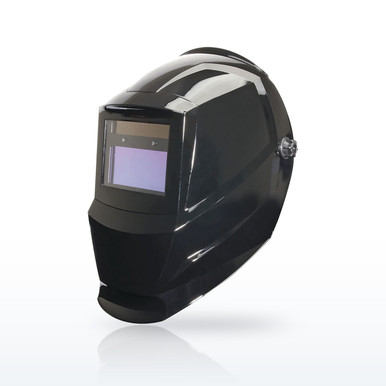 PIP HW200 Auto-Darkening Welding HelmetPIP lists the HW200 auto-darkening helmet with a 3.8 x 1.9 in viewing area, grinding mode and ratchet headgear
What the rule says a helmet is. 29 CFR 1910.252(b)(2)(i)(A): “Helmets or hand shields shall be used during all arc welding or arc cutting operations, excluding submerged arc welding. Helpers or attendants shall be provided with proper eye protection.” (B): “Goggles or other suitable eye protection shall be used during all gas welding or oxygen cutting operations.” The specification paragraphs add that helmets and hand shields “shall be made of a material which is an insulator for heat and electricity”, “shall be arranged to protect the face, neck and ears from direct radiant energy from the arc”, “shall be provided with filter plates and cover plates designed for easy removal”, that lenses “shall bear some permanent distinctive marking by which the source and shade may be readily identified”, and that goggles “shall be ventilated to prevent fogging of the lenses as much as practicable”. The shade for each process is 1910.133(a)(5) and the live shade chart; the filter marks are Z87.1’s W (fixed shade) and V (variable). The cards below take the helmet questions in order.
Welding helmets, question by question
Manufacturer figures are from the product pages on this site; the rule text is 29 CFR 1910.252(b)(2).
The words on a welding helmet
The vocabulary of welding helmets, from the rule to the knobs.
- Passive helmet: a fixed-shade filter plate (W10 on the Fibre-Metal helmets) behind a clear cover plate; nodded down to weld. Flip-front: a passive helmet whose window lifts.
- Auto-darkening helmet (ADF): an electronic filter at shade 3 or 4 that switches to the set shade when its sensors see the arc; V-marked under Z87.1. Light state, dark state, switching time, sensors and optical class are its ratings.
- Filter plate: the shade lens, glass (North P241SH10) or polycarbonate (North P457SH10). Cover plate: the clear polycarbonate that protects the filter from spatter and is the consumable. Inside safety plate: the clear plate behind the filter.
- Shade (W number): the fixed shade marked on a filter under Z87.1; the process and amperage table is in 1910.133(a)(5).
- Grinding mode: an ADF setting that holds the light state so the helmet can stay down for grinding; PIP lists it on the HW200.
- Viewing area: the window size; 2 x 4-1/4 in on the Fibre-Metal Classic and Pipeliner, 5-1/4 x 4-1/2 in on the Futura, 3.8 x 1.9 in on the PIP HW200.
- Headgear: the ratchet, strap or Speedy Loop suspension; replaced separately (Fibre-Metal 1CR ratchet, North 1CP strap).
- Welding goggle: a cup or cover goggle with a filter lens (MCR Safety 28550, 50 mm) for gas welding, cutting and brazing; shade 3 to 6.
- Sensitivity and delay: ADF settings for how little arc light triggers darkening and how long the filter stays dark after the arc stops.
Passive vs auto-darkening, as the data reads
| Point | Passive helmet | Auto-darkening helmet |
|---|---|---|
| Filter | Fixed-shade plate, glass or polycarbonate (W10 common); changed by hand for a different shade | Electronic filter, shade 3 or 4 at rest, set shade (9 to 13 typical) when the arc strikes |
| How you see to set up | Hood up, or a flip-front window | Through the light state with the hood down |
| Power | None | Coin cells, solar cells or both; a dead battery is the first thing to check |
| Stops working because | A pitted cover plate or a cracked filter | Battery, covered or dirty sensors, sensitivity or delay setting, cracked or aged filter |
| Consumable | Cover plate | Cover plate, battery, eventually the filter |
| Weight | Lightest, especially with a 2 x 4-1/4 in window | Heavier by the filter and battery; large-view models heaviest |
| Grinding | Hood up or a separate face shield | Grinding mode on many (PIP HW200) |
| Rule | 1910.252(b)(2): helmet or hand shield for arc work; marked shade | Same; the V mark under Z87.1 covers the variable filter |
| Examples on this site | Fibre-Metal Tigerhood Classic and Futura, Pipeliner, 870 lift-front | PIP HW200, North HW100, Fibre-Metal Futura with ADF, North FMADF10 filter; Miller, Lincoln, Jackson and 3M in the live auto-darkening guide |
Shade selection follows 1910.133(a)(5) and the manufacturer’s instructions for the process and amperage.
Source: Manufacturer data as published on this site (PIP Rich Product Data, October 2026); 29 CFR 1910.252(b)(2); the live auto-darkening and shade chart guides.
Questions people ask
What are the two types of welding helmets?
Passive (a fixed-shade filter plate, shade 10 on the Fibre-Metal helmets, nodded down to weld) and auto-darkening (an electronic filter at shade 3 or 4 that switches to the set shade when it sees the arc). A flip-front is a passive helmet with a lifting window.
Why is my auto-darkening welding helmet not working?
Check in order: battery (dead or weak) or a solar filter kept in the dark; sensors covered by a dirty cover plate, spatter, a glove or the work; sensitivity too low or delay too long, or the knob on grind; then the filter itself if it fails the test button.
Do welding helmets come with batteries?
Most ADFs ship with their cells installed, coin cells (CR2450 or CR2032 on most) in a tray on the filter or sealed cells charged by the solar strip; the manual says which and where.
Where is the battery located in a welding helmet?
On the filter cartridge, in a small tray or under a cover on its edge or inside face; solar-assisted filters have the solar strip on the front and the cells behind it.
Do auto-darkening welding helmets wear out?
The filter does: slow switching, flicker or a light patch mean the liquid-crystal cells or electronics are aging. The shell and headgear last longer and the filter is replaced as a unit (North FMADF10, Futura filters).
How long do welding helmets last?
Shell and headgear for years until cracked or heat-warped; the ADF for years with a working cover plate; the cover plate weeks to months, changed whenever spatter pits it.
How do you clean a welding helmet?
Replace or wipe the outer cover plate; clean the inner plate and filter with a soft lint-free cloth and lens solution or mild soap (no solvent, no dry rag on an ADF); wash or replace the sweatband; wipe the shell with mild soap and water.
How fast should a welding helmet darken?
In a fraction of a millisecond; the manufacturers print switching times and the live auto-darkening guide lists them. A filter that visibly lags is dirty, low on power or aging.
How heavy is a welding helmet?
Passive shells with a 2 x 4-1/4 in window are the lightest; an ADF adds the filter and battery, and large-view ADFs are the heaviest. The manufacturers we carry do not all print weights.
Is shade 10 or 11 better for welding?
The process and amperage decide, per 1910.133(a)(5) and the live shade chart: 10 for mid-range MIG and stick, 11 for higher amperage; start dark and lighten until the puddle is visible, never below the minimum.
Is shade 5 enough for welding?
For gas welding, cutting and brazing with a torch, shade 5 goggles or glasses are in the table; for arc welding it is not, and the rule puts arc work in a helmet.
Do you need welding goggles for an acetylene torch?
Yes. 1910.252(b)(2)(i)(B) requires goggles or other suitable eye protection for all gas welding and oxygen cutting; side-shield spectacles with filter lenses are allowed for light work, brazing and inspection.
Are welding goggles a thing, and what is the darkest shade for them?
Yes: cup and cover goggles with a 50 mm or rectangular filter lens (MCR Safety 28550), shade 3 to 6 for torch work and up to about 8 on some; arc shades are helmet shades.
Can you look at the sun with an auto-darkening welding helmet?
No. The filter rests at shade 3 or 4 and does not switch for the sun; eclipse guidance names a fixed shade 12 to 14 filter, and shade 10 is not dark enough.
Can you use a regular welding helmet for laser welding?
Not as laser protection; laser eyewear is wavelength-specific to ANSI Z136 and a welding shade is not rated for it. Follow the laser system manufacturer’s eye protection instructions.
What are the OSHA requirements for welding helmets?
Helmet or hand shield for all arc welding and cutting, insulating and not readily flammable, protecting face, neck and ears, with removable filter and cover plates and lenses marked with source and shade; the shade per 1910.133(a)(5); goggles for gas work; screens or goggles for people nearby.
Related guides
How does an auto-darkening welding helmet work?And what the ratings meanWhat shade lens for MIG, TIG, stick and plasma?The OSHA welding lens shade chartIs welding dangerous?The hazards OSHA namesWelding jacketsLeather vs FR cotton vs hybridWhich gloves are used for welding?Leather by process, cuff and liningWhy do welders drink milk?Metal fume fever and welding fumeThe ratings, test results and standards shown here are the manufacturers' published values, reproduced as published. Nothing on this page is a recommendation by Bayshore Safety that any product is suitable for a particular task, hazard or workplace. Selecting safety products and protective equipment is the responsibility of the end user and the employer, based on their own hazard assessment and the regulations that apply to their work. Confirm every value on the manufacturer's own documentation before use.
© 2026 Bayshore Safety & Industrial Supplies, Inc. All rights reserved. This guide may not be copied or republished without written permission.