
Bayshore Safety & Industrial Supplies Guide
Which gloves are used for welding, and do you need special gloves to weld? Leather by process, cuff, lining and the ratings MCR Safety states
Welders wear leather gloves, and yes, they are a specific glove: the leather is chosen for the process, the cuff is long enough to keep spatter off the wrist, the seams are sewn with heat-resistant thread, and many are lined. OSHA’s welding standard does not name the glove; 29 CFR 1910.252(b)(3) requires protective clothing under 1910.132 that varies with the size, nature and location of the work, and ANSI Z49.1 clause 4.3 says all welders and cutters wear flame-resistant gloves. OSHA’s PPE booklet states what leather does: it protects against sparks, moderate heat, blows, chips and rough objects. MCR Safety’s welding guide pairs the hide with the process: cow and pig leather for stick and MIG for durability, elk for stick with higher heat protection, goat for MIG and TIG for abrasion resistance with feel, deer for TIG for the greatest sensitivity, and most stick welding in split leather while MIG and TIG gloves take a grain cut. A mechanics glove, a coated knit or a disposable is not a welding glove: the synthetics melt, the cuffs are short, and none carries the contact heat level MCR Safety states on its welding styles (levels 2 to 5 under ANSI/ISEA 105).
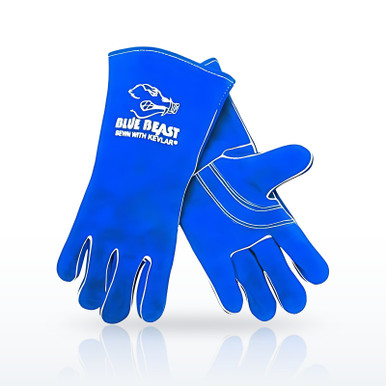 MCR Safety Blue Beast 4600 Welding Gloves, Cowhide, Jersey LinedCowhide gauntlet stick welding glove with the lining and contact heat level MCR Safety states
Why the glove is special. Three things happen to a welder’s hands that do not happen to anyone else’s: spatter and slag land on them, radiant heat from the arc or the torch reaches them, and the hot work piece gets picked up. Leather takes all three, which is why OSHA’s own PPE guidance lists it for sparks, moderate heat, blows, chips and rough objects, and why the welding glove’s differences from a drivers glove are all about heat: a gauntlet cuff of 4 to 5 inches so a spark cannot fall into the wrist, Kevlar or other heat-resistant thread so the seams do not burn open, a cotton, jersey, fleece or foam lining to slow the heat through the palm, and, on the heavy styles, a welted thumb and a reinforced palm. MCR Safety also states what heat does to the leather itself: open flame burns the natural oils and tanning chemicals out of it, so the glove hardens and chars, which is why the grade of the hide decides how long a welding glove lasts. The rows below show the hide, grade, cuff, lining and the ANSI/ISEA 105 contact heat level MCR Safety states for each.
The hides, as MCR Safety pairs them with the process
From MCR Safety’s welding guide; the hide and grade on each product page.
What else is on a welding glove page, and what it means
- Cuff: gauntlet (4 to 5 inches, the stick and MIG pattern), band top or safety cuff, or slip-on open cuff on the thin TIG gloves.
- Lining: cotton, jersey, fleece or foam on the stick gloves; many MIG and TIG gloves are unlined for feel. A fleece-lined glove is also the cold-weather welding glove.
- Thread: MCR Safety lists Kevlar sewing on its heavier welding styles, so the seams take the spatter the leather takes.
- Contact heat: the ANSI/ISEA 105 level MCR Safety states, from the ASTM F1060 hot-plate test, level 2 (140 °C for 15 seconds before a second-degree burn) to level 5 (320 °C); the heat guide explains the scale.
- Cut level: a few MCR Safety welding gloves carry an ANSI/ISEA 105 cut level (A2 to A5) from a cut-resistant lining; most do not, and the leather’s cut resistance is not rated.
- What OSHA requires: the glove comes from the hazard assessment under 1910.132 and 1910.138, and 1910.252(b)(3) says the clothing varies with the size, nature and location of the work; the construction rules (1926.353, 1926.95) say the same.
More questions people ask
How do you break in welding gloves, and which gloves are most worn by welders?
A new leather welding glove is stiff because the hide is thick and the seams are sewn with heat-resistant thread; it breaks in by being worn, flexed and worked, and the leather care guide on this site gives the method that does not ruin it (no heat, no solvents, a little conditioner when nearly dry). MCR Safety’s welding guide pairs the hides with the processes, which answers the “most worn” question by process rather than by brand: cow and pig split leather for stick and MIG, where durability and spatter matter most; goatskin grain for MIG and TIG, for abrasion resistance with feel; deerskin grain for TIG, where sensitivity matters; elk for stick at higher heat. Stick welders mostly wear a lined split-cowhide gauntlet; TIG welders a thin goatskin or deerskin glove. The gloves are called welding gloves, welders’ gloves or, by cut, stick gloves, MIG gloves and TIG gloves.
Answers from the sources named above and in the byline.Questions people ask
Which type of hand gloves are used for welding?
Leather welding gloves: split cowhide or pigskin gauntlets, usually lined, for stick and MIG; grain goatskin gauntlets for MIG; thin goatskin or deerskin slip-on gloves for TIG, in MCR Safety’s pairing. The hide, cuff, lining and contact heat level are on each product page.
Do you need special gloves for welding?
Yes. OSHA requires protective clothing suited to the work (1910.252(b)(3) through 1910.132) and ANSI Z49.1 says welders wear flame-resistant gloves; a welding glove is leather with a long cuff, heat-resistant thread and a lining, and carries a contact heat level a work glove does not. Synthetic and coated gloves melt.
Can you use MIG gloves for stick welding?
A grain goatskin MIG glove gives up the lining and the heavier split leather MCR Safety pairs with stick, so it takes less heat and wears faster in a stick arc; the pairing in MCR Safety’s guide is cow or pig split leather for stick.
Are leather gloves heat resistant?
To the level stated: MCR Safety’s welding gloves carry ANSI/ISEA 105 contact heat levels 2 to 5 (140 °C to 320 °C for 15 seconds before a second-degree burn). Open flame burns the oils out of leather and hardens it, so the glove is replaced when it stiffens or chars.
Is deerskin good for gloves?
MCR Safety pairs deer leather with TIG for the greatest sensitivity, and lists it as a soft grain hide that stays supple; it is a thin glove for a low-spatter process, not the stick welding glove.
Why are welding gloves so long?
The gauntlet cuff (4 to 5 inches on MCR Safety’s) covers the wrist and the shirt cuff so spatter and slag cannot fall inside; TIG gloves, for a process with almost no spatter, use a short slip-on cuff for feel.
How long should welding gloves last?
Until the leather hardens, cracks or burns through or a seam opens; MCR Safety states that flame burns the oils out of leather so the grade decides the life, and 1910.132(e) takes damaged PPE out of service. There is no fixed interval.
How do you break in welding gloves?
By wearing and working them; the leather softens with use. Keep them dry and away from heat and solvents, and condition lightly when nearly dry, as the leather care guide describes.
What gloves are most worn by welders?
By process, per MCR Safety’s welding guide: lined split-cowhide or pigskin gauntlets for stick and MIG, goatskin for MIG and TIG, deerskin for TIG, elk for high-heat stick. The product pages print the hide and the contact heat level.
What are welders’ gloves called?
Welding gloves or welders’ gloves, and by process: stick gloves (heavy, lined gauntlets), MIG gloves and TIG gloves (thinner grain leather). The cuff length and hide tell them apart.
Do you really need welding gloves, and can you weld without them?
ANSI Z49.1 clause 4.3 says all welders and cutters wear flame-resistant gloves, and OSHA’s 1910.252(b)(3) requires protective clothing suited to the work under 1910.132. A mechanics glove, coated knit or disposable melts, is short at the cuff and carries no contact heat level.
Can I wash leather welding sleeves?
As leather gloves are washed: by hand in cool water with mild or saddle soap, no machine, no dryer, no heat, no solvents, conditioned when nearly dry; FR cotton sleeves follow the garment label. The leather care guide gives the steps.
What do welders wear when welding?
Leather gloves, a welding jacket or sleeves of leather or FR cotton, a helmet with the right shade lens, safety glasses under it, leather boots and, for fume, the respirator the exposure calls for; the welding PPE guide covers each piece under 1910.252.
Related guides
MIG vs stick vs TIGWhat each process is and the PPE each needsWhat PPE does OSHA require for welding?1910.252 explainedWelding jackets: leather vs FR cottonAnd hybridCowhide vs goatskin vs pigskin vs deerskinThe leather type and grade on a work gloveHeat-resistant glovesThe ANSI/ISEA 105 contact heat levelsThe ratings, test results and standards shown here are the manufacturers' published values, reproduced as published. Nothing on this page is a recommendation by Bayshore Safety that any product is suitable for a particular task, hazard or workplace. Selecting safety products and protective equipment is the responsibility of the end user and the employer, based on their own hazard assessment and the regulations that apply to their work. Confirm every value on the manufacturer's own documentation before use.
© 2026 Bayshore Safety & Industrial Supplies, Inc. All rights reserved. This guide may not be copied or republished without written permission.