
Bayshore Safety & Industrial Supplies Guide
What is a fire blanket used for, and what is it not used for? The fires it smothers, when to use an extinguisher instead, ASTM F1989 cooking fire blankets, wool and Water-Jel blankets, and whether a workplace or kitchen needs one
A fire blanket is for smothering a small, contained fire by cutting off its air: a pan fire, a small open fire on a bench or in a bin, and above all a person whose clothing is burning, who is wrapped in it and rolled. It is not for a fire that has spread beyond what the blanket can cover, a fire in a wall or ceiling, an electrical panel, a gas leak, a lithium battery pack, or any fire you would have to reach into to cover; those are extinguisher, evacuation and fire department fires. First Aid Only sells three kinds: a treated 80 percent wool blanket in a hanging pouch (62 x 84 inches), a woven glass fabric blanket tested to ASTM F1989 for cooking and clothing fires, and the Water-Jel wool blankets whose water-soluble gel both extinguishes flame and cools the burn. No federal rule requires a fire blanket in a workplace; OSHA 1910.157 covers extinguishers, and a blanket is a supplement to them, not a substitute.
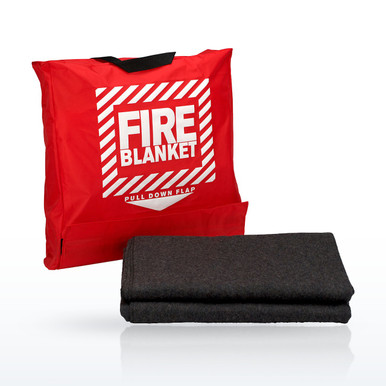 First Aid Only 21-650 62 in x 84 in Wool Fire Blanket in Hanging PouchFirst Aid Only prints a 62 x 84 inch wool fire blanket in a 420 denier nylon hanging pouch; one tug releases it
Why "not used for" is the question people ask most. A blanket that smothers a pan fire looks as if it could smother anything, and the most-searched question in this cluster is what it cannot do. The answer is in how it works: a blanket starves a fire of air, so it works only on a fire it can cover completely, at arm’s length, in one movement. The second most-asked question is what the fire department uses or wants, and the honest answer is that fire departments carry extinguishers and hose lines and teach stop, drop and roll; a fire blanket is a kitchen, lab, shop and first aid station item for the first seconds. This page gives the uses, the limits, the materials (wool, glass fabric, gel-soaked wool), the ASTM F1989 test the cooking blankets name, service life, cost, and what the Red Cross says to do for the person once the flames are out.
What a fire blanket is for, and what it is not for
The statements are First Aid Only’s; the first aid is the Red Cross’s.
The questions, one by one
What is a fire blanket not used for?
Any fire it cannot cover completely in one movement from the side: a fire that has spread, a fire above head height, a fire inside a wall, ceiling, cabinet or duct, a deep fryer or vat larger than the blanket, an electrical panel or motor that is still energized, a gas leak, and a lithium battery pack or vehicle fire. It is also not a shield to walk through fire with, and it is not reused once it has been on a fire. For all of those the answer is an extinguisher of the right class, the alarm and the fire department.
What type of fire should a fire blanket be used for?
A small Class A or Class B fire that is contained in one place and can be covered: a pan of burning oil (the blanket smothers it where water would spread it), a wastebasket, a small spill on a bench, and burning clothing. Class K cooking-oil fires in a commercial fryer and Class C energized electrical fires are extinguisher fires. The fire extinguisher ratings guide linked below explains the classes.
What is the point of a fire blanket, and are they worth having?
Seconds and simplicity. A blanket needs no training, no aim and no maintenance, leaves no residue, and is the only tool that puts out a person. In a kitchen, lab, shop or anywhere people work with open flame or hot oil it is worth having beside the extinguisher; First Aid Only prints "no extinguisher discharge or messy residue" and "perfect for kitchens, labs, workshops and industrial settings" on its glass-fabric blanket.
What do fire departments say about fire blankets, and what blanket do firefighters use?
Fire departments teach stop, drop and roll and extinguisher use, and many list a fire blanket among kitchen safety items; we do not quote any department’s product preference. Firefighters themselves carry hose lines, extinguishers and, for burn care, sterile burn sheets and gel blankets of the Water-Jel kind; the Water-Jel blankets in the band are the EMS and fire-service item, described by First Aid Only as "stabilizes the patient and helps prepare for transport".
What are fire blankets made of, and is fiberglass or wool or silicone better?
Three materials in the line: treated wool (First Aid Only’s 21-610 and 21-650 are "naturally fire-retardant 80 percent wool that is treated to make it even more fire retardant"), woven glass fabric (the ASTM F1989 cooking blanket, "made from woven glass fabric material"), and worsted wool carrying a water-soluble gel (the Water-Jel blankets, "capable of absorbing up to 13 times its own weight"). Glass fabric is light, thin and standard for kitchens; wool is heavier, drapes better over a person and does not shed fibers; the gel blanket cools the burn as it smothers. Silicone-coated glass blankets are sold by others and we do not carry one. "Better" is the wrong word; each is built for a place.
What does ASTM F1989 mean on a fire blanket?
ASTM F1989 is the standard specification for cooking fire suppression blankets; First Aid Only prints "meets ASTM F1989-05 standards for cooking" on its 91731 blanket and describes it as tested for use on clothing fires and small open fires. It is a product test standard, not a code requirement; no OSHA rule names it.
How long does a fire blanket last, and how many times can you use one?
Until it is used once, or until the manufacturer’s stated life if it has a date; First Aid Only does not print a shelf life on its blankets, and a blanket kept dry, in its pouch and out of sunlight stays serviceable for years. After a fire it is replaced: the fibers are heat-damaged, a gel blanket has released its gel, and a wool blanket has been scorched. Inspect the pouch and the pull tabs with the first aid kit.
When should you not use a fire blanket, and what are the disadvantages?
When the fire is too big or out of reach, when the heat source is electrical or gas and still on, when you cannot approach from the side with the blanket between you and the flames, and when the person on fire is running (get them down first). The disadvantages are the limits: a blanket covers one small fire, once; it cannot be thrown from a distance like an extinguisher’s stream; and a blanket laid badly can fan a fire or trap heat on skin.
How long do you leave a fire blanket over a fire?
Until the fire is cold: turn off the heat source, leave the blanket in place for at least 15 to 30 minutes and do not lift it to look, because air re-ignites hot oil. On a person, the blanket comes off as soon as the flames are out so that cooling can start.
What is the first aid after a clothing fire?
The Red Cross burns steps: once the flames are out, remove clothing and jewelry that are not stuck, cool the burns under clean running water for 5 to 20 minutes, cover loosely with a sterile non-adhesive dressing, call 911 for any burn to the face, hands, feet, joints or genitals, any large or deep burn, or any burn around a limb, chest or neck, watch for shock and keep the person warm. The Water-Jel blanket does the cooling and covering in one piece, which is why it is on fire-service trucks; the burn dressings guide linked below has the rest.
Are fire blankets required by code, and does a workplace need one?
No federal rule requires a fire blanket. OSHA 1910.157 requires portable fire extinguishers where the employer provides them for employee use, with placement, inspection and training rules; some state fire codes and lab or kitchen standards call for a blanket. A workplace with open flame, hot oil, welding or cutting, or a lab, has a credible clothing fire and a reason to hang one beside the extinguisher and the burn kit.
How much does a fire blanket cost, and where can I get one?
The current prices of the wool blankets, the glass-fabric blanket and the Water-Jel blankets are on the rows in the band; the wool blanket in a hanging pouch is the general first aid station item and the gel blankets by the case are the fire-service and industrial item. We sell nationwide.
What is a fireplace blanket, and will a fire blanket stop a lithium battery fire?
A fireplace blanket is a hearth rug or fire-resistant screen sold for a home fireplace; it is not a fire blanket. A lithium battery fire makes its own oxygen and heat inside the cells, so a blanket over it does not starve it; large battery fire blankets exist for electric vehicles but are a different product, and a small battery fire is a Class B or specialty-extinguisher and fire department matter.
In plain words
- A fire blanket smothers a small fire it can cover completely, and a person whose clothes are burning.
- Not for a spreading fire, a fire in a wall or duct, a live electrical panel, gas, or a lithium battery.
- Hold it by the corners with your hands behind it, lay it from the side, turn off the heat, leave it until cold.
- Wool, glass fabric or gel-soaked wool; ASTM F1989 is the cooking-blanket test.
- Used once, then replaced. Kept in its pouch, dry, by the extinguisher and the burn kit.
- Then the Red Cross burn steps: cool with running water, cover loosely, call 911 for the serious signs.
- No federal rule requires one; OSHA 1910.157 is the extinguisher rule it stands beside.
Questions people ask
What is a fire blanket not used for?
A spreading fire, a fire in a wall or duct, an energized electrical panel, gas, a lithium battery pack, or anything it cannot cover in one movement; those are extinguisher and fire department fires.
What type of fire is a fire blanket for?
A small contained Class A or B fire (a pan, a bin, a bench) and burning clothing.
Is it worth having a fire blanket at home or at work?
Beside an extinguisher in a kitchen, lab or hot-work area, yes; it is the one tool that puts out a person.
What fire blanket do firefighters use?
Fire services carry extinguishers and hose lines, and for burn care Water-Jel gel blankets and sterile burn sheets; we do not quote a department’s brand preference.
What are fire blankets made of?
Treated wool, woven glass fabric, or worsted wool soaked in a water-soluble gel (Water-Jel), as First Aid Only prints.
What is ASTM F1989?
The standard specification for cooking fire suppression blankets; First Aid Only prints it on its glass-fabric blanket.
How many times can you use a fire blanket?
Once; it is replaced after a fire.
How long do you leave a fire blanket on a fire?
Until the fire is cold, 15 to 30 minutes at least, without lifting it; on a person, off as soon as the flames are out.
Does OSHA require fire blankets?
No; OSHA 1910.157 requires extinguishers where provided; a blanket supplements them.
Will a fire blanket stop a lithium battery fire?
No; the cells make their own oxygen and heat; that is a specialty extinguisher and fire department matter.
What is a fireplace blanket?
A hearth rug or screen for a home fireplace, not a fire blanket.
What do you do after putting out burning clothing?
The Red Cross burn steps: cool with running water, cover loosely with a non-adhesive dressing, call 911 for serious burns, watch for shock.
The ratings, test results and standards shown here are the manufacturers' published values, reproduced as published. Nothing on this page is a recommendation by Bayshore Safety that any product is suitable for a particular task, hazard or workplace. Selecting safety products and protective equipment is the responsibility of the end user and the employer, based on their own hazard assessment and the regulations that apply to their work. Confirm every value on the manufacturer's own documentation before use.
© 2026 Bayshore Safety & Industrial Supplies, Inc. All rights reserved. This guide may not be copied or republished without written permission.