
What is a hazardous (classified) location? How an area is classified by Class, Division and Group, what intrinsic safety means for an electrical circuit, and what an intrinsic safety barrier does
A hazardous (classified) location, in OSHA’s electrical standard, is a place where flammable vapors, liquids or gases, or combustible dusts or fibers may be present in quantities that could burn or explode, classified by the kind of material and how likely it is to be there. 29 CFR 1910.307 names the occupancies (aircraft hangars, gasoline stations, bulk fuel storage, paint-finishing plants, grain and dust facilities, marinas, petroleum and chemical plants) and the nine designations: Class I (gases and vapors), Class II (dusts) and Class III (fibers), each in Division 1 or 2, with Class I Zones 0, 1 and 2 as an alternative. The employer documents the classification, and every room, section or area is considered on its own. Electrical equipment taken into such a location must be intrinsically safe, approved for the location, or safe for the location (1910.307(c)). Intrinsic safety is the technique portable gas monitors use: a circuit designed so it cannot spark, store enough energy or run hot enough to ignite the gas around it, even on a fault, in RKI Instruments’ words. An intrinsic safety barrier is the associated apparatus for a fixed system: a device in the safe area that limits the voltage and current reaching the circuit in the hazardous area, under NFPA 70 Article 504, so that a sensor head on a long cable stays intrinsically safe.
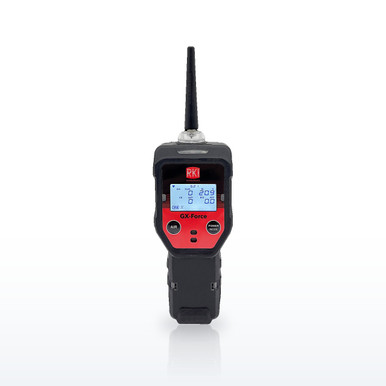 RKI Instruments 72-FA-A-A15 GX-Force 4-Gas Sample-Draw Monitor, LEL/O2/H2S/COIntrinsically safe by RKI’s page: IECEx, ATEX, QPS Class I Division 1 Groups A, B, C, D; Class I Zone 0
Why a gas detector has to be built for the place it is carried into. A portable monitor goes exactly where flammable gas may be: a tank being gas-freed, a sewer, a pit, a process area during a leak. While the gas is there, that space is a hazardous location by 1910.307’s definition, and every electrical thing in it, the monitor included, must be intrinsically safe, approved for the location or shown safe for it. The monitor cannot be explosion-proof in the usual sense (RKI’s FAQ: an explosion-proof housing is cast aluminum or stainless steel and is the method for fixed detector heads where voltages are higher), so it is designed as an intrinsically safe circuit and listed to UL 913 or the equivalent CSA standard by a nationally recognized testing laboratory, with the Class, Division and Group marked on the label (1910.307(c)(2)(ii) requires the class, group and temperature marking on approved equipment). RKI’s FAQ adds that OSHA approves no certification body itself but looks for the third-party verification.
How a location is classified, in the words of 1910.399
The Class says what can burn; the Division or Zone says how likely it is to be there.
Intrinsic safety: the circuit, the system and the barrier
- What intrinsically safe means, in RKI’s words: a circuit that cannot spark, store enough energy or run hot enough to ignite a flammable gas; it is not explosion-proof and does not need to be, and it is the method almost all portable instruments use. 1910.307(c)(1) permits equipment and associated wiring approved as intrinsically safe in any hazardous location it is approved for.
- What an intrinsically safe system is: the whole loop, the apparatus in the hazardous location, the associated apparatus in the safe area and the wiring between them, designed and installed under NFPA 70 Article 504 so that no part of it can release enough energy to ignite the atmosphere, in normal operation or with the faults the standard assumes.
- What an intrinsic safety barrier is: the associated apparatus, a device (Zener barrier or galvanic isolator) mounted in the safe area that limits the voltage and current that can reach the field circuit, so that a fixed sensor head on a long cable stays intrinsically safe. RKI’s fixed detector heads and controllers are the kind of equipment barriers are used with; a portable monitor carries its own protection and needs none.
- Is 24 V intrinsically safe? Voltage alone decides nothing: intrinsic safety is a certified design in which the energy that can reach the hazardous area under fault is limited; a 24 V supply becomes part of an intrinsically safe system only through the barrier and the approved apparatus. A low-voltage device is not intrinsically safe because it is low-voltage.
- Intrinsically safe electrical equipment is equipment approved to UL 913 or the CSA equivalent (or carrying Ex ia or Ex ib in an IECEx or ATEX code) for a stated class, group and temperature class; the listing mark on the label is the evidence. RKI lists its GX-Force and 04 Series as intrinsically safe with IECEx, ATEX and QPS Class I, Division 1, Groups A, B, C, D marks.
- Non-intrinsically safe devices (phones, lights, radios, ordinary meters) may be used in a Division 2 location only where the employer can show they are not a source of ignition under normal conditions (1910.307(e)), and not in Division 1 or Zone 0 and 1.
- The other protection techniques 1910.307(f) allows: explosion-proof apparatus (Class I, Division 1 and 2), dust ignition-proof and dust-tight (Class II and III), purged and pressurized (any location), nonincendive circuit, equipment or component, oil immersion and hermetically sealed (Division 2 and Class III), and any other technique that meets paragraph (c).
Approvals RKI Instruments prints, by model, and where each may go
| Model | Approvals as printed | Locations covered by the listing |
|---|---|---|
| GX-Force | IECEx, ATEX, C QPS US Class I Div 1 Groups A, B, C, D; Class I Zone 0 | Class I, Division 1 and 2, Groups A to D; Class I, Zone 0, 1 and 2 |
| 04 Series (HS-04, CO-04, OX-04, CX-04, SC-04) | ATEX, IECEx, QPS C/US Class I Div 1 Groups A, B, C, D | Class I, Division 1 and 2, Groups A to D |
| GX-3R and GX-3R Pro | ATEX, CSA, IECEx, MED | As the CSA certificate states; the MED mark is the marine equipment directive |
| GX-6100 | ATEX, IECEx, TIIS, cCSAus, Ex ia IIC T4 Ga | Zone 0 (Ga) for gas group IIC at T4; cCSAus for Canada and the United States |
Source: RKI Instruments GX-Force product page and specification table (rkiinstruments.com/product/gx-force-portable-4-gas-monitor, rkiinstruments.com, fetched Nov 8 2026); RKI Instruments 04 Series product page and specification table (rkiinstruments.com/product/04-series-single-gas-detectors, rkiinstruments.com, fetched Nov 8 2026); RKI Instruments GX-3R Pro product page and specification table (rkiinstruments.com/product/gx-3r-pro-gas-detector, rkiinstruments.com, fetched Nov 8 2026); RKI Instruments GX-3R product page and specification table (rkiinstruments.com/product/gx-3r-gas-detector, rkiinstruments.com, fetched Nov 8 2026); RKI Instruments GX-6100 product page, datasheet and PID response chart (rkiinstruments.com/product/gx-6100-multigas-detector, rkiinstruments.com, fetched Nov 8 2026); 29 CFR 1910.307(e) (Division 1 equipment in Division 2)
Honeywell BW and MSA listings by Class, Division and Group
Each row in the one-configuration-per-model group above carries the approval line its manufacturer prints; the table collects them for the whole of both lines.
Hazardous-location approvals as printed by Honeywell BW and MSA (read the label on the unit you buy)
| Model | North America | ATEX | IECEx |
|---|---|---|---|
| Honeywell BW Clip | cULus: Class I, Div. 1, Gr. A, B, C, D; Class I, Zone 0, Gr. IIC | II 1G Ex ia IIC T4 Ga | Ex ia IIC T4 Ga |
| Honeywell BW Clip4 | Class I, Div 1, Group A, B, C, D; Class I, Zone 0, Group IIC | II 1G Ex ia IIC T4 Ga | Ex ia IIC T4 Ga |
| Honeywell BW Solo | Class I, Division 1, Groups A, B, C, D T4; Class II, Division 1, Groups E, F, G T4; Class I, Zone 0, AEx/Ex ia IIC T4 Ga | II 1G Ex ia IIC T4 Ga (Sira 18ATEX2243) | Ex ia IIC T4 Ga / Ex ia I Ma |
| Honeywell BW MicroClip XL / X3 | CSA: Class I, Div. 1, Gr. A, B, C, D | II 1 G Ex ia IIC T4 Ga | Ex ia IIC T4 Ga |
| Honeywell BW MAX XT II | UL: Class I, Div 1, Group A, B, C, D | II 1 G Ga Ex ia IIC T4 | Ga Ex ia IIC T4 |
| MSA ALTAIR 4XR | USA: Class I, Division 1, Groups A, B, C and D; Class II, Division I, Groups E, F and G; Class III, Division I; Canada CSA C22.2 No. 152 and No. 157 | II 1G Ex ia da IIC T3 Ga, −40 °C to +60 °C, IP68 | Ex ia da IIC T3 Ga |
| MSA ALTAIR io 4 | Class I, Division 1, Groups A, B, C and D T4; Class I, Zone 0, AEx da ia IIC Ga T4 | As listed on the product page | As listed on the product page |
| MSA ALTAIR 2X | CSA Class I Div 1 Groups A, B, C, D | As listed on the product page | As listed on the product page |
The markings are the manufacturers’ words; this page adds nothing to them. "Ex ia" is the intrinsic-safety protection concept and "Ex da" the flameproof concept in the IEC 60079 scheme; T3 and T4 are temperature classes.
Source: Honeywell BW Clip, Clip4, Solo and MicroClip data sheets, BW MaxXT II product page; MSA ALTAIR 4XR bulletin (0816-102-MC) and ALTAIR io 4 specification sheet; MSA ALTAIR 2X product page. Fetched Nov 10 2026.
Questions people ask
What is considered a hazardous area?
In OSHA’s 1910.307, a location where flammable vapors, liquids or gases, or combustible dusts or fibers may be present in quantities that could burn or explode, such as aircraft hangars, gasoline stations, bulk fuel storage, paint-finishing plants, dust-producing facilities, marinas and petroleum and chemical plants; each room or area is classified on its own.
How are hazardous areas classified?
By Class (I gases and vapors, II dusts, III fibers) and Division (1, present under normal conditions; 2, only on a failure), or for Class I by Zone (0, 1, 2), with the gas Group (A, B, C, D) and the temperature class marked on the equipment; the nine designations are listed in 1910.307(a)(2) and defined in 1910.399.
What is intrinsic electrical safety?
A design technique in which an electrical circuit cannot release enough energy or heat to ignite a flammable atmosphere, even with a fault; 1910.307(c)(1) permits equipment approved as intrinsically safe in any hazardous location it is approved for, and RKI Instruments states it is the method almost all portable gas monitors use.
What is an intrinsic safety barrier?
The associated apparatus of an intrinsically safe system under NFPA 70 Article 504: a device in the safe area that limits the voltage and current that can reach the field circuit in the hazardous area, so a fixed sensor head on a long cable stays intrinsically safe. Portable monitors need none; their protection is built in.
What does "intrinsically safe system" mean?
The whole loop, apparatus in the hazardous area, associated apparatus (barrier) in the safe area and the wiring between, designed and installed under Article 504 so that no part can ignite the atmosphere in normal operation or under the assumed faults.
What is intrinsically safe electrical equipment?
Equipment listed to ANSI/UL 913 or the CSA equivalent, or marked Ex ia or Ex ib under IECEx or ATEX, for a stated class, group and temperature class; the mark on the label is the evidence an inspector reads.
Is 24V intrinsically safe?
Not by itself. Intrinsic safety is a certified limit on the energy that can reach the hazardous area, achieved through the barrier and the approved apparatus; a 24 V supply is intrinsically safe only as part of such a system.
What is ex-certification?
Certification of equipment for explosive atmospheres under the IEC 60079 standards (IECEx internationally, ATEX in the European Union), read as an Ex code: protection type, gas group, temperature class and equipment protection level. The North American equivalent is the Class/Division listing or the AEx zone marking 1910.307(g) allows.
What is dust group IIIA, IIIB, IIIC?
The IEC 60079 dust groups (IIIA combustible flyings, IIIB non-conductive dust, IIIC conductive dust) used in the zone system for Class II and III-type hazards; OSHA’s 1910.307 classifies dusts and fibers only by the Division system, with NFPA 70 Groups E, F and G.
What is the difference between Class 1, Division 1, and Division 2 hazardous locations?
Division 1: ignitable concentrations may exist under normal operation, frequently during maintenance or leakage, or on breakdown. Division 2: the flammables are normally confined and escape only on rupture or abnormal operation. Equipment approved for Division 1 may be used in Division 2 of the same class and group (1910.307(e)).
What are the NEC codes for hazardous locations?
NFPA 70 (the National Electrical Code) Article 500 for the Class and Division system, Article 505 for Class I Zones and Article 504 for intrinsically safe systems; OSHA’s 1910.307 refers to them. The markings on a Honeywell BW or MSA detector follow Article 500 (Class I, Division 1, Groups A, B, C, D) and, on the Clip, Clip4, Solo and ALTAIR io 4, Article 505 (Class I, Zone 0).
Related guides
Intrinsically safe gas detectorsClass I, Div 1 and Div 2ATEX vs explosion-proof vs intrinsically safeZones against DivisionsWhat is a confined space?The OSHA definition and what makes one permit-requiredWhat does a 4-gas monitor measure?And why those fourWho makes RKI gas monitors?And what happened to the Eagle 2 and GX-6000What is the ATEX equivalent in the US?ATEX vs IECEx, Class I Division 2 and the types of explosion protectionThe ratings, test results and standards shown here are the manufacturers' published values, reproduced as published. Nothing on this page is a recommendation by Bayshore Safety that any product is suitable for a particular task, hazard or workplace. Selecting safety products and protective equipment is the responsibility of the end user and the employer, based on their own hazard assessment and the regulations that apply to their work. Confirm every value on the manufacturer's own documentation before use.