
Temporary, permanent and engineered anchors: the types of fall protection anchors, and how strong an anchor must be for restraint
Fall protection anchors fall into three groups by how they are rated and installed. A temporary anchor (a cross arm strap, a beam clamp, a reusable roof anchor, a concrete strap) is placed for the job and removed, and carries the minimum breaking strength its manufacturer publishes (5,000 lb on Safewaze’s straps, chokers and most anchors). A permanent anchor (a bolted D-ring plate, a permanent roof anchor, a post anchor) is fastened to the structure to stay and inspected on the manufacturer’s schedule. An engineered anchor is part of a complete system designed, installed and used under the supervision of a qualified person with a safety factor of at least two, which is the rule’s alternative to the 5,000-pound figure. ANSI/ASSP Z359.18 sorts anchorage connectors by type: Type A fixed (beam, bolt-on, puck), Type D sliding (beam trolleys and travelers) and Type T tie-off adapters (straps, chokers, cable slings). For restraint the figures are different: 1910.140(c)(13) requires a restraint anchorage to hold 3,000 pounds or twice the maximum expected force, and Safewaze authorizes its anchors for restraint only where the structure holds 1,000 pounds, no free fall is possible and the slope is 4/12 or less.
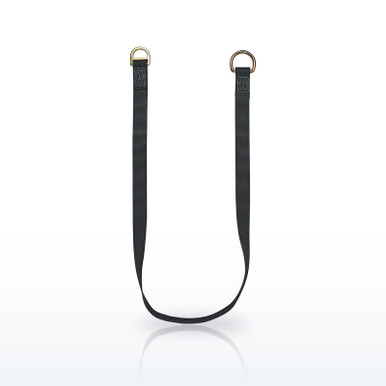 Safewaze FS88811-HW Anchor Straps, 6 ft Heavy Duty Cross ArmCross arm strap, ANSI Z359.18 Type T, 5,000 lb minimum breaking strength (Safewaze data)
Why the three groups are rated differently. A temporary anchor’s strength is in the product: the manufacturer tests the strap or the clamp to 5,000 pounds and prints it, and the user’s job is to put it on a member that can take the load. A permanent anchor’s strength is in the installation as much as the hardware: Safewaze’s manuals specify the fasteners, the substrate and the edge distance, and issue bulletins when a different lag bolt length or a different concrete fastener is allowed. An engineered system moves the proof from the label to the drawing: the qualified person calculates the actual arrest load and designs the anchorage for twice it, which is how a horizontal lifeline whose end anchors see far more than one worker’s arrest load gets rated. The restraint figures are lower because there is no free fall to arrest; the force on a restraint anchor is the worker leaning on the line, which is why 1910.140 allows 3,000 pounds or twice the expected force and Safewaze’s own condition is 1,000 pounds at the structure.
The anchor types, by rating and by Z359.18
The groups the rule and the standard use, with the Safewaze products that fall in each.
Anchor strength: arrest vs restraint vs positioning
The figures, by what the anchor is used for:
- Fall arrest, construction: anchorages hold at least 5,000 lb per employee attached, or are designed, installed and used as part of a complete system that keeps a safety factor of at least two under a qualified person (1926.502(d)(15)); independent of any anchorage used to support or suspend platforms.
- Fall arrest, general industry: the same 5,000 lb or 2:1 rule in 1910.140(c)(13).
- Fall restraint, general industry: 1910.140(c)(13) sets the restraint anchorage at 3,000 lb, or twice the maximum expected force, under the supervision of a qualified person.
- Positioning: anchorages hold twice the potential impact load or 3,000 lb, whichever is greater (1926.502(e)(2)); rigged for 2 ft of free fall or less.
- Safewaze’s own restraint conditions, printed in its anchor manuals and its 2025 bulletin on cable anchors: the structure withstands at least 1,000 lb (4 kN) in the directions the system permits; no free fall is permitted; slopes up to 4/12 only; connection at the dorsal, front/sternal, side or shoulder D-ring; a competent person confirms the anchorage meets the OSHA rule for the system in use.
- Every Safewaze anchor: structure supports 5,000 lb or a 2:1 factor by a qualified person; capacity ANSI 310 lb, OSHA 420 lb including tools; removed from service after a fall.
Anchorage strength by system
| System | Required anchorage strength | Rule |
|---|---|---|
| Personal fall arrest | 5,000 lb per worker, or a 2:1 engineered system under a qualified person | 1926.502(d)(15); 1910.140(c)(13) |
| Personal fall restraint | 3,000 lb, or twice the maximum expected force (qualified person) | 1910.140(c)(13) |
| Positioning device | Twice the potential impact load or 3,000 lb, whichever is greater | 1926.502(e)(2) |
| Restraint on a Safewaze anchor (manufacturer condition) | Structure holds 1,000 lb; no free fall; slope 4/12 or less | Safewaze Technical Bulletin 00290; anchor manuals |
| Horizontal lifeline | Designed, installed and used under a qualified person as part of a complete system with a 2:1 safety factor | 1926.502(d)(8) |
Source: 29 CFR 1926.502 and 1910.140 (current e-CFR); Safewaze Technical Bulletin 00290.
Anchorage vs anchorage connector, as FallTech puts it
FallTech’s anchor guide keeps two words apart: the anchorage is the structure, the anchorage connector is the device that attaches to it, and a connector rated at 5,000 lb says nothing about the structure behind it. It states OSHA’s rule as either 5,000 lb per attached employee or a complete system kept at a safety factor of at least two under a Qualified Person (a certified anchorage), with non-certified anchorages selected by a Competent Person against the prescriptive figure; restraint anchors see less force than arrest anchors. It sorts anchors as penetrating (nails, screws, bolts) or non-penetrating (clamps, friction, weights), and its FAQ allows its anchors on other substrates only when a Qualified Person or Professional Engineer certifies the installation and the structure and fasteners hold the maximum arrest force by a factor of two. Its manuals carry the same figure for every anchor: 5,000 lb static, or two times the maximum arrest force where certified. The BeamLock beam anchor fits flanges from 4 to 14 inches, lists ANSI Z359.18-2017 Type A and CSA Z259.15-2017 Type A with a 5,000 lb minimum static strength, and carries 310 lb ANSI and 425 lb OSHA for one user; the product page lists ANSI Z359.18-2017 and the Minimum Breaking Strength as the manufacturer states them.
FallTech, “Anchors 101: A Comprehensive Guide to Anchorages” (falltech.com, fetched Nov 8 2026); FallTech Frequently Asked Questions, item 9; FallTech Beam Anchors manual MANC38 Rev A and BeamLock brochure (March 2025); the ANSI Standards, Anchor Type and Minimum Breaking Strength fields on each FallTech anchor page.Questions people ask
What is the strength rating of anchor points for fall restraint?
In general industry, 3,000 lb or twice the maximum expected force (1910.140(c)(13)). Safewaze authorizes its anchors for restraint where the structure holds 1,000 lb, no free fall is possible and the slope is 4/12 or less; the anchor itself still carries its 5,000 lb breaking strength.
What are the three types of anchors?
By how they are rated and installed: temporary (a cross arm strap, beam clamp, reusable roof anchor placed for the job and removed), permanent (a bolted D-ring plate or permanent roof anchor that stays on the structure) and engineered (part of a complete system designed, installed and used under a qualified person at a safety factor of two, the alternative 1926.502(d)(15)(ii) allows to the 5,000 lb rule). ANSI Z359.18-2017 sorts anchorage connectors by type instead: Type T, Type D and Type A.
Are roof anchors required by code?
OSHA requires the fall protection, not the anchor: at 6 feet on a roof the worker must have a guardrail, net, personal fall arrest system or, on a low-slope roof, a warning line with one of those or with a safety monitor (1926.501(b)(10) and (11)). Where a personal fall arrest system is the choice, an anchorage that meets 1926.502(d)(15) is required. Permanent roof anchors on a building are a matter of the building code and the owner’s window-washing and maintenance obligations (IBC and ANSI/IWCA I-14.1 as the authority having jurisdiction applies them), not of Subpart M.
What are anchor points used for?
To hold the fall protection system to the structure. For fall arrest the anchorage takes the arresting load and must hold 5,000 lb per worker or be engineered (1926.502(d)(15)); for restraint it keeps the worker from reaching the edge and in general industry must hold 3,000 lb or twice the expected force (1910.140(c)(13)(ii)); for positioning it holds the worker at the work face and must hold 3,000 lb or twice the potential impact (1926.502(e)(2)). Safewaze authorizes its cable anchors for restraint on the conditions in Technical Bulletin 00290.
What type of anchor allows vertical and horizontal movement?
A sliding anchorage connector (Z359.18 Type D, a beam trolley or sliding beam anchor) moves along the member; a horizontal lifeline lets the worker travel the span; a vertical lifeline with a rope grab or a ladder system covers the climb.
Are beam clamps permanent?
A sliding beam anchor or beam clamp is a temporary Type A or Type D connector placed on the flange for the job; Safewaze’s 2025 bulletin on sliding beam anchors adds a release-lever inspection to the manual. A bolted D-ring plate is the permanent equivalent.
What are the types of anchor points?
By rating: temporary (placed for the job), permanent (fastened to stay) and engineered (a complete 2:1 system under a qualified person). By Z359.18: Type A fixed, Type D sliding, Type T tie-off adapters such as straps and chokers.
What is the difference between a temporary and a permanent anchor?
A temporary anchor is removed after the job and is rated by its own breaking strength; a permanent anchor is fastened to the structure per the manual and inspected on a schedule (Safewaze’s permanent roof anchor every 6 months by a competent person).
What is an engineered anchor?
An anchorage designed, installed and used as part of a complete personal fall arrest system with a safety factor of at least two, under a qualified person; the alternative to the 5,000 lb figure in 1926.502(d)(15)(ii). Horizontal lifelines are rated this way.
The ratings, test results and standards shown here are the manufacturers' published values, reproduced as published. Nothing on this page is a recommendation by Bayshore Safety that any product is suitable for a particular task, hazard or workplace. Selecting safety products and protective equipment is the responsibility of the end user and the employer, based on their own hazard assessment and the regulations that apply to their work. Confirm every value on the manufacturer's own documentation before use.