
Bayshore Safety & Industrial Supplies Guide
What is an arc flash suit, and do arc flash suits work? 8, 12, 25, 40, 65 and 100 cal kits, what the rating means, what PPE category 4 requires, what goes under the suit, how long a suit lasts, and whether 480 V needs one
An arc flash suit is a set of arc-rated garments worn over FR clothing for work above the lower categories: a jacket or coat, overpants or a bib, and an arc flash hood with a window, usually sold as a kit with a hard hat and safety glasses and a bag. Its number is the arc rating of the fabric system in calories per square centimeter, the incident energy at which it gives a 50 percent probability of a second-degree burn: PIP’s Ultralight PPE 4 kit and PYRAD kit are 40 cal/cm², which is the NFPA 70E minimum for PPE Category 4, and the 8 and 12 cal/cm² garments are Category 2 pieces worn with a face shield and balaclava rather than a hood. Do they work? Within the rating they are tested to, yes; the ASTM F1959 arc test is destructive and the fabric either holds the energy or it does not. What the rating does not cover is the arc blast’s pressure and shrapnel, an arc above the suit’s rating, or a suit worn over a meltable layer, which is why 1910.269(l)(8) bans acetate, nylon, polyester, rayon and polypropylene next to the skin and why the incident energy on the label, not the voltage, decides whether a 480 V panel needs one.
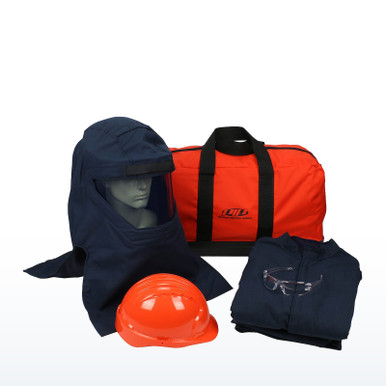 PIP 9150-540ULT Ultralight PPE 4 Arc Flash Kit, 40 Cal/cm2PIP lists the 9150-540ULT Ultralight PPE 4 kit at ATPV 40 cal/cm²: jacket, overpant, arc hood, hard hat, safety glasses and carry bag
What the number on the suit is. Every arc-rated garment carries an arc rating measured by the ASTM F1959 arc test: panels of the fabric are exposed to a controlled arc and the result is the ATPV (the incident energy at which there is a 50 percent probability of a second-degree burn through the fabric) or the EBT (the energy at which the fabric breaks open), whichever comes first, in calories per square centimeter. NFPA 70E then sorts garments into PPE categories by minimum rating, as the manufacturers print it from Table 130.7(C)(15)(c): Category 1 at 4 cal/cm², Category 2 at 8, Category 3 at 25, Category 4 at 40. A “40 cal suit” is a Category 4 system; an “8 cal” or “12 cal” garment is a Category 2 layer. The label on the equipment, worked from the incident energy analysis 1910.269(l)(8)(ii) and NFPA 70E require, says which the task needs. Everything on this page about suits comes from the PIP, Portwest and Neese product data and the live arc flash guides; the cards take the questions in order.
Arc flash suits, question by question
Ratings are the manufacturers’ own as printed on the product pages on this site; category minimums are NFPA 70E’s as the manufacturers print them.
The words on an arc flash suit
The vocabulary of an arc flash suit, in order.
- Arc rating: the ATPV or EBT in cal/cm² from the ASTM F1959 arc test; the number people call the “cal rating”. ATPV: 50 percent probability of a second-degree burn. EBT: the fabric breaks open.
- PPE Category 1 to 4: NFPA 70E’s groups by minimum arc rating, 4, 8, 25 and 40 cal/cm², as the manufacturers print Table 130.7(C)(15)(c). A 40 cal suit is Category 4.
- Kit: jacket (or coat) and overpant (or bib), arc hood, hard hat, safety glasses and a carry bag, sold as one part number (PIP 9150-540ULT, 9150-40PYR).
- Arc hood: a hooded garment with an arc-rated window that covers head, face and neck; rated with the suit (10.6 to 40 cal/cm² on this site). Arc shield: a face shield with an arc-rated window on a hard hat (12, 20, 25 and 40 cal/cm² lenses on PIP’s 9400 series), worn with a balaclava for Category 2.
- Incident energy: the energy per area at the working distance if an arc occurs, estimated by the employer (1910.269(l)(8)(ii); NFPA 70E) and printed on the equipment label. The garment’s rating must be at or above it.
- Arc flash boundary: the distance at which the incident energy falls to 1.2 cal/cm²; covered in the live boundary guide.
- Meltable fabrics: acetate, nylon, polyester, rayon and polypropylene, prohibited under FR by 1910.269(l)(8)(iii) unless treated.
- Switching suit: a trade name for a Category 4 suit used for operating medium-voltage switchgear; the same 40 cal/cm² kit.
- ASTM F1506, F1959, F1891: the garment specification, the arc test method, and the arc-rated rainwear specification.
Arc flash kits, garments, hoods and shields on this site by rating
| Item | Arc rating as published | Category | What it is |
|---|---|---|---|
| PIP 9150-540ULT Ultralight PPE 4 kit | 40 cal/cm² | 4 | Jacket, overpant, arc hood, hard hat, safety glasses, carry bag |
| PIP 9150-40PYR PYRAD by GORE-TEX Labs kit | 40 cal/cm² | 4 | Kit with PYRAD jacket, bib and hood |
| PIP 9100-524ULT / 530ULT / 525ULT | 40 cal/cm² | 4 | Ultralight jacket, pants and bib overall sold separately |
| PIP 9150-523ULT and 9150-538PYR hoods | 40 cal/cm² | 4 | Arc flash hoods |
| Portwest FR610 parka, FR422 bib, FR514 coverall | 40 cal/cm² | 4 | Bizflame Work insulated outerwear |
| Portwest Avenger and Ultrasoft 9 oz insulated parkas and bibs | 61 cal/cm² | above 40 | Insulated winter outerwear with the highest ATPV on this site |
| Portwest UFR48 jacket and UFR49 bib | 45 cal/cm² | 4 | DuraDuck quilt-lined |
| Bisley 385M8387H jacket | 40 cal/cm² | 4 | Dual-certified AR/FR ripstop |
| PIP 9100-21721 jacket, 21731 overall, 52772 coverall | 25 cal/cm² | 3 | Category 3 garments |
| PIP 385-HDFR-13 hood | 32.4 cal/cm² | 3 | Double-layer AR/FR cotton hood |
| Portwest IKBJ58 Kermel balaclava | 33 cal/cm² | 3 | Knit balaclava worn under a shield or hood |
| PIP 9100-21782 jacket, 22070 overpant, 52564 overalls | 12.4 cal/cm² | 2 | Category 2 outer layer |
| PIP 9400 series arc shields | 12, 20, 25 and 40 cal/cm² lenses | 2 to 4 | Hard hat face shields; anti-fog and hi-vis lens versions |
| PIP 9100-2110D / 2160D / 2170D coveralls | 8.5, 9.2 and 13.2 cal/cm² | 2 | AR/FR dual certified coveralls |
Current prices are on the product list on this page; sizes on each product page.
Source: PIP Rich Product Data, October 2026; Portwest and PIP product pages on this site, fetched Nov 5–9 2026. Category per NFPA 70E Table 130.7(C)(15)(c) minimums as the manufacturers print them.
Questions people ask
What is an arc flash suit?
A set of arc-rated garments worn over FR clothing: jacket or coat, overpants or bib, and an arc hood with a window, sold as a kit with hard hat, glasses and bag. Its rating in cal/cm² is the energy the fabric system holds.
Do arc flash suits actually work?
For the energy they are rated for, yes; the ASTM F1959 arc test is destructive and the rating is measured, not claimed. They do not stop the blast pressure or shrapnel, and they do nothing above the rating or over a meltable layer.
Will an arc flash suit save your life?
It is built to keep burns at or below second degree at its rated energy; the rating is matched to the label with margin and the boundary keeps the body back. Survival depends on the energy, the distance and the whole PPE set, not the suit alone.
What is the highest cal arc flash suit?
Complete kits on this site are 40 cal/cm² (PIP Ultralight PPE 4, PYRAD); Portwest’s insulated Avenger and Ultrasoft pieces reach ATPV 61. Industry systems go to 65, 100 and 140 cal/cm² for energies above 40.
What is the highest rated PPE for arc flash?
The system whose rating exceeds the incident energy on the equipment label. Category 4 starts at 40 cal/cm²; higher energies are specified by the number, since NFPA 70E’s table stops at 40.
What is a 100 cal suit?
A multi-layer arc flash suit rated 100 cal/cm² for incident energies above what a 40 cal system covers. Not a category; specified by the label energy.
What does 40 cal mean on an arc flash suit?
The fabric system has an arc rating of 40 calories per square centimeter, the NFPA 70E minimum for PPE Category 4.
How many calories is level 4 arc flash PPE rated for?
A minimum of 40 cal/cm², as the manufacturers print NFPA 70E Table 130.7(C)(15)(c). Category 3 is 25, Category 2 is 8, Category 1 is 4.
What is the minimum arc-rated clothing for PPE Category 2?
A minimum arc rating of 8 cal/cm²: arc-rated shirt and pants or coverall, an arc-rated face shield with balaclava or a hood, hard hat, safety glasses, hearing protection, gloves and leather footwear.
What should be worn under arc flash PPE?
FR or arc-rated clothing and nothing meltable: 1910.269(l)(8)(iii) prohibits acetate, nylon, polyester, rayon and polypropylene next to the skin unless treated. Cotton or FR underlayers are fine.
Do you need arc flash gear for 480 V?
The incident energy, not the voltage, decides. A 480 V panel can be a few cal/cm² or above 40 depending on fault current and clearing time; the label from the energy analysis says what the task needs.
What is the typical voltage rating for an 8 cal arc flash suit?
None; an 8 cal garment is a Category 2 piece for any task whose estimated incident energy is at or below 8 cal/cm². Arc ratings are energy ratings, not voltage ratings.
How long is a 40 cal suit good for, and does it expire?
No printed expiration; it is retired for condition: a scratched or hazed hood window, torn, thinned or contaminated fabric, non-FR repairs, broken closures, or any arc exposure.
Is ATPV the same as the cal rating?
Yes. The cal rating is the arc rating from ASTM F1959, reported as ATPV (50 percent chance of second-degree burn) or EBT (fabric breakopen), whichever comes first.
What is the main standard for arc flash clothing?
ASTM F1506 for the garment, ASTM F1959 for the arc test, NFPA 70E for the categories, and 29 CFR 1910.269(l)(8) and 1910.335 as the OSHA rules behind them.
What type of clothing should be worn for arc flash protection?
Arc-rated clothing with a rating at or above the incident energy: FR shirt and pants or coverall as the base, an arc-rated outer layer and face protection for Category 2, and a 40 cal suit and hood for Category 4.
Related guides
What is an arc flash?And what causes oneNFPA 70E PPE categories 1 to 4What each requiresWhat is an arc rating (ATPV and EBT)?And how it is measuredArc-rated face shields and hoodsWhat category needs whichWhat has to be worn under FR clothing?Meltable fabrics and layeringWhat is the arc flash boundary?And how it is determinedThe ratings, test results and standards shown here are the manufacturers' published values, reproduced as published. Nothing on this page is a recommendation by Bayshore Safety that any product is suitable for a particular task, hazard or workplace. Selecting safety products and protective equipment is the responsibility of the end user and the employer, based on their own hazard assessment and the regulations that apply to their work. Confirm every value on the manufacturer's own documentation before use.
© 2026 Bayshore Safety & Industrial Supplies, Inc. All rights reserved. This guide may not be copied or republished without written permission.