
Bayshore Safety & Industrial Supplies Guide
Beam anchors for fall protection: clamp, trailing anchor and trolley, the flange range, and why a rigging beam clamp is not one
A beam anchor is an anchorage connector that clamps the flange of an I- or H-beam and gives the worker a D-ring to tie off to. It comes in three forms. A fixed beam anchor is set at one point, a trailing (sliding) beam anchor rides along the top flange of the beam the worker is walking so the tie-off stays overhead or beside them, and a beam trolley rolls along the bottom flange of an overhead beam on wheels. What makes any of them a fall protection anchor rather than a piece of rigging is the listing: ANSI/ASSP Z359.18-2017 (Type A for a fixed or sliding connector), a 5,000 lb minimum static strength, and a structure that meets 29 CFR 1926.502(d)(15), 5,000 lb per attached worker or a certified system at a 2:1 safety factor. A beam clamp sold for lifting carries a working load limit for a hoist, not that listing. FallTech’s manual states its beam anchors attach to the bottom flange of an overhead beam for an overhead anchor or to the top flange of the walking beam for trailing use; its BeamLock fits flanges from 4 to 14 inches, its trailing anchors adjust to 12¼ or 18¼ inches, its vertical anchors to 12¾ or 24½ inches, and its trolleys fit 8-inch and 18-inch flanges.
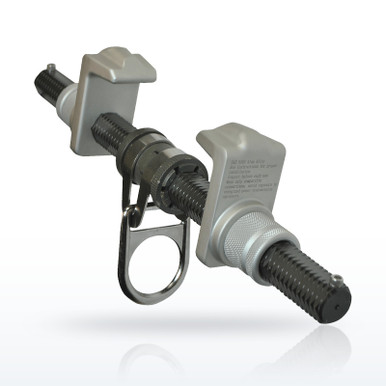 FallTech 7533 Beam Anchors, 12.25 in Trailing Beam, Dual-clamp AdjustmentBeamLock beam anchor: dual adjustment for 4 to 14-inch flanges, swivel D-ring, Z359.18-2017 Type A (FallTech data)
Why the flange range is the first number. A beam anchor holds by clamping both edges of a flange, so it only works, and is only tested, inside the width range on its label; too wide and the jaws will not close, too narrow and the anchor can walk off the flange under load. FallTech’s designs handle this differently: the BeamLock slides to any width from 4 to 14 inches on a push-button adjustment with short or long composite wear pads to fit the flange thickness, the dual-clamp trailing anchors adjust in two ranges, and the fixed vertical anchors are sized to a point. The second number is the structure. FallTech’s anchor guide separates the anchorage (the beam) from the anchorage connector (the clamp) and warns that a 5,000 lb connector rating says nothing about the beam behind it; the Qualified Person confirms the beam, and FallTech’s FAQ allows its anchors on other substrates only when a Qualified Person or Professional Engineer certifies the installation at a 2:1 factor on the maximum arrest force.
The three forms and the rules they share
From the FallTech manual and the anchor guide.
How FallTech’s beam anchors are used, from the manual
MANC38 sections 3.1 to 3.5 and the BeamLock brochure:
- Attached to the bottom flange of an overhead beam to create an overhead anchor, or to the top flange of a beam on the walking-working surface in a trailing application; only the orientations in the manual’s installation section are approved.
- The longer the free fall, the greater the energy in the system, the clearance required and the force on the body; the anchor location is chosen with that in mind, away from sharp edges, abrasive surfaces and thermal, electrical and chemical hazards.
- The PFAS on the anchor is an anchorage, a full body harness and an energy-absorbing connecting device (energy-absorbing lanyard, self-retracting device or fall arrester connecting subsystem) on the dorsal D-ring; free fall is limited to 6 ft and arrest force to 1,800 lb.
- Remove from service any anchor subjected to fall arrest forces or that fails inspection; do not alter the anchor.
- The BeamLock’s 360-degree swivel D-ring reduces binding and wear on the attached device; its wear pads prevent direct metal contact with the flange.
- The Anchor Type field on each FallTech beam anchor page reads I-Beam/Clamping, and the Length field carries the flange range where FallTech states one.
FallTech beam anchors by form and flange range
| Part | Form | Flange range | Listing on the product page |
|---|---|---|---|
| 7540A14 BeamLock | trailing or overhead, dual adjustment | 4 to 14 in | ANSI Z359.18-2017; MBS 5,000 lb |
| 7533 | trailing beam, dual-clamp | to 12¼ in | ANSI Z359.18-2017; MBS 5,000 lb |
| 7534 | trailing beam, dual-clamp | to 18¼ in | ANSI Z359.1-2007 and Z359.18-2017; MBS 5,000 lb |
| 7535 | vertical beam, fixed location | to 12¾ in | ANSI Z359.18-2017; MBS 5,000 lb |
| 7536 | vertical beam, fixed location | to 24½ in | ANSI Z359.18-2017; MBS 5,000 lb |
| 7711 | beam trolley, all steel | 8 in | ANSI Z359.18-2017; MBS 5,000 lb |
| 7712 | beam trolley, aluminum | 18 in | ANSI Z359.18-2017; MBS 5,000 lb |
| 7542A / 7542B | BeamLock replacement wear pads, short and long | — | ANSI Z359.18-2017 |
Source: The FallTech beam anchor product pages on this site (names, Anchor Type, Length, ANSI Standards and Minimum Breaking Strength).
Questions people ask
Can you use a beam clamp for fall protection?
Only a beam anchor listed for it: ANSI/ASSP Z359.18-2017 with a 5,000 lb minimum static strength and the manufacturer’s PFAS instructions, on a beam the Qualified Person has confirmed meets 1926.502(d)(15). A beam clamp sold for lifting carries a hoist working load limit, not that listing.
What sizes do beam clamps come in?
For fall protection the size is the flange range the anchor fits, and FallTech prints it on each page: the BeamLock and its trailing beam anchors adjust across flanges from about 4 to 14 inches wide, with the flange thickness limit in the manual. A rigging beam clamp is sized by working load limit (½, 1, 2 tons and up) for the lifted load, which is a different rating for a different job, and FallTech states it is not a fall arrest anchorage unless the maker lists it to Z359.18.
What is a trailing beam anchor?
A sliding anchor that rides the top flange of the beam the worker is walking so the tie-off follows them; FallTech’s dual-clamp trailing anchors and the BeamLock are its examples.
What size beam does a beam anchor fit?
The flange range on its label: FallTech’s BeamLock 4 to 14 inches, its trailing anchors to 12¼ or 18¼ inches, its fixed vertical anchors to 12¾ or 24½ inches, its trolleys 8 or 18 inches.
How much weight can a beam clamp hold?
A rigging clamp holds its working load limit, a static lifted load with the maker’s design factor. A fall protection beam anchor is not rated that way: it is listed to ANSI Z359.18 with a minimum breaking strength of 5,000 lb (Type A on FallTech’s pages) and used for one worker, on a beam the qualified or competent person has judged able to take the 5,000 lb or the engineered load. The two numbers are not interchangeable.
Can beam clamps be side-loaded?
A fall protection beam anchor is used as its manual states, loaded in the directions it was tested for; FallTech’s trailing anchors are designed to follow the worker along the flange and take the arrest load from below. A rigging beam clamp’s working load limit is for a vertical lift, and side loading is outside it. Neither is wrapped by a lanyard or hooked to anything but its D-ring.
Does a 5,000 lb beam anchor mean the beam is strong enough?
No. FallTech’s anchor guide: the anchorage connector’s rating says nothing about the structure; the beam is confirmed by a Qualified Person against the 5,000 lb or certified 2:1 rule.
Can a beam anchor go on the bottom flange?
Yes, as an overhead anchor; FallTech’s manual approves bottom-flange attachment on an overhead beam and top-flange attachment on the walking beam for trailing use, in the orientations its installation section shows.
What is Type A under Z359.18?
The anchorage connector type for a fixed or sliding connector on a structure, as listed by the manufacturer; FallTech’s BeamLock brochure lists Z359.18-2017 Type A, while the product pages list the standard without a type.
What is the weight of a scaffolding beam clamp?
A rigging beam clamp’s weight and working load limit are on its label; neither is a fall protection figure. The beam anchors on this page carry a 5,000 lb minimum static strength and an ANSI Z359.18 listing instead, with FallTech’s product weights on each page.
What is a friction beam clamp, and what are the four main types of clamps?
A friction clamp grips the flange by screw pressure rather than a positive lock; rigging catalogs sort clamps into screw (friction), bolt-on, lockable and trolley types for hoists. Fall protection beam anchors are a different product: fixed, trailing (sliding) and trolley forms listed to ANSI Z359.18 Type A.
Can a beam clamp be used vertically?
A fall protection beam anchor is used only in the orientations its manual approves (FallTech: bottom flange of an overhead beam, or top flange of a walking-surface beam for trailing use); a rigging beam clamp is not used for fall protection in any orientation.
The ratings, test results and standards shown here are the manufacturers' published values, reproduced as published. Nothing on this page is a recommendation by Bayshore Safety that any product is suitable for a particular task, hazard or workplace. Selecting safety products and protective equipment is the responsibility of the end user and the employer, based on their own hazard assessment and the regulations that apply to their work. Confirm every value on the manufacturer's own documentation before use.
© 2026 Bayshore Safety & Industrial Supplies, Inc. All rights reserved. This guide may not be copied or republished without written permission.