
Steel erection fall protection: the 15 ft and 30 ft rules of 1926.760, connectors, controlled decking zones, and the equipment manufacturers list for open steel
Steel erection has its own fall protection rule, 29 CFR 1926.760 in Subpart R, and its trigger is 15 feet, not the 6 feet of Subpart M: each employee on a walking or working surface with an unprotected side or edge more than 15 feet above a lower level is protected by a guardrail system, safety net system, personal fall arrest system, positioning device system or fall restraint system (1926.760(a)(1)). Two exceptions sit between 15 and 30 feet. Connectors, the workers who place and bolt members as they are hoisted, must be protected above two stories or 30 feet, and between 15 and 30 feet must be provided with a personal fall arrest, positioning or restraint system and wear the equipment needed to tie off, or have another means of protection, while being allowed to work unprotected in that band (1926.760(b)). Decking crews in a controlled decking zone, a limited-access area for initial metal decking between 15 and 30 feet, may work unprotected inside it under the conditions of 1926.760(c). FallTech’s steel erection guide reads the rule the same way and adds the field reality: no overhead anchors, tie-off below the D-ring, edges everywhere, and the controlled decking zone written when leading-edge devices did not exist.
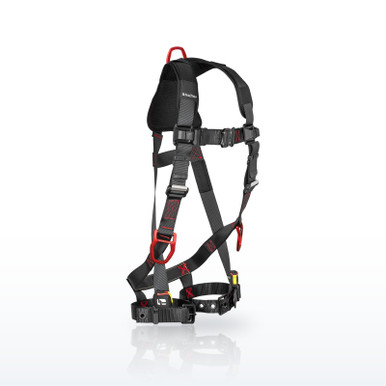 FallTech 8142 Harnesses, FT-Iron 3D Standard Non-Belted, Tongue Buckle LegsFT-Iron construction harness with back and side D-rings, the ironworker line (FallTech data)
Why the steel rule reads differently. Subpart M assumes a floor with an edge; Subpart R was negotiated for a structure that is still a skeleton. The members a connector stands on are the members being set, there is no deck to anchor to, the hazards include being struck by a swinging load and the structure not yet being stable, and in 2001 the equipment to tie off low and over an edge did not exist, which is why the rule carved out the connector exception and the controlled decking zone. FallTech’s guide makes the point that those carve-outs are permissions, not requirements: modern planning puts an anchor on the column or beam, uses a Class 2 SRL tested for the edge and the below-D-ring tie-off, and gets the connector protected inside the 15-to-30-foot band rather than leaving him to the exception. Its one-line summary is that crews should not wait for 30 feet to establish an anchorage; planning starts as soon as steel goes up.
1926.760, paragraph by paragraph
Condensed from the rule.
What FallTech states about the equipment on open steel
From the steel erectors guide and the product data:
- Many steel erection tasks call for Class 2 SRLs because of edge exposure: devices tested for sharp steel, lower tie-off heights and limited clearance; connectors often use personal SRLs, decking crews longer units to cover a bay.
- FallTech’s reading of an edge is that all steel edges are treated as sharp: decking transitions, flange edges and weld areas raise cut risk, and horizontal movement near exposed edges points to a leading-edge SRL.
- An ironworker harness carries reinforced shoulders and sub-pelvic areas for abrasion from beams, quick-adjust hardware for gloved hands, and tool-carrying capacity; FallTech’s FT-Iron line lists back and side D-rings on its product pages.
- Positioning lanyards hold a connector hands-free on a beam or column with a stand-by fall arrest system behind them.
- Anchors: beam clamps, sliding (trailing) beam anchors, fixed beam anchors and column straps, chosen for load direction and worker movement; raising the anchor reduces free fall and simplifies rescue. FallTech’s beam anchors attach to the bottom flange of an overhead beam or the top flange of the walking beam for trailing use; the BeamLock fits 4 to 14-inch flanges and lists Z359.18-2017 Type A.
- Horizontal lifelines are common for decking crews; deflection, anchor spacing and connector compatibility are addressed in the design.
- Steel is hard on equipment: abrasion, welding slag and metal-on-metal wear; FallTech directs removal when webbing is frayed or burned, connectors bent, housings cracked, lock-up fails or an anchor shows deformation after loading.
Questions people ask
At what height is fall protection required in steel erection?
15 feet above a lower level under 1926.760(a)(1), by guardrail, net, personal fall arrest, positioning device or fall restraint; connectors and controlled decking zones have the 15-to-30-foot provisions of (b) and (c). FallTech notes that exposure above 6 feet without protection can still be cited.
What equipment must connectors wear when working at heights over 15 and up to 30 feet?
At heights over 15 and up to 30 feet above a lower level each connector must be provided with a personal fall arrest system, positioning device system or fall restraint system “and wear the equipment necessary to be able to be tied off,” or be provided with other means of protection (guardrail, net or PFAS) under 1926.760(a)(1); above two stories or 30 feet, whichever is less, the connector must be protected, and every connector has completed connector training under 1926.761 (1926.760(b)). The harness, the lanyard or SRL and the anchorage connector are the equipment the sentence means.
What is the connector exception?
Between 15 and 30 feet a connector must be provided with a PFAS, positioning or restraint system and wear the gear to tie off, or be given other protection, but may elect not to tie off; above two stories or 30 feet the connector is protected per (a)(1).
What is a controlled decking zone?
A marked, limited-access area for the initial placement and securing of metal decking on a leading edge between 15 and 30 feet, no more than 90 by 90 feet, trained decking employees only, unsecured decking limited to 3,000 square feet (1926.760(c)). FallTech notes the CDZ was written before leading-edge devices existed.
Who inspects the harness, lanyard, connectors and anchor points before each use on open steel?
The user, before each use, under 1926.502(d)(21); the competent person for the formal inspection and for the perimeter safety cables, controlled decking zone and fall protection the erector installs. The controlling contractor who accepts the erector’s fall protection after the steel erector leaves takes on its inspection and maintenance (1926.760(e)).
What SRL is used in steel erection?
FallTech states many steel tasks call for Class 2 SRLs, tested for edge contact and anchorage up to 5 feet below the D-ring, with personal SRL-Ps common for connectors and longer cable units for decking bays; the device label and clearance chart govern.
Can you tie off to a beam?
With a beam anchor rated for it: FallTech’s beam anchors attach to the bottom flange of an overhead beam or the top flange of the walking beam for trailing use, within the flange range on the label (the BeamLock fits 4 to 14 inches) and the 5,000 lb or certified 2:1 anchorage rule.
Who owns the perimeter cables after the steel erector leaves?
1926.760(e): the controlling contractor, once it has inspected the fall protection and accepted control and responsibility in writing; otherwise the steel erector removes it.
The ratings, test results and standards shown here are the manufacturers' published values, reproduced as published. Nothing on this page is a recommendation by Bayshore Safety that any product is suitable for a particular task, hazard or workplace. Selecting safety products and protective equipment is the responsibility of the end user and the employer, based on their own hazard assessment and the regulations that apply to their work. Confirm every value on the manufacturer's own documentation before use.