
Bayshore Safety & Industrial Supplies Guide
What is a bloodborne pathogen exposure incident? Which body fluids are OPIM under OSHA 1910.1030, which fluid is the likely source, how pathogens are and are not transmitted, the hepatitis B vaccine, and what the employer must do after an exposure
OSHA 1910.1030 defines an exposure incident as "a specific eye, mouth, other mucous membrane, non-intact skin, or parenteral contact with blood or other potentially infectious materials that results from the performance of an employee’s duties", and parenteral as "piercing mucous membranes or the skin barrier through such events as needlesticks, human bites, cuts, and abrasions". Blood is the body fluid most likely to carry bloodborne pathogens; the rule defines them as "pathogenic microorganisms that are present in human blood and can cause disease in humans", naming hepatitis B virus (HBV) and HIV, and its list of other potentially infectious materials (OPIM) runs semen, vaginal secretions, cerebrospinal, synovial, pleural, pericardial, peritoneal and amniotic fluid, saliva in dental procedures, any body fluid visibly contaminated with blood, and all body fluids where it is difficult or impossible to tell them apart. Sweat, tears, urine, vomit and feces are not on the list unless they visibly contain blood. After an exposure incident the employer must make a confidential medical evaluation and follow-up immediately available, with the route and circumstances documented, the source individual identified and tested where the law allows, the exposed employee’s blood tested, and post-exposure prophylaxis offered as the U.S. Public Health Service currently states; the hepatitis B vaccine must be offered within 10 working days of assignment to every employee with occupational exposure.
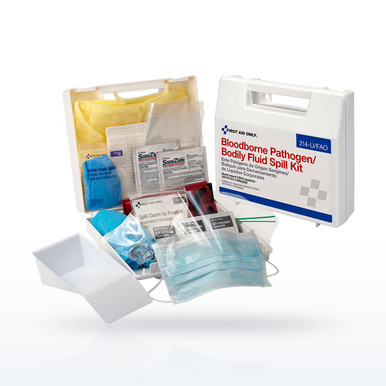 First Aid Only 214-U/FAO Bloodborne Pathogen Spill Kit, 23 Pieces, Plastic CaseFirst Aid Only prints a 23-piece bloodborne pathogen spill kit in a wall-mountable plastic case with gown, shoe covers, eye and face shield, gloves, scoop, solidifier, germicidal wipes and biohazard bags
Why the exposure questions get their own page. The live bloodborne pathogens guide explains what a bloodborne pathogen is and what 1910.1030 asks an employer to write and buy; the spill kit guide lists what goes in the kit. The questions this page takes are the ones training quizzes and new first aiders ask next: which fluid is the likely source, whether a toilet seat or a water fountain can pass a bloodborne pathogen, how long a virus stays infectious outside the body, what counts as an exposure incident, what happens in the hours after one, and whether there is a vaccine. The answers below are the rule’s own definitions and paragraphs, cited by letter, with the CDC and Public Health Service named where the rule points to them; we do not add medical advice of our own.
The rule’s definitions, 29 CFR 1910.1030(b)
| Term | What 1910.1030 says | What it means on a jobsite or in a plant |
|---|---|---|
| Bloodborne pathogens | "Pathogenic microorganisms that are present in human blood and can cause disease in humans. These pathogens include, but are not limited to, hepatitis B virus (HBV) and human immunodeficiency virus (HIV)." | HBV, HCV and HIV are the three the training names; the rule’s list is open |
| Other potentially infectious materials | Semen, vaginal secretions, cerebrospinal, synovial, pleural, pericardial, peritoneal and amniotic fluid, saliva in dental procedures, any body fluid visibly contaminated with blood, all body fluids where it is difficult or impossible to differentiate; unfixed human tissue; HIV or HBV cultures | Blood, and anything that might have blood in it; a bloody nose, a cut, a tooth knocked out |
| Occupational exposure | "Reasonably anticipated skin, eye, mucous membrane, or parenteral contact with blood or other potentially infectious materials that may result from the performance of an employee’s duties" | The designated first aiders, the people who clean up spills, anyone assigned to handle sharps |
| Exposure incident | "A specific eye, mouth, other mucous membrane, non-intact skin, or parenteral contact with blood or other potentially infectious materials that results from the performance of an employee’s duties" | Blood in the eye or mouth, blood on broken skin, a needlestick, a bite, a cut from a contaminated blade |
| Parenteral | "Piercing mucous membranes or the skin barrier through such events as needlesticks, human bites, cuts, and abrasions" | Through the skin, not onto it |
| Universal precautions | "An approach to infection control. According to the concept of Universal Precautions, all human blood and certain human body fluids are treated as if known to be infectious for HIV, HBV, and other bloodborne pathogens." | Gloves and a barrier every time, no exceptions for people you know |
| Regulated waste | Liquid or semi-liquid blood or OPIM; items that would release it if compressed; items caked with dried blood that can release it; contaminated sharps; pathological and microbiological waste | The soaked towels and the sharps go in the red bag or container; a bandage with a spot of blood usually does not |
Source: 29 CFR 1910.1030 Bloodborne pathogens (eCFR)
The questions, one by one
Which bodily fluid is most likely to be a source of bloodborne pathogens?
Blood. The rule’s definition of a bloodborne pathogen is a microorganism "present in human blood", and its OPIM list is built around blood: the named fluids, "any body fluid that is visibly contaminated with blood", and all body fluids where you cannot tell which fluid it is. Training programs answer the quiz question the same way, blood first, then the OPIM list.
What are bloodborne pathogens NOT found in, and are they disease-causing organisms carried in human blood?
Yes to the second: the definition is "pathogenic microorganisms that are present in human blood and can cause disease in humans". For the first, the rule does not list sweat, tears, saliva outside dental procedures, urine, vomit or feces as OPIM unless they are visibly contaminated with blood or cannot be distinguished from a listed fluid, which is where the "not found in" quiz answers come from. The practical rule is the universal precautions paragraph: when you cannot tell, treat it as infectious.
Can bloodborne pathogens be transmitted through sharing equipment like toilets and water fountains?
1910.1030 is written around contact with blood and OPIM through the eyes, mouth, mucous membranes, non-intact skin and parenteral routes; it does not treat an intact-skin touch of a shared surface as an exposure incident, and the CDC’s hepatitis B, hepatitis C and HIV pages (which the rule’s training paragraph points employers to) describe transmission through blood and the listed fluids, not through casual contact. We state the rule and leave the medical detail to those pages.
What are bloodborne pathogens primarily transmitted through, and how are blood-borne infections transferred from person to person?
Through the routes the rule names for an exposure incident: blood or OPIM reaching the eye, mouth or another mucous membrane, broken skin, or entering through the skin by a needlestick, bite, cut or abrasion. On a jobsite the usual version is a first aider without gloves and a bleeding coworker, or a sharp that was not put in a container.
What is considered a bloodborne pathogen exposure incident, and what are the OSHA guidelines after one?
The definition above: specific eye, mouth, mucous membrane, non-intact skin or parenteral contact with blood or OPIM in the course of the job. Paragraph (f)(3) then requires the employer to make "immediately available to the exposed employee a confidential medical evaluation and follow-up" with at least: documentation of the route and circumstances; identification and testing of the source individual where consent is obtained or not required by law; collection and testing of the exposed employee’s blood for HBV and HIV status (the employee may have the sample held for 90 days before deciding on testing); post-exposure prophylaxis "when medically indicated, as recommended by the U.S. Public Health Service"; counseling; and evaluation of reported illnesses. Paragraph (f)(5) requires a written opinion from the healthcare professional within 15 days.
What can be done to control exposure, and what is the most effective way to prevent transmission?
The rule’s order is engineering and work practice controls first (paragraph (d)(2): sharps containers, needleless systems, handwashing facilities, no recapping by hand, no eating where exposure can occur), then PPE (gloves, gowns, face shields, masks, eye protection, mouthpieces and resuscitation bags under (d)(3)), housekeeping and decontamination under (d)(4), the hepatitis B vaccine under (f)(1), and training under (g)(2). Universal precautions is the rule’s stated approach: every blood and listed fluid is handled as infectious. The band below lists the kits, apparel packs, face shields, gloves and sharps containers that fill those paragraphs.
What are engineering controls for bloodborne pathogens, and what tasks might involve exposure?
Engineering controls are defined as controls "that isolate or remove the bloodborne pathogens hazard from the workplace": sharps disposal containers, self-sheathing needles, safer medical devices and needleless systems. Exposure tasks in a non-medical workplace are rendering first aid, cleaning up a spill of blood or vomit with blood in it, handling the sharps a diabetic coworker or a drug user left behind, laundering contaminated clothing, and collecting regulated waste; the employer’s exposure control plan lists the job classifications and tasks under paragraph (c)(2).
How long do bloodborne pathogens stay infectious, and how long do viruses live in dried blood?
The rule does not give a number, and we do not either. Its regulated waste definition treats items "caked with dried blood" that can release it during handling as regulated, and its housekeeping paragraph requires surfaces to be decontaminated "immediately or as soon as feasible when surfaces are overtly contaminated or after any spill of blood"; both are written on the assumption that dried blood can still be infectious. The CDC’s hepatitis B page is the source for the survival figures people quote, and the body fluid spill guide linked below carries the cleanup steps.
How soon after exposure can symptoms develop?
That is a medical question the rule answers only by procedure: the post-exposure evaluation is "immediately available", the baseline blood draw is collected after the incident, and the healthcare professional’s written opinion comes within 15 days. The incubation periods for hepatitis B, hepatitis C and HIV are on the CDC pages the training paragraph (g)(2)(vii) points to; a first aider who has had an exposure reports it the same shift and lets the evaluation run.
How many people are carrying BBPs, and what is the most common chronic bloodborne infection?
Prevalence figures are the CDC’s, not OSHA’s, and they change year to year, so we do not print them. The rule’s position is universal precautions: because you cannot know who is carrying what, every exposure to blood is handled as if the source were infectious.
Is MRSA a bloodborne pathogen? Is syphilis? What are bloodborne diseases?
The rule names HBV and HIV and leaves the list open ("include, but are not limited to"); OSHA’s training materials and the CDC add hepatitis C. MRSA is a skin and surface bacterium rather than a bloodborne virus, and is handled under the same gloves-and-handwashing practices rather than this standard; syphilis is a bloodborne infection in the medical sense and can be transmitted through blood, but it is not one of the three the workplace training is built on. Bloodborne diseases, in the rule’s words, are the diseases those pathogens cause.
Is there a vaccine for bloodborne pathogens?
For hepatitis B, yes, and 1910.1030(f)(1) requires the employer to make the vaccination series available "after the employee has received the training ... and within 10 working days of initial assignment to all employees who have occupational exposure", at no cost, at a reasonable time and place, under the supervision of a licensed healthcare professional. An employee may decline by signing the declination statement in Appendix A and may accept later. There is no vaccine the rule names for HIV or hepatitis C.
Which statements about bloodborne pathogens are true?
The ones the rule makes: they are microorganisms in human blood that can cause disease; HBV and HIV are named and the list is open; OPIM includes the listed fluids and anything visibly bloody; an exposure incident is contact through the eye, mouth, mucous membrane, broken skin or a puncture; universal precautions treats all blood as infectious; the hepatitis B vaccine must be offered within 10 working days; the employer must have a written exposure control plan, provide PPE at no cost, and train employees at assignment and annually.
Where can I find the OSHA Bloodborne Pathogen Standard in PDF format?
On osha.gov under Laws and Regulations, 29 CFR 1910.1030, and on the eCFR, which is the copy we fetched for this page. OSHA 3317 is the first aid guide that carries the standard’s first-aid-provider paragraphs.
In plain words
- Blood is the fluid that carries bloodborne pathogens; the rule’s OPIM list adds the fluids that may contain blood.
- An exposure incident is blood or OPIM in the eye, mouth, a mucous membrane, broken skin, or through the skin by a needle, bite or cut.
- After one: report it, and the employer provides an immediate, confidential medical evaluation, source and employee testing, and follow-up.
- Universal precautions: treat every drop of blood as infectious, gloves every time.
- Hepatitis B vaccine offered within 10 working days of assignment, free; declination may be signed and reversed.
- Engineering controls and work practices first, then PPE, then housekeeping, then training.
- Dried blood is still handled as regulated waste and decontaminated.
Questions people ask
What is a bloodborne pathogen exposure incident?
Blood or OPIM contact with the eye, mouth, a mucous membrane, non-intact skin, or through the skin (needlestick, bite, cut, abrasion) in the course of the job.
Which bodily fluid is most likely to carry bloodborne pathogens?
Blood; the OPIM list is the fluids that may contain it.
What are other potentially infectious materials?
Semen, vaginal secretions, cerebrospinal, synovial, pleural, pericardial, peritoneal and amniotic fluid, dental saliva, any visibly bloody fluid, and fluids you cannot tell apart.
Are sweat, tears, urine and vomit OPIM?
Not unless visibly contaminated with blood or indistinguishable from a listed fluid.
Can a toilet seat or water fountain transmit a bloodborne pathogen?
The rule’s exposure routes are mucous membranes, broken skin and punctures, not intact-skin contact with a shared surface; the CDC pages carry the medical detail.
What must the employer do after an exposure?
Make a confidential medical evaluation immediately available: document the route, test the source where allowed, test the employee, offer prophylaxis per the Public Health Service, counsel, and give a written opinion within 15 days.
Is there a vaccine?
Hepatitis B, offered within 10 working days of assignment at no cost; none the rule names for HIV or hepatitis C.
How long do pathogens stay infectious in dried blood?
The rule gives no figure and treats dried blood as regulated waste; the CDC pages carry the survival figures.
What are engineering controls?
Controls that isolate or remove the hazard: sharps containers, self-sheathing needles, needleless systems, handwashing facilities.
What is universal precautions?
Treating all human blood and certain body fluids as if known to be infectious for HIV, HBV and other bloodborne pathogens.
Is MRSA a bloodborne pathogen?
No; it is a bacterium spread by skin and surface contact, handled by the same glove and handwashing practices but not under this standard.
Related guides
What is a bloodborne pathogen?What OSHA 1910.1030 requiresBloodborne pathogen spill kitsWhat should be in oneGloves for bloodborne pathogensWhat 1910.1030 asks of the gloveHow do you manage a body fluid spill?Vomit, dried blood, biohazard bags and labelsWhat do you do with a full sharps container?FDA and OSHA 1910.1030 disposal rulesBloodborne pathogens and protective clothingASTM F1670 and F1671The ratings, test results and standards shown here are the manufacturers' published values, reproduced as published. Nothing on this page is a recommendation by Bayshore Safety that any product is suitable for a particular task, hazard or workplace. Selecting safety products and protective equipment is the responsibility of the end user and the employer, based on their own hazard assessment and the regulations that apply to their work. Confirm every value on the manufacturer's own documentation before use.
© 2026 Bayshore Safety & Industrial Supplies, Inc. All rights reserved. This guide may not be copied or republished without written permission.