
Bayshore Safety & Industrial Supplies Guide
How do you manage a body fluid spill at work? Whether vomit, urine and dried blood are biohazards, what goes in a biohazard bag, the label and bag colors OSHA requires, a bodily fluid spill kit vs a bloodborne pathogen kit, and the cleanup steps
A body fluid spill at work is managed the way OSHA 1910.1030 and the First Aid Only bodily fluid pick-up guide in each kit describe it: keep people away, put on the PPE in the kit (gloves at minimum; gown, shoe covers and an eye and face shield when there is blood or splashing), pour the solidifier powder over the liquid, scoop the gelled mass and any broken glass into the biohazard bag, wipe the surface with the germicidal wipes, bag the used PPE and towels with it, tie or zip-tie the bag, label it, wash your hands, and restock the kit. Under the rule, blood and the listed other potentially infectious materials (OPIM) are the regulated hazard; vomit, urine and feces are not OPIM unless they visibly contain blood or cannot be told apart from a listed fluid, which is why First Aid Only sells a bodily fluid spill kit with minimal PPE for the no-blood spill and a bloodborne pathogen kit with full PPE for the rest. Dried blood is still treated as regulated waste when it can flake off during handling. Biohazard labels must be fluorescent orange or orange-red with the symbol and the word BIOHAZARD in a contrasting color; red bags or red containers may be used instead of labels.
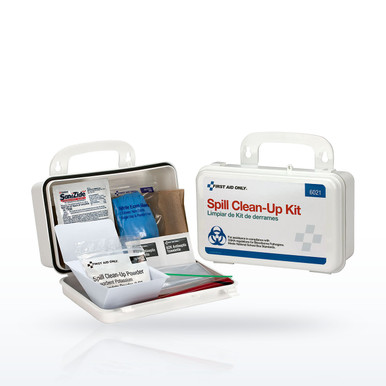 First Aid Only 6021 Bloodborne Pathogen Spill Kit, 21 Pieces, Plastic CaseFirst Aid Only prints a 21-piece bodily fluid spill clean-up kit in a wall-mountable plastic case: biohazard bag, scoop, pick-up guide, BZK towelettes, clean-up towels, germicidal wipe, gloves and solidifier powder
Why there are two kits. The question that drives this page is "is this a biohazard?", asked about vomit in a break room, urine on a warehouse floor, a dried bloodstain on a bench. First Aid Only’s mini brochure draws the line the way the rule does: a spill with blood or OPIM gets the bloodborne pathogen kit with PPE; a questionable spill gets the same kit under universal precautions; an uncontaminated spill (no blood) gets the bodily fluid spill kit, which "will have minimal personal protection, as there would be no risk of exposure". This page prints that decision, the cleanup steps as the kit guide and the rule’s housekeeping paragraph state them, the label and bag colors, and what goes in the bag.
How to clean up a body fluid spill, as the First Aid Only pick-up guide and 1910.1030(d)(4) state it
Every First Aid Only spill kit carries a bodily fluid pick-up guide; these are its steps with the rule’s housekeeping paragraph beside them.
- Keep people away from the spill and get the kit. Decide which kit: blood or anything that might contain blood, or a spill you cannot identify, is the bloodborne pathogen kit; a known no-blood spill (vomit, urine) is the bodily fluid kit.
- Put on the PPE in the kit: nitrile gloves always; the disposable gown, shoe covers and eye and face shield when there is blood, a large spill, or any chance of splashing (1910.1030(d)(3) requires PPE that keeps blood and OPIM from reaching your clothes, skin, eyes and mouth).
- Cover the liquid with the solidifier or Spill Magic powder and let it gel; this is what makes a liquid spill scoopable.
- Scoop the gelled material, with any broken glass or sharps picked up with the scoop and scraper rather than by hand, into the biohazard bag. 1910.1030(d)(4)(ii)(D) forbids picking up broken contaminated glassware directly with the hands.
- Wipe the surface with the germicidal wipes; the rule requires surfaces to be decontaminated with an appropriate disinfectant "immediately or as soon as feasible" after any spill of blood or OPIM.
- Put the used towels, wipes and PPE in the biohazard bag, tie or zip-tie it, and attach the hazard ID label if the bag is not already a labeled red bag.
- Wash your hands with soap and water (1910.1030(d)(2)(v): "immediately or as soon as feasible after removal of gloves"); the BZK towelettes in the kit are for when a sink is not at hand, followed by handwashing as soon as feasible.
- Dispose of the bag as regulated waste if it holds blood or OPIM (closable, leak-proof, labeled or color-coded, per (g)(1)); a no-blood spill bag goes with ordinary trash under the site’s rules. Restock the kit the same day.
The questions, one by one
Is human vomit a biohazard? Is urine?
Under 1910.1030, vomit and urine are not on the OPIM list and are not regulated unless they are visibly contaminated with blood or cannot be told apart from a listed fluid. That is the line First Aid Only draws between its bodily fluid spill kit (no blood expected, minimal PPE) and its bloodborne pathogen kit (blood or OPIM, full PPE). Either way the cleanup wears gloves and uses the solidifier, scoop and germicidal wipes; the difference is the gown, shoe covers and face shield, and whether the bag is regulated waste.
Is dried blood still considered a biohazard, and how long do diseases last in dried blood?
The rule treats items "caked with dried blood or other potentially infectious materials and ... capable of releasing these materials during handling" as regulated waste, and requires contaminated surfaces to be decontaminated; dried blood is cleaned up with the same gloves and disinfectant as wet blood. How long a virus survives in dried blood is a CDC figure, not an OSHA one, and we do not print it; the practice does not change with it.
What is considered a biohazard, and what is considered biohazardous waste?
For this rule, blood and OPIM and anything contaminated with them. Regulated waste is liquid or semi-liquid blood or OPIM, items that would release it if compressed, items caked with dried blood that can release it, contaminated sharps, and pathological and microbiological waste. 1910.145(e)(4) and (f)(8) use the biological hazard sign and tag for the same thing: "infectious agents presenting a risk or potential risk to the well-being of man".
What color are biohazard labels required to be, and what are the OSHA requirements for biohazard labeling?
1910.1030(g)(1)(i): warning labels on containers of regulated waste, refrigerators and freezers holding blood or OPIM, and containers used to store, transport or ship them, carrying the biohazard legend; "these labels shall be fluorescent orange or orange-red or predominantly so, with lettering and symbols in a contrasting color", affixed as close as feasible to the container by string, wire, adhesive or another method that prevents loss. Red bags or red containers may be substituted for labels. The hazard ID label in the First Aid Only kits is that label.
Which color bag is used for infectious waste, and what kind of waste goes in the red bag?
Red bags or red containers substitute for the orange-red biohazard label, so a red bag is regulated waste: liquid or semi-liquid blood or OPIM, soaked dressings and towels that would release it if compressed, items caked with dried blood, and (in a rigid container, not a bag) contaminated sharps. A bandage with a spot of blood, a glove with no visible blood, or the no-blood vomit cleanup does not have to go in the red bag under the federal rule; state and local medical waste rules can be stricter, and the site follows those.
How do I clean up a spill of bloodborne pathogens, and how do you manage a body fluid spill?
The eight steps above: isolate, PPE, solidify, scoop, disinfect, bag and label, wash hands, dispose and restock. The live chemical spill guide covers chemical spills; a blood spill is never cleaned with the chemical spill kit’s absorbent because that kit has no PPE for blood and its waste is not bagged as regulated.
How do you manage urine spills in a hospital setting, and how do I clean blood spillage in a hospital?
Hospitals follow their own infection control policies written to 1910.1030 and the CDC’s guidelines, with housekeeping staff trained under the rule; this page is written for the non-medical workplace, where the same rule applies through the first aiders and the people assigned to clean up. The steps and the kit contents are the same; the hospital adds its own disinfectant contact times and waste contracts.
What is a body fluid cleanup kit, and what are some good spill kits for bodily fluids?
First Aid Only’s bodily fluid spill kits (6021 in a wall-mountable plastic case, 91297 as a disposable bag, both 21 pieces) carry a 10-gallon biohazard bag, scoop, pick-up guide, BZK towelettes, a clear bag, 10 clean-up towels, a germicidal wipe, nitrile gloves, 2 ounces of solidifier and a twist tie. The bloodborne pathogen kits add the gown, shoe covers, eye and face shield and a second bag; the school and campus sheet pairs the SM-BIOHAZARD disposable bag (Spill Magic encapsulator, mini dustpan and broom, hard floors) with the 214-U/FAO case (solidifier, scraper set, hard floors and carpet). The band lists them with the piece counts First Aid Only prints.
What should be in a blood spill kit, and what should be used to clean up a blood spill?
The PPE the rule names for the task (gloves, gown, eye and face protection, shoe covers), a solidifier, a scoop and scraper, biohazard bags and a label, germicidal wipes or an EPA-registered disinfectant, hand cleaning, and a guide. The live spill kit contents guide walks the list item by item; this page is about using it.
What are the steps involved in cleanup of a biohazard spill, and what is the first step?
The first step is to keep everyone away and put on the PPE before touching anything; the rest is the numbered list above. The rule’s own first step is written into the exposure control plan: who is assigned to clean up, which kit, and where the waste goes.
How much does biohazard disposal cost, and what is a biohazard disposal fee?
Regulated waste leaves a site through a licensed medical waste hauler or a mail-back program, priced per container or per pickup by the hauler; a small shop that generates a bag a year usually uses a mail-back box. We sell the kits, bags and sharps containers, not the hauling, so we do not quote a fee.
What is a biohazard specimen bag, and what are biohazard bags used for?
A specimen bag is the labeled zip bag a lab uses to transport a sample; the biohazard bags in a spill kit (24 x 24 inch, 10 gallon, printed with the symbol) are for the regulated waste from a cleanup: the gelled spill, the towels, the PPE. The bag is tied closed, labeled or red, and not reused.
What cleaner is used for bodily fluids?
The rule says "an appropriate disinfectant"; OSHA’s enforcement guidance accepts EPA-registered disinfectants labeled for HBV and HIV, or a fresh dilution of household bleach. The germicidal wipes in the First Aid Only kits are the packaged version; a site that uses a bottled disinfectant follows the contact time on its label.
In plain words
- Blood or anything that might contain blood: bloodborne pathogen kit, full PPE, red bag or labeled bag, regulated waste.
- Vomit or urine with no blood: bodily fluid kit, gloves, same powder-scoop-wipe steps, ordinary disposal under site rules.
- Dried blood is cleaned up and bagged the same as wet blood.
- Labels: fluorescent orange or orange-red with the symbol; a red bag or container can replace the label.
- Never pick up contaminated glass by hand; use the scoop and scraper.
- Wash hands as soon as the gloves come off; the towelettes are a stopgap.
- Restock the kit the same day; a kit is one spill.
Questions people ask
How do you manage a body fluid spill?
Isolate, put on the kit’s PPE, solidify, scoop into the biohazard bag, disinfect the surface, bag the PPE, label, wash hands, dispose and restock.
Is human vomit a biohazard?
Not under 1910.1030 unless it visibly contains blood; it gets the bodily fluid kit and gloves.
Is dried blood still a biohazard?
Yes for cleanup and disposal: items caked with dried blood that can release it are regulated waste.
What color are biohazard labels?
Fluorescent orange or orange-red with the symbol and legend in a contrasting color; red bags or containers may substitute.
What goes in the red bag?
Liquid or semi-liquid blood or OPIM, items that would release it if compressed, items caked with dried blood; sharps go in a rigid container.
What is the difference between a bodily fluid spill kit and a bloodborne pathogen kit?
The PPE: the BBP kit adds gown, shoe covers and an eye and face shield for blood or OPIM; the bodily fluid kit is for no-blood spills.
What is a body fluid cleanup kit?
A bag or case with biohazard bag, scoop, solidifier, towels, germicidal wipe, gloves, towelettes and a pick-up guide; First Aid Only’s hold 21 pieces.
What cleaner is used for bodily fluids?
The rule says an appropriate disinfectant; the kits carry germicidal wipes, and a bottled disinfectant is used per its label.
Can I pick up broken glass from a blood spill by hand?
No; 1910.1030 requires a brush, dustpan, tongs or forceps, which is what the kit’s scoop and scraper are for.
How much does biohazard disposal cost?
Set by the medical waste hauler or mail-back program; we sell the kits and containers, not the hauling.
Related guides
Bloodborne pathogen spill kitsWhat should be in oneWhat is a bloodborne pathogen?What OSHA 1910.1030 requiresWhat is a bloodborne pathogen exposure incident?OPIM, transmission, the vaccine and what follows an exposureWhat do you do with a full sharps container?FDA and OSHA 1910.1030 disposal rulesHow to clean up a chemical spillThe steps and the PPEGloves for bloodborne pathogensWhat 1910.1030 asks of the gloveThe ratings, test results and standards shown here are the manufacturers' published values, reproduced as published. Nothing on this page is a recommendation by Bayshore Safety that any product is suitable for a particular task, hazard or workplace. Selecting safety products and protective equipment is the responsibility of the end user and the employer, based on their own hazard assessment and the regulations that apply to their work. Confirm every value on the manufacturer's own documentation before use.
© 2026 Bayshore Safety & Industrial Supplies, Inc. All rights reserved. This guide may not be copied or republished without written permission.