
Bayshore Safety & Industrial Supplies Guide
What are the warning signs of carbon monoxide? The symptoms, where CO comes from, what a CO detector reads and does not, where to place it, the ppm numbers, and how long CO stays in the body
Carbon monoxide has no warning sign of its own: it is colorless, odorless and tasteless, so the two signs people actually get are the symptoms in a person and the alarm on a detector. The symptoms are headache, dizziness, weakness, nausea, vomiting, chest pain and confusion, often described as flu-like, with no fever, and hitting more than one person in the same building at once; the detector sign is a reading above zero in parts per million, because fresh air carries none. CO comes from anything burning a carbon fuel incompletely, so the places to think about are engines, furnaces, water heaters, stoves, generators, grills and charcoal, not the electrical system. At work the legal limit is 50 ppm averaged over 8 hours, NIOSH sets 35 ppm with a 200 ppm ceiling, and 1,200 ppm is immediately dangerous to life.
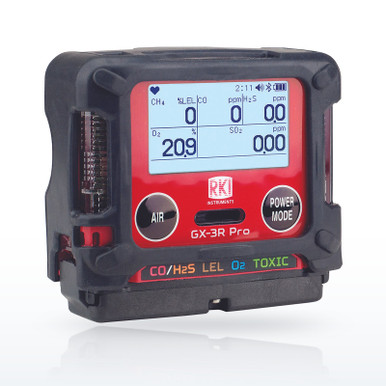 RKI Instruments 72-PRX-A Single Gas Monitors, GX-3R Pro Single-Gas Monitor CORKI GX-3R Pro single-gas CO monitor: 0 to 2,000 ppm, alarms preset at 25 and 50 ppm, Bluetooth to a phone app
The question “what are two warning signs of carbon monoxide” is asked about a house, and the answer is the same in a house, a shop, a warehouse or a manhole: a person with the symptoms and an instrument with a number. This page takes the home questions first, in the words people ask them, and then the work side, where the numbers come from OSHA and NIOSH and the detector is a personal monitor worn on the collar. The facts are from the CDC, the OSHA fact sheet, the NIOSH Pocket Guide and the manufacturer manuals for the monitors we sell; we are an industrial safety supplier and we do not sell residential CO alarms, so where a home alarm is the right tool we say so.
The warning signs, the sources and the detector, question by question
Every answer names its source. The CDC pages were updated Oct 26 and Aug 21 2026; the OSHA fact sheet is current.
CDC, Carbon Monoxide Poisoning Basics; CDC Clinical Guidance for CO Poisoning; OSHA Fact Sheet, Carbon Monoxide Poisoning.
NIOSH Pocket Guide, carbon monoxide; OSHA Fact Sheet, Carbon Monoxide Poisoning.
CDC, Carbon Monoxide Poisoning Basics (sources, reducing risk, CO detectors).
RKI Instruments GX-3R Pro Operator’s Manual, Table 1 and Appendix C Table 18 (ESR-A13P-CO interference chart); GX-Force Operator’s Manual, Appendix D Table 23.
RKI Instruments GX-3R Pro and GX-Force Operator’s Manuals, Table 1 (CO range, LDL, increment, alarm points); NIOSH Pocket Guide, carbon monoxide; 29 CFR 1910.1000 Table Z-1.
29 CFR 1910.1000 Table Z-1; NIOSH Pocket Guide, carbon monoxide; NIOSH IDLH documentation, carbon monoxide; OSHA Fact Sheet, Carbon Monoxide Poisoning (maritime 100 and 200 ppm).
CDC, Carbon Monoxide Poisoning Basics (CO detectors); OSHA Fact Sheet, Carbon Monoxide Poisoning (employer actions); NIOSH Pocket Guide, carbon monoxide.
CDC, Carbon Monoxide Poisoning Basics (oil and gas furnaces, chimneys); OSHA Fact Sheet, Carbon Monoxide Poisoning; RKI Instruments GX-3R Pro Operator’s Manual, Appendix C Table 18.
CDC Clinical Guidance for Carbon Monoxide Poisoning (management, confirmation of diagnosis, common questions); CDC, Carbon Monoxide Poisoning Basics (risk factors); OSHA Fact Sheet, Carbon Monoxide Poisoning.
OSHA Fact Sheet, Carbon Monoxide Poisoning (what to do, employer and employee actions).
Carbon monoxide in plain words
- Carbon monoxide (CO) is the gas made when a carbon fuel burns without enough air. Natural gas, propane, gasoline, diesel, kerosene, oil, coal, charcoal and wood all make it; electricity does not.
- It has no color, odor or taste. The smell people call “gas” is an odorant added to natural gas and propane; CO itself gives no warning, which is why a detector exists.
- The warning signs in a person are headache, dizziness, weakness, nausea, vomiting, chest pain and confusion, without a fever, often in several people at once.
- A CO detector reads one gas. It does not read natural gas, propane or smoke; a combination alarm has a second sensor inside.
- In clean air the reading is zero. At work the numbers are 50 ppm (OSHA 8-hour limit), 35 ppm and a 200 ppm ceiling (NIOSH), 1,200 ppm (NIOSH IDLH, immediately dangerous to life).
- A home alarm is placed near every sleeping area and replaced on the manufacturer’s schedule or at 5 years (CDC). A work monitor is worn in the breathing zone and bump tested before each day’s use (RKI).
- If an alarm sounds, everyone goes to fresh air and help is called before anyone goes back in. Opening windows comes after, not instead.
- CO leaves the blood as a person breathes clean air; 100 percent oxygen for about 4 to 5 hours is the CDC’s usual treatment, and damage to the heart and brain can outlast the gas.
Carbon monoxide: the published numbers and what each one is
| Figure | Who sets it | What it means |
|---|---|---|
| 0 ppm | Clean air | A CO sensor in fresh air reads zero; RKI lists a 3 ppm lowest detectable limit and 1 ppm steps |
| 25 ppm | RKI preset warning; ACGIH TLV (8-hour) | First alarm on an RKI personal monitor; also the TWA alarm preset |
| 35 ppm | NIOSH REL (8-hour average) | NIOSH’s exposure limit for a shift |
| 50 ppm | OSHA PEL (8-hour average), 29 CFR 1910.1000 Table Z-1 | The legal limit in general industry, construction and shipyards; RKI’s second alarm preset |
| 100 ppm | OSHA maritime | Workers are removed from exposure above 100 ppm (OSHA fact sheet) |
| 200 ppm | NIOSH ceiling; RKI STEL preset | Never to be exceeded; the 15-minute alarm on the monitor |
| 1,200 ppm | NIOSH IDLH; RKI high alarm preset | Immediately dangerous to life or health; only a pressure-demand SCBA or combination airline respirator is allowed |
| 12.5 to 74 percent by volume | NIOSH Pocket Guide (LEL and UEL) | The range in which CO itself can burn: 125,000 ppm and up, far above any toxic figure |
ACGIH figures are from the ACGIH TLV booklet as cited on the exposure-limit guide; every other number is from the source in the column.
Source: NIOSH Pocket Guide to Chemical Hazards, carbon monoxide; 29 CFR 1910.1000 Table Z-1; OSHA Fact Sheet, Carbon Monoxide Poisoning; NIOSH IDLH documentation, carbon monoxide; RKI Instruments GX-3R Pro Operator’s Manual Table 1.
What an RKI CO sensor reads when another gas is present (interference chart)
| Gas applied | Concentration applied | CO reading |
|---|---|---|
| Methane (natural gas) | 1.25 percent by volume | 0 ppm |
| Propane | 0.5 percent by volume | 0 ppm |
| Carbon dioxide | 100 percent by volume | 8 ppm |
| Hydrogen sulfide | 30 ppm | 0 ppm |
| Hydrogen | 100 ppm | 11 ppm (the H2-compensated sensor is built to subtract this) |
| Acetylene | 99.6 ppm | 50 ppm |
| Nitrogen monoxide | 99.2 ppm | 53 ppm |
| Silane | 29.9 ppm | 27 ppm |
| Ethanol | 0.825 percent by volume | 2 ppm (may fluctuate) |
Natural gas and propane do not register on a CO sensor; they are read by the combustible (LEL) sensor of a multi-gas monitor.
Source: RKI Instruments GX-3R Pro Operator’s Manual, Appendix C, Table 18, Interference Chart for ESR-A13P-CO (the same chart is Table 23 in the GX-Force manual). RKI states the values are approximate and vary between sensors.
Questions people ask
What are two warning signs of carbon monoxide in a house?
The symptoms in people (headache, dizziness, weakness, nausea, vomiting, chest pain, confusion, with no fever and often in more than one person) and a CO detector alarm. The gas itself is colorless, odorless and tasteless and gives no sign.
What kind of gas does a carbon monoxide detector detect?
Carbon monoxide only. A CO sensor is an electrochemical cell for CO; natural gas, propane and other fuels are read by a combustible (LEL) sensor. RKI’s interference chart shows methane and propane producing a 0 ppm reading on the CO sensor.
What is a normal reading on a carbon monoxide detector?
Zero. Clean air has no CO at the level a sensor reads; RKI’s CO sensor has a 3 ppm lowest detectable limit, so a steady 1 or 2 ppm is sensor floor and anything from about 5 ppm up is gas.
How many ppm is bad for CO?
The published limits: 35 ppm is NIOSH’s 8-hour average, 50 ppm is OSHA’s legal 8-hour average, 200 ppm is the NIOSH ceiling never to be exceeded, 1,200 ppm is immediately dangerous to life or health.
Is 220 ppm CO bad?
Yes. It is above the NIOSH ceiling of 200 ppm, which is never to be exceeded even briefly, and more than four times OSHA’s 50 ppm shift average. A personal monitor’s STEL alarm is preset at 200 ppm.
Is 40 ppm CO bad?
It is above NIOSH’s 35 ppm 8-hour average and below OSHA’s 50 ppm legal average, so as a shift average it is over the NIOSH limit; as a brief reading it is below every short-term figure. Find the source.
What are the differences between carbon monoxide and natural gas leaks?
Natural gas is methane with an odorant added so a leak smells; it is flammable and read in percent LEL. Carbon monoxide is odorless, comes from burning fuel rather than from the fuel itself, poisons at 50 ppm, and is read in ppm by a different sensor.
Why is my carbon monoxide detector going off near my furnace?
A furnace is a combustion appliance; a failed heat exchanger, a loose or back-sloped vent, a blocked chimney or a bad burner puts CO into the room. Treat the alarm as real, get to fresh air, and have the appliance checked before it runs again.
How long does CO stay in your body?
It leaves as you breathe clean air, faster on oxygen: the CDC gives 100 percent oxygen until the patient is symptom-free, usually about 4 to 5 hours, and says a blood test is less useful after several hours of room air because the level has already fallen.
How long does it take to recover from CO poisoning?
Hours for the gas to clear on oxygen; the CDC warns of possible delayed neurological complications, re-examines patients in 2 weeks, and says cardiac injury during poisoning raises mortality risk in the following 10 years. OSHA says acute poisoning may permanently damage the heart and brain.
Does an all electric house need a carbon monoxide detector?
The CDC’s advice to install detectors near every sleeping area has no exception for electric homes; an electric house has no appliance source, but generators, grills, a car in an attached garage or a neighbor’s exhaust still produces CO.
Where should I place a CO detector?
The CDC says near every sleeping area, battery-powered or battery backed up, replaced per the manufacturer or every 5 years. Room-by-room placement and count are set by state and local codes. At work the monitor is worn in the breathing zone.
Can a cell phone detect carbon monoxide?
No. A phone has no gas sensor. A phone can display readings from a monitor that transmits to it: RKI’s GX-3R Pro sends its readings over Bluetooth to a host within 30 feet, but the sensing is still done by the electrochemical cell in the monitor.
Does a carbon monoxide detector detect gas?
Not natural gas or propane. Those need a combustible sensor. A combination home alarm, or a four-gas monitor at work, has both sensors in one unit.
Is carbon monoxide explosive?
Only at very high concentrations: the NIOSH Pocket Guide lists a lower explosive limit of 12.5 percent and an upper limit of 74 percent by volume, which is 125,000 ppm against a 50 ppm exposure limit. The poisoning comes long before the fire hazard.
How long do CO detectors last?
The CDC says to replace a home CO detector following the manufacturer’s instructions or every 5 years. A workplace monitor’s electrochemical CO sensor is a replaceable part; the sensor-life guide linked below covers the manufacturers’ figures.
Does opening windows help with carbon monoxide?
It dilutes the gas in the room but does not remove the source or the person. OSHA’s first step is to move the victim to fresh air in an open area and call 911; ventilation is what happens after everyone is out.
What is the 8-hour safe exposure limit for carbon monoxide?
OSHA’s permissible exposure limit is 50 ppm averaged over 8 hours (29 CFR 1910.1000 Table Z-1); NIOSH’s REL is 35 ppm over 8 hours with a 200 ppm ceiling.
What CO defaults do the wearable monitors ship with?
Honeywell BW: 35 ppm low and 200 ppm high on the Clip, MicroClip and MAX XT II; MSA: 25 ppm low and 100 ppm high on the ALTAIR, 2X, 4X and 5X; both state the points are adjustable.
Related guides
What is the carbon monoxide exposure limit at work?OSHA, NIOSH and the ppm numbersWhat is TWA, STEL and ceiling?The three shapes of an exposure limitSingle-gas vs multi-gas detectorsWhich does the job need?What does a 4-gas monitor measure?And why those fourGas detector sensor lifeWhen to replace sensorsBump test vs calibrationWhat each does and how oftenThe ratings, test results and standards shown here are the manufacturers' published values, reproduced as published. Nothing on this page is a recommendation by Bayshore Safety that any product is suitable for a particular task, hazard or workplace. Selecting safety products and protective equipment is the responsibility of the end user and the employer, based on their own hazard assessment and the regulations that apply to their work. Confirm every value on the manufacturer's own documentation before use.
© 2026 Bayshore Safety & Industrial Supplies, Inc. All rights reserved. This guide may not be copied or republished without written permission.