
Bayshore Safety & Industrial Supplies Guide
What are the 5 P’s for cold weather? Cold weather first aid supplies for crews: hand warmers and the reaction inside them, emergency blankets, hot packs, and the first aid OSHA and the Red Cross state for frostbite, hypothermia and trench foot
The P’s for cold weather are the National Weather Service’s four: "protect the 4 P’s: people, pets, pipes, and plants"; local emergency managers add a fifth, practice fire safety, and the "5 P’s of emergency" people also ask about is a different mnemonic from preparedness training. For a crew the first P is the only one that is first aid, and OSHA’s cold stress page states what that first aid is. Frostbite: get into a warm room, do not walk on frostbitten feet unless necessary, protect the area by wrapping it loosely in a dry cloth, "DO NOT rub or massage the affected area", "DO NOT try to re-warm the frostbitten area before getting medical help", give warm sweetened drinks if alert. Hypothermia: call 911, move the worker to a warm room or vehicle, remove wet clothing and replace it with dry, wrap the entire body including the head and neck in layers of blankets with a vapor barrier, do not cover the face, give warm sweetened drinks if alert, "place warm bottles or hot packs in armpits, sides of chest, and groin", and give CPR if there is no pulse. Trench foot: remove wet boots and socks, dry and elevate the feet, do not walk on them, get medical attention. The supplies those steps name are what a cold-weather crew carries: blankets and a vapor barrier, hot packs or hand warmers for the armpits, chest and groin, dry socks and gloves, warm sweet drinks, and a way to call 911. Hand warmers are air-activated: open the pack and the contents react with the air; PIP states its heat packs reach full temperature in 2 to 5 minutes, give over 8 hours of warmth, and can be paused by resealing them in an airtight container; First Aid Only states its Heat Factory warmers give up to 8 hours per pack.
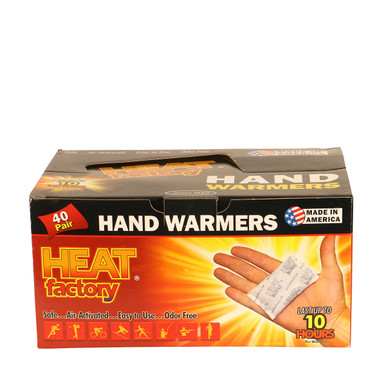 First Aid Only 90866 Hand Warmers, 40 x 2 per BoxFirst Aid Only prints Heat Factory hand warmers, 40 two-packs per box, up to 8 hours of warming heat per pack
Why the cold questions are mostly about what to carry. The live cold stress guide covers the hazard: what cold stress is, wind chill, how to dress, the first signs of hypothermia, why not to rub frostbite. What it does not do is list the first aid supplies and explain the hand warmer. This page takes the questions that are left (the P’s, the reaction inside a hand warmer, whether the packs are safe, whether an instant ice pack can be refrozen) and prints the OSHA and Red Cross first aid steps beside the item in the kit that each step names, so a foreman stocking a truck for January knows why the blanket, the hot packs and the dry socks are there.
The OSHA cold stress first aid steps, and the kit item each names
| Condition | OSHA’s first aid steps (winter weather cold stress page) | Red Cross addition | What is in the truck for it |
|---|---|---|---|
| Frostbite | Get into a warm room; do not walk on frostbitten feet unless necessary; wrap the area loosely in a dry cloth and protect it until medical help; do not rub or massage; do not try to re-warm before getting medical help (no heating pads, no warm water); if rewarmed and refrozen, more damage; warm sweetened drinks if alert | Remove wet clothing and jewelry; immerse in clean lukewarm water (not over 99 to 104 °F) only where that is the care given; do not break blisters; after rewarming, loosely bandage with dry sterile bandage, gauze between fingers and toes; never rub; never let it refreeze | Dry cloth or sterile gauze and roller bandage, a blanket, a thermos of something warm and sweet, a phone |
| Hypothermia | Call 911; move to a warm room or vehicle; remove wet clothing, replace with dry; wrap the entire body (including head and neck) in layers of blankets and a vapor barrier (tarp, garbage bag); do not cover the face; warm sweetened drinks if alert, never to an unconscious person; warm bottles or hot packs in armpits, sides of chest and groin; CPR if no pulse | Rewarm slowly, rapid rewarming can cause dangerous heart rhythms; dry the person, dry clothing including hat, gloves and socks; wrap heating pads or hot water bottles in thin dry cloth; small sips of warm non-caffeinated liquid if alert; care for shock; be ready for CPR and the AED | Emergency blankets, a wool or foam blanket, a tarp or large bag for the vapor barrier, hot packs and hand warmers, dry socks, hat and gloves, a thermos, a stretcher to move the person |
| Trench foot | Call 911 in an emergency, otherwise seek medical assistance soon; remove wet shoes, boots and socks; dry the feet; avoid working on them; keep the feet elevated | Dry socks, a towel, a blanket, a place to sit | |
| Chilblains | Avoid scratching; slowly warm the skin; corticosteroid cream for itching and swelling (as the OSHA page states it); keep blisters and ulcers clean and covered | Hydrocortisone packets as labeled, sterile pads and tape |
Source: OSHA Winter Weather: Cold Stress page (osha.gov); American Red Cross Learn First Aid, Frostbite and Hypothermia (redcross.org)
The questions, one by one
What are the 5 P’s for cold weather, and the five P’s of winter safety?
The National Weather Service prints four: "protect the 4 P’s: people, pets, pipes, and plants", with people meaning minimize time outdoors, prepare for power outages and check on the elderly and vulnerable; pets kept warm, dry and indoors; pipes insulated, cabinets opened, hoses disconnected; plants covered. Local emergency managers add a fifth P, practice fire safety (space heaters and generators), and some lists say "prepare" or "pavement". For a crew the list is a reminder that the people P is first aid and the rest is the yard and the building.
What are the 5 P’s of emergency, and the 5 P’s of disaster?
A different mnemonic from preparedness classes: people, prescriptions, papers, personal needs and priceless items, which is what to grab when evacuating; some versions use plan, prepare, practice, protect, and people. The pass-1 72-hour kit guide covers the evacuation kit; the cold P’s above are the National Weather Service’s.
What is the chemical reaction behind hand warmers, and are hand warmer packs safe?
The disposable packs are air-activated: opening the pouch lets air reach the contents and the reaction that follows gives off heat for hours. PIP states its heat packs "reach full temperature in 2-5 minutes", "generate over 8 hours of warmth", and that "heating can be suspended at any time by resealing the inserts in an airtight container"; First Aid Only states up to 8 hours per pack. The usual contents of this kind of warmer are iron powder with salt, water, carbon and vermiculite, and the heat is the iron rusting quickly; the packs we sell do not print their formula, so we state that as the common description and not as a label claim. The safety line on the label is the one to follow: against the skin inside a glove or pocket, not on bare skin for long periods, not on a person who cannot feel it, and, per OSHA’s hypothermia steps, hot packs for rewarming go in the armpits, chest and groin wrapped in cloth.
Can you refreeze instant ice?
No. An instant cold pack is a one-time chemical reaction (the water pouch breaks into the salt) and once it has gone cold it is finished; the pass-1 cold pack guide explains it. The reusable gel packs (First Aid Only’s hot/cold packs in the band) are the ones that go in a freezer or hot water and come back; those are what a cold-weather crew uses as hot packs.
Should you rub frostbite, or put it in warm water?
OSHA: do not rub or massage, and do not try to re-warm the frostbitten area before getting medical help, because rewarming followed by refreezing does more damage. The Red Cross frostbite page describes immersion in lukewarm water not over 99 to 104 °F as the care where rewarming is being done and refreezing can be prevented, with the same no-rubbing and no-refreezing rules. On a jobsite where the person is going to a clinic, OSHA’s version applies: protect it, keep it dry, move the person inside, and let the clinic rewarm it.
What goes in a cold-weather first aid kit for a crew?
The ordinary Class A kit plus what the steps above name: two or more emergency blankets and a wool or foam blanket, a tarp or contractor bag for the vapor barrier, hot packs or hand warmers, dry socks, hat and gloves in a bag, a thermos for warm sweet drinks, hydrocortisone packets, sterile gauze and roller bandage for a frostbitten hand, and a stretcher if the site is far from the truck. The outdoor and preparedness kits in the band carry blankets; the response bag carries the rest.
Which outdoor tape for cold weather, and what do I need if I lose power in winter?
The tape question is a building question, not a first aid one; the power outage question is the 72-hour kit guide’s (blankets, water, a radio and flashlight, food rations), and the preparedness kits in the band are First Aid Only’s version. We leave the tape to the hardware aisle.
Does OSHA have a cold weather standard?
No; its cold stress page says so and relies on the General Duty Clause, with training, monitoring, warm breaks, scheduling, a buddy system, warm sweet drinks, no alcohol, and radiant heaters as the employer’s side. The live cold stress and cold-weather dressing guides cover that; this page is the kit.
In plain words
- NWS 4 P’s: people, pets, pipes, plants; the fifth, from local agencies, is fire safety.
- Frostbite: inside, protect it, do not rub, do not rewarm before medical help, no refreezing.
- Hypothermia: 911, warm room or vehicle, dry clothes, blankets with a vapor barrier, hot packs in armpits, chest and groin, warm sweet drinks if alert, CPR if no pulse.
- Trench foot: boots and socks off, dry and elevate, medical attention.
- Hand warmers are air-activated and run about 8 hours; reseal to pause; follow the label about bare skin.
- Instant cold packs do not refreeze; reusable gel packs do, and double as hot packs.
Questions people ask
What are the 5 P’s for cold weather?
The National Weather Service’s four, people, pets, pipes and plants, plus the fifth local agencies add, practice fire safety.
What is the first aid for frostbite?
As OSHA states it: warm room, protect the area loosely in dry cloth, do not rub, do not rewarm before medical help, warm sweet drinks if alert.
What is the first aid for hypothermia?
As OSHA states it: call 911, warm room or vehicle, dry clothes, layers of blankets with a vapor barrier, hot packs in armpits, chest and groin, warm sweet drinks if alert, CPR if no pulse.
What is the reaction in a hand warmer?
An air-activated reaction of the contents, commonly iron rusting; the labels state 2 to 5 minutes to full heat and about 8 hours.
Are hand warmer packs safe?
As labeled: in a glove or pocket, not long on bare skin, not on someone who cannot feel them; wrapped in cloth for rewarming.
Can you refreeze instant ice?
No; a reusable gel pack is the one that goes back in the freezer.
What goes in a cold-weather crew kit?
Blankets and a vapor barrier, hot packs or hand warmers, dry socks, hat and gloves, a thermos, gauze and roller bandage, a stretcher for a far site.
Does OSHA have a cold weather standard?
No; the General Duty Clause and its cold stress guidance.
Related guides
Cold stressThe OSHA and NIOSH guidance for cold-weather workHow do you dress for cold-weather work?Layers, insulated coveralls and bibsMylar emergency blanketsHow they work and how many times you can use oneInstant cold packsHow they work, how long they last, and reuseWhat should be in a 72-hour emergency kit?The ready.gov list and the preparedness kitsFirst aid for remote sites and lone workersNear proximity in minutes, and the remote-site kitHeat exhaustion vs heat strokeThe signs and first aidThe ratings, test results and standards shown here are the manufacturers' published values, reproduced as published. Nothing on this page is a recommendation by Bayshore Safety that any product is suitable for a particular task, hazard or workplace. Selecting safety products and protective equipment is the responsibility of the end user and the employer, based on their own hazard assessment and the regulations that apply to their work. Confirm every value on the manufacturer's own documentation before use.
© 2026 Bayshore Safety & Industrial Supplies, Inc. All rights reserved. This guide may not be copied or republished without written permission.