
Bayshore Safety & Industrial Supplies Guide
First aid for remote sites and lone workers: what near proximity means in minutes under OSHA 1910.151, the 3 to 4 minute and 15 minute figures, Cal/OSHA’s one trained employee per 20 at remote locations, the 30-minute ambulance rule, and the kit
A remote site is one where the clinic is not "in near proximity", and OSHA has put that phrase in minutes: its 2007 letter says "OSHA has long interpreted the term near proximity to mean that emergency care must be available within no more than 3-4 minutes from the workplace" where serious injuries such as falls, suffocation, electrocution or amputation are possible, with "a somewhat longer response time of up to 15 minutes" reasonable in low-hazard workplaces such as offices; its 2019 bleeding-control letter repeats both figures. Past those minutes, 1910.151(b) requires "a person or persons ... adequately trained to render first aid" and adequate supplies readily available, and the farther the site, the more the kit and the training carry. California adds numbers of its own: section 3439 requires "at least 1 employee for every 20 employees at any remote location with training for the administering of emergency first aid", with advance provisions for prompt medical attention by on-site facilities, transport or a communication system; section 3400(e) lets the Division require stretchers and blankets "unless ambulance service is available within 30 minutes under normal conditions"; and 3400(f) requires a communication system able to direct emergency services to the location. OSHA’s logging standard, written for the most remote work it regulates, puts the list in Appendix A: gauze pads including two large 8 x 10 inch pads, adhesive bandages, a 2-inch roller bandage, two triangular bandages, wound cleaning towelettes, scissors, at least one blanket, tweezers, tape, gloves, resuscitation equipment such as a pocket mask, two elastic wraps, a splint, and directions for requesting emergency assistance, for a site of two or three employees, with more kits or more supplies for larger or multiple operations. A lone worker is the remote site with no second person: the kit, the training, a check-in schedule and a way to call for help that gives the location are the four things the rules together ask for.
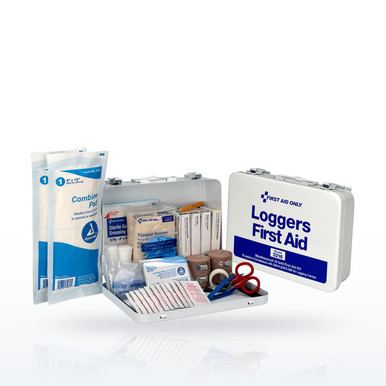 First Aid Only 5216 Loggers First Aid Kit, 25 Person, 67 Pieces, Metal CaseFirst Aid Only prints a 25-person loggers first aid kit, 67 pieces, in a weatherproof metal case, built to 29 CFR 1910.266 with two emergency blankets, a wire splint, elastic wraps and trauma pads
Why minutes matter more than miles. The remote-site questions are about time: how far away a clinic can be before the employer must train someone, whether a 911 call is enough, what a crew an hour from town carries, what Wilderness First Aid teaches. OSHA’s letters answer the first in minutes, California’s sections answer the next two in ratios and a half-hour test, and OSHA’s logging appendix is the one federal list written for a crew in the woods. This page prints those four sources side by side, reads the loggers list across First Aid Only’s kits (its loggers kit is built to the appendix), and says what a lone worker’s version looks like.
The figures the rules give for a site far from help
| Figure | Source | What it says | What it means for the crew |
|---|---|---|---|
| 3 to 4 minutes | OSHA letter of interpretation, March 23 2007, "in near proximity"; OSHA letter of interpretation, June 19 2019, First aid for bleeding control | Emergency care must be available within no more than 3 to 4 minutes where serious injuries (falls, suffocation, electrocution, amputation) are possible, or a trained first aider is required | Every construction, logging, utility, farm and plant crew out of town trains someone |
| Up to 15 minutes | OSHA letter of interpretation, March 23 2007, "in near proximity"; OSHA letter of interpretation, June 19 2019, First aid for bleeding control | A longer response time of up to 15 minutes may be reasonable in workplaces such as offices where serious injury is more remote | An office in a small town may rely on the clinic; a crew may not |
| 1 trained per 20 | Cal/OSHA Title 8 section 3439 First-Aid Kit, Agricultural Operations (dir.ca.gov) | At least 1 employee for every 20 employees at any remote location with training for emergency first aid, plus advance provisions for prompt medical attention | A 40-person harvest or pipeline crew trains at least two |
| 30 minutes | Cal/OSHA Title 8 section 3400 Medical Services and First Aid (dir.ca.gov) | Stretchers and blankets may be required by the Division unless ambulance service is available within 30 minutes under normal conditions | Past half an hour from an ambulance, the truck carries a stretcher and blankets |
| A system that gives the location | Cal/OSHA Title 8 section 3400 Medical Services and First Aid (dir.ca.gov) | A communication system for contacting a doctor or EMS, such as 911, with the ability to direct emergency services to the location of the injured employee | A phone or radio that works at the site, and the site’s coordinates written down |
| Latitude and longitude posted | 29 CFR 1926.50 Medical services and first aid, construction (eCFR) | Where the 911 system does not supply the caller’s location, the employer posts the site’s latitude and longitude or other location information | On the trailer wall and in the truck |
| The logging list | 29 CFR 1910.266 Logging operations, Appendix A (eCFR) | Appendix A: the minimum kit for a site of two or three employees, with more for larger or multiple operations; the number and content of kits reflect the degree of isolation, the number of employees and the hazards | The remote-site kit, whatever the trade |
| Check in | OSHA 3317, Best Practices Guide: Fundamentals of a Workplace First-Aid Program | A first aid program includes assessment, training, supplies, equipment and a plan for the worksite’s own risks | A lone worker’s program is a check-in schedule and a call-for-help device |
Source: As cited in each row
The questions, one by one
What does "near proximity" mean, and does calling 911 satisfy OSHA?
OSHA’s March 2007 letter: near proximity means emergency care within no more than 3 to 4 minutes where serious injuries are possible, up to 15 minutes where they are more remote, "an interpretation that has been upheld by the Occupational Safety and Health Review Commission and by federal courts". A 911 call that brings an ambulance in 20 minutes does not meet it; the employer trains first aiders and stocks the kit. The live first aid provider guide covers the training; the letter is the number.
How many first aiders does a remote crew need?
Federal OSHA says "a person or persons", with the number set by the hazards, the headcount and the shifts; California’s farm rule sets a floor of one per 20 at a remote location, and its construction rule allows employers on one site to pool their trained people as long as the pool covers everyone. One per crew truck is the practical answer, so that no crew drives off without one; the logging standard requires every employee to have first aid and CPR training, which is the far end of the scale.
What does Wilderness First Aid cover?
The Red Cross and other providers run Wilderness and Remote First Aid courses for the case where EMS is more than an hour away: the same assessment and care as standard first aid, plus extended care (keeping a person warm, hydrated and monitored for hours), improvised splints and litters, when and how to move someone, and the decision to evacuate. The Red Cross lists Wilderness and Remote First Aid among its courses and sells supplies for it; the course is the training 1910.151(b) means by "adequately trained" when the site is that far out. We state that from the Red Cross course list and leave the content to the course.
What is in a remote-site first aid kit?
The 1910.266 Appendix A list at the top, which First Aid Only’s loggers kit (5216) follows: 10 sterile 4 x 4 gauze pads, two 8 x 10 trauma pads, 16 adhesive bandages, 2 conforming gauze rolls, 2 triangular bandages, 10 BZK towelettes, scissors, two 52 x 84 inch emergency blankets, tweezers, tape, nitrile gloves, a CPR face shield, 2 elastic wraps, a wire splint, a rubber tourniquet and a pencil, in a weatherproof metal case. A crew of more than two or three, or a site with saws, heights or livestock, adds a bleeding control kit with a windlass tourniquet and hemostatic gauze, a pocket mask, a second and third blanket, a stretcher where the ambulance is far, and the snake bite kit where that applies.
Do we need a stretcher?
In California, when the Division requires it, which turns on whether an ambulance can reach the site within 30 minutes under normal conditions; on tall construction, a basket litter with two blankets per building five or more floors up or down (1512(h)). Federally the logging standard’s blanket and the general duty to transport (1926.50(e): "proper equipment for prompt transportation of the injured person to a physician or hospital, or a communication system for contacting necessary ambulance service") are the hooks. A crew that would have to carry a person a quarter mile to the truck carries a stretcher.
What does a lone worker need?
The same kit as a crew of one plus the things a second person would otherwise be: a check-in schedule with a named person who acts when a check-in is missed, a phone, radio or satellite messenger that works where the work is and can give the location (3400(f) and 1926.50(f)), first aid training so the lone worker can treat themselves while help comes, a bleeding control kit with a tourniquet they can apply one-handed, and an emergency blanket. OSHA has no lone-worker standard; the general duty clause and 1910.151 are the rules, and the logging standard’s "directions for requesting emergency assistance" in the kit is the one line written for it.
What about the truck kit?
The crew that drives to the site keeps the kit in the cab, sized to the crew and checked weekly (1926.50(d)(2)); the pass-1 car, truck and boat guide and the live jobsite vehicle guide cover the vehicle kits, and the third group in the band is First Aid Only’s truck line. A vehicle kit is the remote-site kit for most trades.
Is the farm covered?
Yes, by Cal/OSHA 3439 in California (kit at headquarters or on the bus, a kit in the foreman’s vehicle for scattered crews, one trained per 20 at remote locations) and by 1910.151 as applied to agriculture elsewhere; the Cal/OSHA guide linked below prints the section.
In plain words
- Near proximity is 3 to 4 minutes where serious injury is possible, up to 15 in an office; past that, train first aiders and stock the kit.
- California: one trained employee per 20 at a remote location; stretchers and blankets unless an ambulance is within 30 minutes; a phone that can give the location.
- The logging appendix is the federal remote-site list: big gauze pads, triangular bandages, a blanket, a pocket mask, elastic wraps, a splint, directions for calling for help.
- Add bleeding control, more blankets, a stretcher and a snake bite kit as the site demands.
- Lone worker: check-in schedule, a device that works and gives the location, training, a one-handed tourniquet.
- Post the latitude and longitude where 911 cannot see you.
Questions people ask
What does near proximity mean in minutes?
3 to 4 minutes where serious injuries are possible; up to 15 minutes in low-hazard workplaces such as offices, per OSHA’s 2007 and 2019 letters.
Does calling 911 satisfy the first aid rule at a remote site?
Not when the ambulance is more than those minutes away; the employer trains first aiders and stocks the kit.
How many trained people does a remote crew need?
Federal: a person or persons by the hazards and headcount; California farms: at least one per 20 at a remote location.
When is a stretcher required?
In California when the Division requires it, unless an ambulance is within 30 minutes; on tall construction, a basket litter and two blankets per building.
What is in a remote-site kit?
The 1910.266 Appendix A list: gauze pads including two 8 x 10, bandages, roller bandage, two triangular bandages, towelettes, scissors, a blanket, tweezers, tape, gloves, a pocket mask, two elastic wraps, a splint, and directions for calling for help.
What does Wilderness First Aid cover?
Standard first aid plus extended care, improvised splints and litters, moving a person, and the evacuation decision, for sites more than an hour from EMS; the Red Cross runs the course.
What does a lone worker need?
The kit, training, a check-in schedule, a device that works and gives the location, and a one-handed tourniquet.
Must the site’s coordinates be posted?
On construction where the 911 system does not supply the caller’s location, yes (1926.50(f)); California requires a system that can direct EMS to the location.
Related guides
What is first aid under OSHA?When a trained first aid provider is requiredOSHA first aid kit requirementsWhat 1910.151 and ANSI Z308.1 requireFirst aid kits for vehicles and crewsWhat 1926.50 requires on a jobsiteCar, truck and boat first aid kitsDOT triangles, 1926.50 and the USCG listCal/OSHA Title 8 first aid and eyewash rulesSections 3400, 1512, 5162 and 3439Construction site first aid kits by crew size1926.50 and the Cal/OSHA 1512 tableWhat is an IFAK?IFAK vs AFAK and what is in a trauma kitWhat is a rescue plan?And does OSHA require oneThe ratings, test results and standards shown here are the manufacturers' published values, reproduced as published. Nothing on this page is a recommendation by Bayshore Safety that any product is suitable for a particular task, hazard or workplace. Selecting safety products and protective equipment is the responsibility of the end user and the employer, based on their own hazard assessment and the regulations that apply to their work. Confirm every value on the manufacturer's own documentation before use.
© 2026 Bayshore Safety & Industrial Supplies, Inc. All rights reserved. This guide may not be copied or republished without written permission.