
Competent person vs qualified person vs authorized person: the OSHA definitions, and what each one does in fall protection
A competent person is one who is capable of identifying existing and predictable hazards in the surroundings or working conditions and who has authorization to take prompt corrective measures to eliminate them (29 CFR 1926.32(f)). A qualified person is one who, by a recognized degree, certificate or professional standing, or by extensive knowledge, training and experience, has successfully demonstrated the ability to solve or resolve problems relating to the subject matter, the work or the project (1926.32(m)). An authorized person is one approved or assigned by the employer to perform a specific duty or to be at a specific location on the jobsite (1926.32(d)). The difference is knowledge plus authority against knowledge plus credentials: the competent person is the one on site who can spot the hazard and has the power to stop the work; the qualified person is the one who can do the engineering. OSHA issues no competent-person card; the employer designates the person, and the designation has to be true in fact. In fall protection the two roles are written into the rules themselves: the competent person trains workers, inspects scaffolds before each shift, supervises a fall protection plan and acts as the safety monitor; the qualified person designs horizontal lifelines and engineered anchorages and writes the fall protection plan.
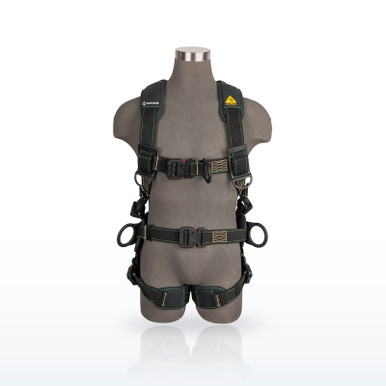 Safewaze 020-1344–1350 Harnesses, Arc Flash, Construction, 3 D-RingsThe harness the competent person inspects at least annually, per the manufacturer’s manual (Safewaze data)
Why two words. The construction standards were written so that judgment calls would be made by named people with defined abilities, not left to whoever happened to be there. “Competent” was built for the field: the hazards of a scaffold, a trench or a roof edge change by the hour, so the rule wants someone present who knows what to look for and can act without asking. “Qualified” was built for the design table: a horizontal lifeline’s end-anchor loads or a structural anchorage are calculations, so the rule wants someone whose training or credentials show they can do them. The authority half of the competent-person definition is the part employers miss most often: a foreman who can see the hazard but cannot stop the job is not a competent person under 1926.32(f), however well trained. In general industry the fall protection rule writes its own, narrower competent person: one who can identify hazards in any personal fall protection system or component and in their use, with the same authority to correct them (1910.140(b)).
The three definitions side by side
From 29 CFR 1926.32, the definitions that apply to every construction standard, and 1910.140(b).
Where Subpart M and the related rules call for each person
| Duty | Who | Paragraph |
|---|---|---|
| Train employees exposed to fall hazards | Competent person qualified in the subjects listed | 1926.503(a)(2) |
| Supervise the implementation of a fall protection plan | Competent person | 1926.502(k)(4) |
| Prepare a fall protection plan and approve changes to it | Qualified person | 1926.502(k)(1) and (2) |
| Act as the safety monitor on a low-slope roof or in a CAZ | Competent person | 1926.502(h)(1) |
| Design, install and supervise the use of a horizontal lifeline | Qualified person | 1926.502(d)(8) |
| Design and supervise an engineered anchorage (the alternative to 5,000 lb) | Qualified person | 1926.502(d)(15)(ii) |
| Return a system to service after it has arrested a fall | Competent person determines it is undamaged and suitable | 1926.502(d)(19) |
| Inspect scaffolds before each shift and after any occurrence | Competent person | 1926.451(f)(3) |
| Supervise scaffold erection, moving, dismantling and alteration | Competent person; the scaffold is designed by a qualified person | 1926.451(f)(7); 1926.451(a)(6) |
| Inspect ladders periodically and after any occurrence | Competent person | 1926.1053(b)(15) |
| Inspect lanyard and lifeline knots before use (general industry) | Competent or qualified person | 1910.140(c)(6) |
| Inspect harnesses, lanyards and SRLs at least annually (manufacturer requirement) | Competent person other than the user, recorded | Safewaze Technical Bulletin 00303; manufacturer manuals reproducing ANSI Z359.11 and Z359.14 |
Source: 29 CFR, e-CFR text current as of November 5, 2026; Safewaze Technical Bulletin 00303 (2025).
What the designation has to include
The rule defines the person by ability and authority; these are the things an inspector looks for.
- The knowledge: the competent person for fall protection knows the hazards of the systems in use and the paragraphs that govern them, which is why 1926.503(a)(2) requires the trainer to be a competent person qualified in the eight subjects it lists, from the nature of the fall hazards to the standards in Subpart M.
- The authority: written or understood, the person can stop work, pull equipment from service and change the setup without asking a supervisor; without that, the definition is not met (1926.32(f)).
- The presence: a competent person inspects scaffolds before each shift (1926.451(f)(3)) and acts as a safety monitor on the same surface as the workers (1926.502(h)(1)(ii)); those duties cannot be done from the office.
- The record: training certifications signed by the trainer or employer (1926.503(b)), annual inspection records on the equipment label or in the manual’s log as the manufacturers direct, scaffold and ladder inspection tags where the site uses them.
- The qualified person’s work product: the fall protection plan, the horizontal lifeline design, the engineered anchorage calculation, each kept at the site or with the system it covers (1926.502(k)(3)).
The annual inspection the manufacturers put on the competent person
OSHA’s rules require inspection before each use (1926.502(d)(21); 1910.140(c)(18)) and a competent person’s judgment after a fall (1926.502(d)(19)). The annual, documented inspection by a competent person other than the user comes from ANSI Z359.11 and Z359.14 as the manufacturers reproduce them: Safewaze’s 2025 bulletin on service life states that the user inspects before each use, a Competent Person other than the user inspects at least once a year and records it in the manual’s log or on the product label, a product that fails inspection or has been exposed to a fall is removed from service and destroyed, and only Safewaze or a party it authorizes in writing may repair its equipment. Its inspection checklist forms for harnesses, lanyards, SRLs, anchors, horizontal lifelines and vertical lifelines are the records it issues for that inspection.
Safewaze Technical Bulletin 00303, Service Life of Safewaze Products (rev. 1, 11-11-2025); Safewaze Inspection Checklist forms; 29 CFR 1926.502(d)(19) and (21); 1910.140(c)(18).Questions people ask
What is a competent person?
One who is capable of identifying existing and predictable hazards in the surroundings or working conditions which are unsanitary, hazardous or dangerous to employees, and who has authorization to take prompt corrective measures to eliminate them (29 CFR 1926.32(f)). Knowledge and authority, both.
What is the OSHA competent person definition for fall protection?
In construction, the general definition in 1926.32(f) applies to Subpart M. In general industry, 1910.140(b) defines the competent person for personal fall protection as one capable of identifying existing and predictable hazards in any personal fall protection system or component, and in their application and use, with authorization to take prompt corrective action.
What is a qualified person under OSHA?
One who, by possession of a recognized degree, certificate or professional standing, or by extensive knowledge, training and experience, has successfully demonstrated the ability to solve or resolve problems relating to the subject matter, the work or the project (1926.32(m)).
What is the difference between a competent person and a qualified person?
The competent person is defined by hazard recognition plus the authority to correct; the qualified person by the demonstrated ability, through credentials or experience, to solve the technical problem. Subpart M gives the competent person the field duties (training, supervising the plan, monitoring, returning equipment to service) and the qualified person the design duties (horizontal lifelines, engineered anchorages, writing the plan).
What is an authorized person?
A person approved or assigned by the employer to perform a specific type of duty or duties or to be at a specific location or locations at the jobsite (1926.32(d)); “designated person” means the same (1926.32(i)). In the confined space rule the authorized entrant is the parallel term (1910.146(b)).
Does OSHA certify competent persons?
No. The rules set the definition and leave the designation to the employer; there is no OSHA-issued card, license or hour requirement. Course certificates from training providers are evidence that the person has the knowledge; the authority to correct hazards has to come from the employer.
Who can be a competent person for fall protection training?
Anyone who meets 1926.32(f) and is qualified in the eight subjects 1926.503(a)(2) lists: the nature of the fall hazards, erecting and inspecting the systems, using guardrails, arrest systems, nets, warning lines, safety monitors and controlled access zones, the safety monitor role, mechanical equipment on low-slope roofs, handling and storage of equipment, the role of employees in fall protection plans, and the Subpart M standards.
How often does a competent person have to inspect a harness?
OSHA requires inspection before each use (1926.502(d)(21)) and a competent person’s inspection before any system that has arrested a fall goes back into service (1926.502(d)(19)). The annual documented competent-person inspection comes from the manufacturers’ manuals under ANSI Z359.11; Safewaze states at least once a year, by someone other than the user, recorded (Technical Bulletin 00303).
Who inspects a scaffold, and when?
A competent person, for visible defects, before each work shift and after any occurrence that could affect the scaffold’s structural integrity (1926.451(f)(3)); erection, moving, dismantling and alteration are done under a competent person’s supervision by trained, experienced employees the competent person selects (1926.451(f)(7)).
Who designs a horizontal lifeline or an engineered anchorage?
A qualified person: horizontal lifelines are designed, installed and used under a qualified person’s supervision as part of a complete system with a safety factor of at least two (1926.502(d)(8)), and an anchorage that is not rated at 5,000 lb per worker must be designed, installed and used under a qualified person’s supervision at the same safety factor (1926.502(d)(15)(ii)).
Related guides
Fall protection training requirementsWho trains, what it covers, the recordHarness inspectionBefore each use and the annual inspectionWhat is a horizontal lifeline?The qualified-person rule in 1926.502(d)(8)What is an anchor point?The 5,000-pound rule and the engineered alternativeDoes OSHA require a written fall protection plan?Prepared by a qualified person, supervised by a competent personThe ratings, test results and standards shown here are the manufacturers' published values, reproduced as published. Nothing on this page is a recommendation by Bayshore Safety that any product is suitable for a particular task, hazard or workplace. Selecting safety products and protective equipment is the responsibility of the end user and the employer, based on their own hazard assessment and the regulations that apply to their work. Confirm every value on the manufacturer's own documentation before use.