
Does OSHA require a written fall protection plan? What 1926.502(k) requires, when a plan is allowed, and what comes first
For most work, no: Subpart M does not require a written fall protection program, and the written document it requires everywhere is the training certification record (29 CFR 1926.503(b)). The written fall protection plan in 1926.502(k) is something narrower and stricter. It is the alternative to equipment, available only to employees doing leading edge work, precast concrete erection or residential construction, and only where the employer can demonstrate that guardrails, safety nets and personal fall arrest systems are infeasible or would create a greater hazard (1926.501(b)(2), (b)(12), (b)(13)). When it is used, the plan must be prepared by a qualified person for that specific site, kept up to date and on the job site, implemented under a competent person, document why the conventional systems cannot be used, discuss the other measures that will reduce the hazard, identify each location where conventional protection is impossible and treat it as a controlled access zone, add a safety monitoring system where nothing else has been implemented, name each employee allowed in the zones, and be revised after any fall or near miss. On priority, the rule is plain about what comes first: the plan is reached only after the conventional systems have been shown infeasible, and inside the plan the first question is how to reduce or eliminate the fall hazard, for example by working from scaffolds, ladders or vehicle-mounted platforms, before the zone and the monitor are set up.
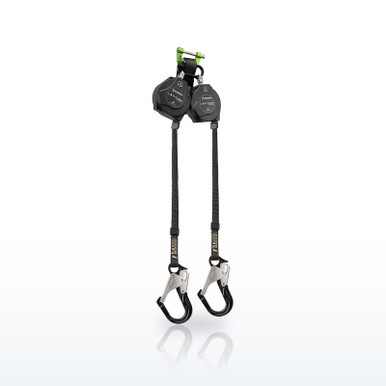 Safewaze Latitude Edge 024-5391–5394 Self-Retracting Lifelines, 11 ft Dual WebClass 2 leading-edge SRL: the device built for a line over the edge where the plan allows equipment at all (Safewaze data)
Why the plan is the last resort. The 1994 rule set a hierarchy without numbering it: guardrails, nets or arrest first, and a written plan only where those three cannot be used, and only in three kinds of work where OSHA accepted that they sometimes cannot. The plan is not permission to skip fall protection. It is a document that has to prove the point location by location, written by someone qualified to make the engineering judgment, and it has to replace the equipment with something: a controlled access zone that keeps everyone else back, a safety monitor who watches the people inside it, and whatever else the qualified person can find, from working off a scaffold to sequencing the job so the edge is guarded sooner. The question people search for, what should be the highest priority when creating a protection plan, has the same answer at every level of the rule: get rid of the fall hazard, then keep people from reaching it, then catch them, and only then warn and watch. Appendix E prints sample plans for precast, residential and leading edge work; they are non-mandatory, and they show how much has to be written down.
What the plan must contain
From 1926.502(k)(1) through (10), in order.
Where a fall protection plan is allowed, and where it is not
The plan is tied to three paragraphs of 1926.501(b).
- Leading edge work: each employee constructing a leading edge 6 feet or more above a lower level has a guardrail, net or arrest system, except that where the employer can demonstrate those are infeasible or a greater hazard, it develops and implements a fall protection plan meeting 1926.502(k) (1926.501(b)(2)(i)).
- Precast concrete erection: the same terms (1926.501(b)(12)).
- Residential construction: the same terms, with OSHA’s 2011 directive STD 03-11-002 on what a residential employer has to show (1926.501(b)(13)).
- Nowhere else in Subpart M: roofs, floor edges, holes, excavations, hoist areas, scaffolds and steel erection have their own paragraphs and none of them offers the plan as an alternative. The general industry rule, 1910 Subpart D, has no fall protection plan provision at all.
- A written fall protection program that a company adopts for every job is good practice and is required by some owners, state plans and contracts; under federal Subpart M it is not a 1926.502(k) plan and does not by itself allow anything the equipment rules would not.
What comes first: the order Subpart M imposes on a plan
| Step | What the rule says | Paragraph |
|---|---|---|
| 1. Conventional protection | Guardrail, safety net or personal fall arrest system; the plan is reached only when these are shown infeasible or a greater hazard | 1926.501(b)(2), (12), (13) |
| 2. Reduce or eliminate the hazard | The plan discusses other measures that reduce or eliminate the fall hazard, for example scaffolds, ladders or vehicle-mounted work platforms as a safer working surface | 1926.502(k)(6) |
| 3. Keep everyone else away | Each location without conventional protection becomes a controlled access zone: control line 6 to 25 ft from the edge, 39 to 45 in high, 200 lb, only named employees inside | 1926.502(k)(7) and (g) |
| 4. Watch the ones inside | A safety monitoring system where no other alternative measure has been implemented: a competent person on the same surface, no other duties, within sight and voice | 1926.502(k)(8) and (h) |
| 5. Name them, train them, keep the plan on site | Named employees only; training in the role of employees in fall protection plans; current copy at the job site | 1926.502(k)(3) and (9); 1926.503(a)(2)(vii) |
| 6. Revise after any fall or near miss | Investigate and change the plan | 1926.502(k)(10) |
The five-level hierarchy manufacturers teach (elimination, passive systems, restraint, arrest, administrative controls) is on the four-types guide as Safewaze prints it; the plan sits at the administrative level, which is why the rule makes the employer prove the levels above it are unavailable.
Source: 29 CFR, e-CFR text current as of November 5, 2026
Where equipment still appears inside a plan
A plan does not have to exclude equipment; it has to explain where the conventional systems cannot be used and what is done there. Many plans use arrest or restraint wherever an anchorage exists and reserve the controlled access zone for the spans where it does not, which is why Appendix E’s sample residential plan still talks about anchors and harnesses. Where a line will run over the edge, the devices built for it are Class 2 leading-edge SRLs under ANSI Z359.14-2021 and 12-foot free-fall lanyards, each with the clearance its manufacturer’s chart gives; on a wood-framed roof, the reusable and permanent anchors in the Safewaze roofing manuals, fastened to the truss with the fastener count the manual states. The product rows below carry the figures.
29 CFR 1926 Subpart M, Appendix E; Safewaze product data (SRL Class, Leading Edge Rated, Minimum Breaking Strength fields); Safewaze roof anchor manuals as cited on the roof anchor guide.Questions people ask
Does OSHA require a fall protection plan?
Not as a general requirement. A written fall protection plan under 1926.502(k) is required only when an employer doing leading edge work, precast concrete erection or residential construction chooses to use it in place of guardrails, nets and personal fall arrest after showing those are infeasible or a greater hazard (1926.501(b)(2), (12), (13)). Elsewhere Subpart M requires no written program; it requires the training certification record (1926.503(b)).
Does OSHA require a written fall protection program?
Federal Subpart M does not. The written documents it requires are the fall protection plan in the three situations above and the training certification record everywhere (1926.503(b)). State plans, owners and contracts often require a written program; Cal/OSHA’s Injury and Illness Prevention Program (Title 8 section 3203) is the California example.
What must a fall protection plan include?
Preparation by a qualified person for the specific site and kept current; a copy on the job site; implementation under a competent person; the documented reasons conventional systems are infeasible or a greater hazard; a written discussion of the other measures that will reduce or eliminate the hazard; each location where conventional protection cannot be used, classified as a controlled access zone; a safety monitoring system where nothing else is implemented; the names of the employees allowed in the zones; and revision after any fall or near miss (1926.502(k)(1) through (10)).
When creating a fall protection plan, what should be the highest priority?
Reducing or eliminating the fall hazard itself: the plan must first show that guardrails, nets and arrest cannot be used, then discuss the measures that reduce or eliminate the hazard, such as scaffolds, ladders or vehicle-mounted platforms as a safer working surface (1926.502(k)(5) and (6)), before it falls back on controlled access zones and a safety monitor (k)(7) and (8). The manufacturers’ hierarchy says the same: elimination first, administrative controls last.
Who writes a fall protection plan?
A qualified person, one who by degree, certificate, professional standing or extensive knowledge, training and experience has demonstrated the ability to solve the problem (1926.32(m)); changes are approved by a qualified person and the plan is carried out under a competent person (1926.502(k)(1), (2) and (4)).
Does a fall protection plan have to be site-specific?
Yes. It is developed specifically for the site where the leading edge, precast or residential work is being performed and maintained up to date, with a copy with all approved changes kept at the job site (1926.502(k)(1) and (3)). A company template becomes a plan only when it is completed for the site and signed off by the qualified person.
Can a framing crew use a fall protection plan instead of harnesses?
Only after the employer demonstrates that guardrails, nets and personal fall arrest are infeasible or a greater hazard on that job, documents the reasons, and meets every other element of 1926.502(k) (1926.501(b)(13)). OSHA’s 2011 residential directive, STD 03-11-002, ended the earlier policy that let home builders use alternatives without that showing.
What is the role of employees in a fall protection plan?
To be named in it if they will work in the controlled access zones, to stay out of those zones if they are not named (1926.502(k)(9)), and to be trained in their role in the plan under 1926.503(a)(2)(vii). The competent person supervising the plan directs the work inside the zones.
Does a fall protection plan have to be reviewed after an accident?
Yes. In the event an employee falls, or some other related serious incident occurs such as a near miss, the employer investigates the circumstances to determine whether the plan needs to change, for example new practices, procedures or training, and implements the changes (1926.502(k)(10)).
Where can I see a sample fall protection plan?
Appendix E to Subpart M prints sample fall protection plans for precast concrete erection, residential construction and leading edge work; they are non-mandatory guidelines and show the level of detail the rule expects, from the statement of policy to the list of named employees.
Related guides
What is a controlled access zone?The control line figures in 1926.502(g)Fall protection for residential construction1926.501(b)(13) and STD 03-11-002What is a rescue plan, and does OSHA require one?The other plan questionWhat are the four types of fall protection?And the five-level hierarchyCompetent person vs qualified personWho writes the plan and who runs itThe ratings, test results and standards shown here are the manufacturers' published values, reproduced as published. Nothing on this page is a recommendation by Bayshore Safety that any product is suitable for a particular task, hazard or workplace. Selecting safety products and protective equipment is the responsibility of the end user and the employer, based on their own hazard assessment and the regulations that apply to their work. Confirm every value on the manufacturer's own documentation before use.