
What are an employer’s fall protection responsibilities? The duties in 1926.501, 1926.502 and 1926.503, and the standard OSHA cites most
Subpart M puts five duties on the employer. Assess: determine that the walking and working surfaces have the strength and structural integrity to support the workers before anyone is allowed on them (29 CFR 1926.501(a)(2)). Provide: provide and install the fall protection systems the situation requires, and meet every other requirement of the subpart, before the employee begins the work that needs the protection (1926.502(a)(2)); in construction the equipment is at the employer’s cost (1926.95(d)). Build it right: every system conforms to the criteria in 1926.502, from the 42-inch guardrail to the 5,000-pound anchorage (1926.501(a)(1)). Train: a training program for each employee who might be exposed to a fall hazard, by a competent person, with a written certification record and retraining when the site, the equipment or the worker’s performance calls for it (1926.503). Rescue: provide for prompt rescue of a fallen worker or assure that workers can rescue themselves (1926.502(d)(20)). The duty is the employer’s, not the worker’s: the general requirements paragraph, 1926.501, has been the most frequently cited OSHA standard every year since 2011, and the training paragraph, 1926.503, sits in the top ten beside it.
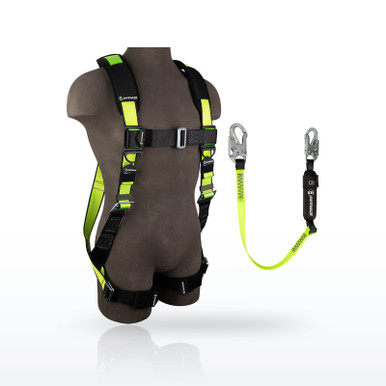 Safewaze PRO FS129-4 Fall Protection Kits, Combo, FS280 Harness, FS560-4 LanyardOne worker outfitted: harness and connecting device in one part number (Safewaze data)
Why the duty is written this way. Fall protection is the one hazard where OSHA can show, year after year, that the rule is known and still not followed: 1926.501 has led the most-cited list for more than a decade, and the training paragraph, 1926.503, is cited thousands of times a year on top of it. The citations are not for exotic failures. They are for workers on roofs and leading edges at 6 feet with nothing, for anchors that were never checked, for crews that were handed harnesses and never trained. Subpart M was built so that each of those has an owner: the employer determines the surface will hold, provides and installs the system before the work, meets the equipment criteria, trains and keeps the record, and has a rescue ready. The worker’s part, wearing and connecting the equipment, comes after all five.
The five duties, with the paragraph for each
Everything an employer owes under Subpart M, in the order the work happens.
OSHA’s most frequently cited standards, preliminary fiscal year 2026 (October 1, 2025 to August 31, 2026)
| Rank | Standard | Section |
|---|---|---|
| 1 | Fall Protection, general requirements (construction) | 29 CFR 1926.501 |
| 2 | Hazard Communication (general industry) | 1910.1200 |
| 3 | Control of Hazardous Energy, lockout/tagout | 1910.147 |
| 4 | Scaffolding (construction) | 1926.451 |
| 5 | Ladders (construction) | 1926.1053 |
| 6 | Respiratory Protection | 1910.134 |
| 7 | Powered Industrial Trucks | 1910.178 |
| 8 | Fall Protection, training requirements (construction) | 1926.503 |
| 9 | Eye and Face Protection (construction) | 1926.102 |
| 10 | Machine Guarding | 1910.212 |
Four of the ten are the fall and height standards: 1926.501, 1926.451, 1926.1053 and 1926.503. OSHA ranks the list by standard, not by paragraph; its FY2025 count for 1926.501 was reported at 5,914 citations, the fifteenth year the standard led the list.
Source: OSHA, Top 10 Most Frequently Cited Standards, osha.gov/top10citedstandards, preliminary list for FY2026 (page updated October 5, 2026; fetched November 9, 2026).
What the employer has to be able to show
The duties above, read as the records an inspector asks for.
- That the surface was assessed before the crew went up: the competent person’s judgment on the deck, roof or platform, and on the anchorage structure a personal fall arrest system will load (1926.501(a)(2); 1926.502(d)(15)).
- That the system was in place before the exposure began, not after the first lift of material: 1926.502(a)(2) is written as a sequence.
- That the equipment met its paragraph: the manufacturer’s labels and data for the harness, lanyard, SRL and anchor (standard, capacity, class), the guardrail heights, the net placement, the cover marking.
- That every exposed employee was trained by a competent person in the eight subjects, with the written certification record kept and the latest one maintained (1926.503(a) and (b)), and retrained when the site or the equipment changed (c).
- That a rescue was provided for: who, with what, how fast, and what the suspended worker does meanwhile (1926.502(d)(20)); a trauma relief strap on the harness is part of the answer, not the whole of it.
- That the equipment was inspected before use and retired after a fall or a failed inspection, with the manufacturer’s inspection records where the manuals call for them (1926.502(d)(19) and (21); Safewaze Technical Bulletin 00303).
- That the employer paid for the equipment and that it fits the worker who wears it (1926.95(c)(2) and (d)).
The worker’s part
Subpart M is written to the employer, and the citations go to the employer. The employee’s obligations come through training and the employer’s rules: wear and connect the system the employer has provided, inspect it before use as trained, report damage, stay inside the warning line or control line, and follow the safety monitor. Where an employee provides his or her own equipment, the employer is still responsible for its adequacy (1926.95(b)).
29 CFR 1926.95(b); 1926.503(a).Questions people ask
What are five areas of employer responsibility concerning fall hazards?
Assess the walking and working surfaces for strength (1926.501(a)(2)); provide and install the required systems before the work starts (1926.502(a)(2)); make every system meet the criteria in 1926.502 (1926.501(a)(1)); train each exposed employee by a competent person, keep the certification and retrain when needed (1926.503); and provide for prompt rescue after a fall (1926.502(d)(20)). Paying for and fitting the equipment (1926.95(c) and (d)) runs through all five.
What is OSHA’s most cited violation?
Fall Protection, general requirements, 29 CFR 1926.501, first on OSHA’s most-frequently-cited list for the preliminary fiscal year 2026 (October 1, 2025 to August 31, 2026), as it has been every year since 2011; its FY2025 count was reported at 5,914 citations. Scaffolding (1926.451), ladders (1926.1053) and fall protection training (1926.503) are also in the top ten.
What are the top three most cited OSHA standards?
On the preliminary FY2026 list: fall protection general requirements (1926.501), hazard communication (1910.1200) and control of hazardous energy, lockout/tagout (1910.147). Scaffolding is fourth and ladders fifth (osha.gov, Top 10 Most Frequently Cited Standards, updated October 5, 2026).
Who is responsible for fall protection, the employer or the employee?
The employer. 1926.501 sets forth requirements for employers to provide fall protection systems (1926.501(a)(1)), 1926.502(a)(2) requires the employer to provide and install them before the work, 1926.503 requires the employer to train, and 1926.95(d) requires the employer to pay. The employee’s duties, wearing, connecting, inspecting and reporting, come through that training.
Does the employer have to pay for fall protection equipment?
Yes. Protective equipment used to comply with Part 1926 is provided by the employer at no cost to employees (1926.95(d)(1)); the exceptions (ordinary safety-toe footwear, prescription eyewear, everyday clothing and weather gear) do not cover harnesses, lanyards, SRLs or anchors. Replacement is paid unless the employee lost or intentionally damaged it (d)(5). General industry: 1910.132(h).
Does OSHA require fall protection equipment to fit?
Yes. Since January 13, 2025, 1926.95(c)(2) requires construction employers to ensure PPE is selected to properly fit each affected employee (89 FR 100346, December 12, 2024); for a harness that means the size range on the manufacturer’s chart and the adjustment that puts the dorsal D-ring between the shoulder blades. General industry has required proper fit under 1910.132(d)(1)(iii) since 1994.
What training does an employer have to provide for fall protection?
A program for each employee who might be exposed, by a competent person, covering the nature of the fall hazards, erecting, maintaining, disassembling and inspecting the systems, the use of guardrails, arrest systems, nets, warning lines, safety monitors and controlled access zones, the safety monitor role, mechanical equipment on low-slope roofs, handling and storage, the role of employees in fall protection plans, and the Subpart M standards, with a written certification record (1926.503(a) and (b)).
How often does an employer have to retrain workers in fall protection?
When the employer has reason to believe a trained employee lacks the understanding or skill: when changes in the workplace or in the systems and equipment make the previous training obsolete, or when the employee’s knowledge or use shows a gap (1926.503(c)). No fixed interval is in the rule.
What must an employer do after a worker falls?
Carry out the rescue it provided for (1926.502(d)(20)); remove the personal fall arrest system from service until a competent person inspects it and finds it undamaged and suitable (1926.502(d)(19)); where a fall protection plan was in use, investigate the circumstances and change the plan to prevent a repeat (1926.502(k)(10)); and report a hospitalization within 24 hours or a fatality within 8 hours under 1904.39.
Does the employer have to determine whether the surface will hold the workers?
Yes, before anyone works on it: the employer shall determine if the walking/working surfaces on which its employees are to work have the strength and structural integrity to support employees safely, and employees shall be allowed to work on those surfaces only when they do (1926.501(a)(2)).
Related guides
OSHA fall protection requirements, section by sectionSubpart M from 1926.500 to 1926.503Fall protection training requirementsThe eight subjects and the recordWhat is a rescue plan, and does OSHA require one?The prompt-rescue dutyWhen is fall protection required?The height rulesCompetent person vs qualified personWho does what in Subpart MThe ratings, test results and standards shown here are the manufacturers' published values, reproduced as published. Nothing on this page is a recommendation by Bayshore Safety that any product is suitable for a particular task, hazard or workplace. Selecting safety products and protective equipment is the responsibility of the end user and the employer, based on their own hazard assessment and the regulations that apply to their work. Confirm every value on the manufacturer's own documentation before use.