
Bayshore Safety & Industrial Supplies Guide
What goes on a first aid treatment log, and when does an injury go on the OSHA 300 Log? What 1904.7 counts as first aid, recordable vs reportable, the 300, 300-A and 301 forms, the annual summary, documenting a wound dressing, and Cal/OSHA’s forms
A first aid treatment log is the employer’s own record of every injury treated from the kit; the OSHA 300 Log is the federal record of the injuries that go beyond first aid. The line between them is 1904.7(b)(5)(ii), which lists everything that counts as first aid for recordkeeping: using a non-prescription medication at non-prescription strength; tetanus shots; cleaning, flushing or soaking a surface wound; wound coverings such as bandages, gauze pads, butterfly bandages or Steri-Strips; hot or cold therapy; non-rigid support such as elastic bandages and wraps; temporary immobilization while transporting a victim; drilling a nail or draining a blister; eye patches; removing a foreign body from the eye with irrigation or a cotton swab; removing splinters elsewhere by irrigation, tweezers or cotton swab; finger guards; massage; and drinking fluids for heat stress. The rule says "this is a complete list". A work-related injury that results in death, days away, restricted work or job transfer, medical treatment beyond that list, loss of consciousness, or a significant diagnosis is recordable on the OSHA 300 Log within 7 calendar days, with a 301 incident report for each entry, summarized on the 300-A posted from February 1 to April 30. Reportable is a different word: a fatality is reported to OSHA within 8 hours, and an in-patient hospitalization, amputation or loss of an eye within 24 hours (1904.39). Cal/OSHA’s construction rule lists "appropriate record forms" as a kit item at every crew size, which is the first aid log.
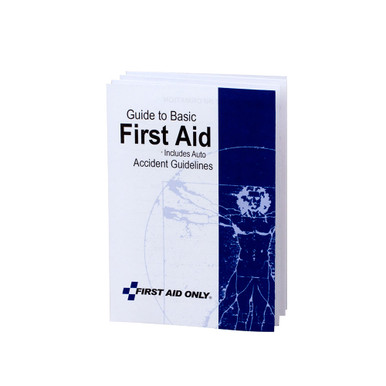 First Aid Only BK021 First Aid GuideFirst Aid Only prints the first aid guide booklet that ships in its kits
Why a treatment log and a 300 Log are two different books. People ask how to document a wound dressing, which record is updated annually, what the difference between recordable and reportable is, and which OSHA log summarizes the year, and they are asking about two records that sit in the same drawer. The first aid log is yours: who, when, what happened, what was done from the kit, by whom, and whether the person was sent on. The 300 Log is OSHA’s, for the cases that cross the first aid line, and it has its own forms, deadlines, privacy rules and posting dates. This page prints the first aid list from the rule, the recordable criteria, the three forms and their deadlines, the reporting clock, and a plain treatment-log layout that feeds the 301 when a case crosses over.
The two records, and the forms
| Record | What it holds | Who requires it | Deadline and retention |
|---|---|---|---|
| First aid treatment log | Date and time, name, what happened and where, the injury, what was done from the kit (by the 1904.7 list), who gave it, whether the person returned to work, went home or was sent for care, restocking note | The employer’s own program; Cal/OSHA 1512(c) lists "appropriate record forms" in every construction kit; OSHA 3317 names records as part of a first aid program | Kept with the kit or at the office; the entry becomes the 301 if the case turns recordable |
| OSHA 300 Log of Work-Related Injuries and Illnesses | A one or two line description of each recordable injury or illness: case number, name (or "privacy case"), job title, date, where it happened, description, outcome, days away or restricted | 1904.29 for employers with more than 10 employees not in a partially exempt industry | Entered within 7 calendar days of learning of a recordable case; kept 5 years |
| OSHA 301 Injury and Illness Incident Report | The detail of each 300 entry: what the employee was doing, what happened, the injury, the object or substance, the physician, hospitalization | 1904.29(b)(2): one per 300 entry; an equivalent form (insurance first report) is allowed if it carries the same information | Within 7 calendar days; kept 5 years |
| OSHA 300-A Summary | The year’s column totals from the 300 Log, the establishment’s annual average employees and total hours, certified by a company executive | 1904.32: review the log, create, certify and post the summary | Posted February 1 to April 30 of the following year; zeros if no cases |
| Report to OSHA | A fatality; an in-patient hospitalization, amputation or loss of an eye | 1904.39, by phone to the Area Office, the 800 number, or the online application | Fatality within 8 hours; hospitalization, amputation, eye loss within 24 hours |
Source: 29 CFR 1904.7, 1904.29 and 1904.32 Recording and reporting occupational injuries and illnesses (eCFR); 29 CFR 1904.39
The questions, one by one
How do I document a wound dressing change, and how do I describe a wound for documentation?
On the first aid log: the date and time, the person, the wound (where on the body, how big, cut or scrape or puncture or burn, bleeding stopped or not, clean or contaminated), what was done (cleaned with a BZK wipe, antibiotic ointment, a 2 x 2 sterile pad and tape, as the 1904.7 list words it), who did it, and the plan (return to work, re-dress tomorrow, sent to the clinic). A dressing change is a second line with the date, what the wound looked like (closed, red, swollen, draining) and what was applied. Keep the words plain and factual; the log is read by the next first aider and, if the case turns recordable, by whoever fills in the 301.
What is the difference between a recordable and a reportable injury?
Recordable means it goes on the 300 Log: death, days away, restricted work or transfer, medical treatment beyond first aid, loss of consciousness, or a significant diagnosis (1904.7(a)). Reportable means it is phoned or filed to OSHA: a fatality within 8 hours, an in-patient hospitalization, an amputation or a loss of an eye within 24 hours (1904.39). Every reportable case is also recordable; most recordable cases are not reportable.
What does OSHA consider first aid treatment?
The fourteen items of 1904.7(b)(5)(ii) listed at the top, and only those; "this is a complete list of all treatments considered first aid for part 1904 purposes", and who gives them does not matter, since the rule says the treatments "are considered first aid regardless of the professional status of the person providing the treatment". Stitches, staples, prescriptions, a rigid splint, physical therapy and any immunization other than tetanus are medical treatment. The live first aid provider guide covers the same list from the training side.
What OSHA recordkeeping log provides a summary of the past year’s injuries and illnesses, and which record is updated annually?
The OSHA 300-A Summary. 1904.32 requires the employer at the end of each calendar year to review the 300 Log, total its columns, enter the year, the establishment, the annual average number of employees and the total hours worked, have a company executive certify it, and post it in a conspicuous place from February 1 to April 30. "Might include your input" is the employee-involvement rule of 1904.35: employees and their representatives are told how to report and may see the 300 Log and their own 301.
What are the OSHA standards for reporting injuries?
1904.39: a fatality to OSHA within 8 hours; an in-patient hospitalization, amputation or loss of an eye within 24 hours; by phone to the nearest Area Office, the 800 number (1-800-321-6742) or the online application; a message on an answering machine, a fax or an email does not count. Recording (the 300 Log) is 1904.4 to 1904.35; most employers with 10 or fewer employees and those in the partially exempt industries keep no 300 Log but still report under 1904.39.
Who has to keep a 300 Log?
Employers with 11 or more employees at any time in the year, unless the establishment is in a partially exempt industry listed in 1904.2 (many offices, retail and service industries are). Every employer, exempt or not, reports fatalities and the 24-hour cases under 1904.39 and must keep records if OSHA or the Bureau of Labor Statistics asks in writing.
What is a privacy concern case?
1904.29(b)(7): an injury to an intimate body part or the reproductive system, sexual assault, mental illness, HIV, hepatitis or tuberculosis, a needlestick or sharps cut contaminated with another person’s blood or OPIM, and any other illness the employee asks to keep off the log by name. The log says "privacy case" and the employer keeps a separate confidential list of the names. A bloodborne pathogen exposure incident that is recordable is one of these.
How long are the records kept, and who can see them?
Five years following the year they cover (1904.33). Employees, former employees and their representatives may see the 300 Log by the end of the next business day and their own 301 the same way (1904.35); government representatives see everything; anyone else sees the 300 and 301 only with names removed (1904.29(b)(10)). The first aid treatment log is not an OSHA record and is kept as the employer’s program says.
What record forms does Cal/OSHA want in the construction kit?
Section 1512(c)(1)’s table lists "appropriate record forms" and an "up-to-date standard or advanced first-aid textbook, manual or equivalent" at every crew size, which is the first aid treatment log and the first aid guide. The California 300 Log rules are Title 8 section 14300 and parallel the federal ones.
What is the first aid treatment log for, if it is not an OSHA form?
For the program: it shows the inspector that first aid was given and by whom, it feeds the 301 when a case crosses the line, it tells the first aider what was done yesterday, it is the restock list, and it is the injury pattern the hazard assessment reads (five fingertip cuts a month at the strapping station is a glove problem). OSHA 3317 names evaluation and records as part of a first aid program for that reason.
In plain words
- First aid log: yours, every kit use, who, what, when, what was done, where the person went.
- 300 Log: OSHA’s, the cases beyond the 1904.7 first aid list, entered within 7 days, kept 5 years.
- 301: one per 300 entry; 300-A: the year’s totals, certified, posted February 1 to April 30.
- Recordable = on the 300 Log; reportable = phoned to OSHA (8 hours for a death, 24 hours for hospitalization, amputation, eye loss).
- Stitches, prescriptions, rigid splints and non-tetanus shots are medical treatment; bandages, wraps, cold packs, tweezers and eye irrigation are first aid.
- Write a wound entry plainly: where, what, what was done, by whom, what next.
Questions people ask
What goes on a first aid treatment log?
Date and time, name, what happened and where, the injury, what was done from the kit, who gave it, and whether the person returned, went home or was sent for care.
When does an injury go on the OSHA 300 Log?
When it results in death, days away, restricted work or transfer, medical treatment beyond first aid, loss of consciousness, or a significant diagnosis; entered within 7 calendar days.
What does OSHA count as first aid?
The 14 items of 1904.7(b)(5)(ii): non-prescription medication, tetanus shots, cleaning a wound, wound coverings, hot or cold therapy, wraps, temporary immobilization, draining a blister, eye patches, eye irrigation, splinter removal, finger guards, massage, fluids for heat stress.
What is the difference between recordable and reportable?
Recordable goes on the 300 Log; reportable is phoned to OSHA: a death within 8 hours, hospitalization, amputation or eye loss within 24 hours.
Which OSHA log summarizes the year?
The 300-A Summary, certified by an executive and posted February 1 to April 30.
What is the 301 form?
The incident report behind each 300 entry; an insurance first report with the same information may substitute.
How do I document a wound dressing change?
A dated line with what the wound looked like and what was applied, by whom, and the plan.
How long are the records kept?
Five years; employees may see the 300 Log and their own 301.
Does Cal/OSHA want record forms in the kit?
Yes; section 1512 lists appropriate record forms and a first aid manual in every construction kit.
Related guides
What is first aid under OSHA?When a trained first aid provider is requiredOSHA first aid kit requirementsWhat 1910.151 and ANSI Z308.1 requireFirst aid kit refillsHow often to check and restockWhat is a bloodborne pathogen exposure incident?OPIM, transmission, the vaccine and what follows an exposureConstruction site first aid kits by crew size1926.50 and the Cal/OSHA 1512 tableGas detection recordsWhat to log, who signs it, how long to keep itHow to bandage a woundThe Red Cross steps, the four wraps and the golden ruleThe ratings, test results and standards shown here are the manufacturers' published values, reproduced as published. Nothing on this page is a recommendation by Bayshore Safety that any product is suitable for a particular task, hazard or workplace. Selecting safety products and protective equipment is the responsibility of the end user and the employer, based on their own hazard assessment and the regulations that apply to their work. Confirm every value on the manufacturer's own documentation before use.
© 2026 Bayshore Safety & Industrial Supplies, Inc. All rights reserved. This guide may not be copied or republished without written permission.