
Bayshore Safety & Industrial Supplies Guide
What should be in a first aid kit for a construction site, and how many kits does a crew need? OSHA 1926.50, the Cal/OSHA section 1512 supply table by crew size, kits for a 10, 25 and 50 person crew, the weatherproof case, and kits by trade
OSHA 1926.50(d) sets the container and the inspection, not the list: first aid supplies "easily accessible when required", kept "in a weatherproof container with individual sealed packages for each type of item", and "checked by the employer before being sent out on each job and at least weekly on each job to ensure that the expended items are replaced". Its non-mandatory Appendix A points to ANSI Z308.1 for the contents, which is the Class A fill (or Class B for a higher-risk site) in a Type III or Type IV container. California writes the list itself: Cal/OSHA section 1512(c) requires every employer on a construction project, on line crews and on short-duration jobs to provide "at least one first-aid kit in a weatherproof container" with sterile dressings in individually sealed packages, and sets the minimum supplies by crew size in a table (adhesive dressings, 1-inch tape, eye dressing packet, 2-inch gauze rolls, 2-inch and 4-inch sterile pads, triangular bandages, safety pins, tweezers and scissors for every crew; 1-inch and 4-inch gauze rolls from 6 employees; pressure dressings, applicators, forceps, emesis basin, flashlight and magnifying glass from 16; oxygen over 200), plus record forms and a first aid manual at every size. How many kits: one per crew, one per truck, and one at the site office, so that no crew is farther from a kit than the time it takes to walk back, with the person count on the kit at or above the crew it serves. First Aid Only’s contractor kits are built in 10, 25 and 50 person sizes in plastic, metal and weatherproof cases, which is the band below.
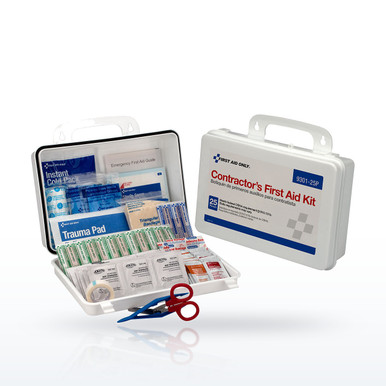 First Aid Only 9301-25P Contractor First Aid Kit, 25 Person, 178 PiecesFirst Aid Only prints a 25-person contractor first aid kit, 178 pieces, in a plastic case with a carry handle and wall-mount holes
Why the crew size decides the kit. The construction questions are the practical ones: what has to be in the kit, how many a crew needs, whether the kit in the truck counts, and what "first aid requirements for construction sites" actually says. The federal rule says almost nothing about contents and a great deal about the container and the weekly check; the California rule prints a table by headcount that is the clearest list any regulator publishes, and First Aid Only sizes its contractor kits to the same breaks (10, 25, 50). This page puts the two rules side by side, reads the California table across the First Aid Only kits, and answers the trade-by-trade question with what each trade adds to the base kit rather than with a different kit.
Cal/OSHA section 1512(c) minimum first aid supplies by number of employees on the project
| Supply | 1 to 5 | 6 to 15 | 16 to 200 | Over 200 |
|---|---|---|---|---|
| Adhesive dressings | X | X | X | X |
| Adhesive tape rolls, 1 inch wide | X | X | X | X |
| Eye dressing packet | X | X | X | X |
| 1-inch gauze bandage roll or compress | X | X | X | |
| 2-inch gauze bandage roll or compress | X | X | X | X |
| 4-inch gauze bandage roll or compress | X | X | X | |
| Sterile gauze pads, 2-inch square | X | X | X | X |
| Sterile gauze pads, 4-inch square | X | X | X | X |
| Sterile surgical pads suitable for pressure dressings | X | X | ||
| Triangular bandages | X | X | X | X |
| Safety pins | X | X | X | X |
| Tweezers and scissors | X | X | X | X |
| Cotton-tipped applicators (readily available, not necessarily in the kit) | X | X | ||
| Forceps | X | X | ||
| Emesis basin | X | X | ||
| Flashlight | X | X | ||
| Magnifying glass | X | X | ||
| Portable oxygen and its breathing equipment | X | |||
| Tongue depressors | X | |||
| Appropriate record forms | X | X | X | X |
| Up-to-date standard or advanced first aid textbook or manual | X | X | X | X |
Section 1512(c)(3): drugs, antiseptics, eye irrigation solutions, inhalants, medicines or proprietary preparations are not included in the kit unless approved in writing by an employer-authorized licensed physician. "Dressings in adequate quantities"; the table sets the types, not the counts.
Source: Cal/OSHA Title 8 section 1512 Emergency Medical Services, Construction Safety Orders (dir.ca.gov)
The questions, one by one
What are the OSHA first aid requirements for construction sites?
1926.50 in full: (a) medical personnel available for advice; (b) provisions made before the project starts for prompt medical attention in case of serious injury; (c) where no infirmary, clinic, hospital or physician is "reasonably accessible in terms of time and distance", a person with a valid first aid certificate (Bureau of Mines, Red Cross or verifiable equivalent) available at the worksite; (d) supplies easily accessible, in a weatherproof container with individually sealed packages, checked before each job and at least weekly; (e) transportation or a communication system for ambulance service; (f) emergency numbers posted where there is no 911, and the site’s latitude and longitude or other location information posted where the 911 system does not supply it; (g) quick drenching or flushing facilities where eyes or body may be exposed to injurious corrosive materials. The live 1910-vs-1926 guide explains why a jobsite reads 1926 and a shop reads 1910.
What should be included in a first aid kit for a construction site?
Federally, the Z308.1 Class A fill in a Type III or IV (weatherproof, portable or mountable) container, with Class B where the site’s risk is higher; the live Class A vs Class B guide prints the fill. In California, the 1512 table above, approved by a physician if the employer departs from it, with no medications, antiseptics or eyewash solutions in the kit unless a physician approves them in writing. First Aid Only’s 25-person contractor kits (9301-25P, 178 pieces; 91335, Class A, 131 pieces; 91350, Class A, 181 pieces) carry the dressings, pads, rolls, triangular bandages, tape, tweezers and scissors the table names; a California contractor whose kit includes the ointment and eyewash packets of a Class A fill keeps the physician’s written approval with the kit.
How many first aid kits does a construction crew need?
The rules say "easily accessible" (1926.50(d)(1)) and "at least one first-aid kit" per employer on the project (1512(c)(1)); the number that meets them is one kit wherever a crew works out of reach of another. The usual pattern: one in each crew truck, one at the site office or trailer, one on each floor or in each zone of a large building once the walk back exceeds a few minutes, and one with any crew sent out alone. Size each to the crew it serves: a 10-person kit for a three-man crew is fine, a 10-person kit for a 25-person floor is not. The live how-many-kits guide covers the general industry count.
Does the kit in the truck count?
Yes, when the truck is at the site and the kit in it is reachable; 1512(c)(1) names line crews and transient jobs, where the truck is the site. A kit that drives away with the foreman at lunch is not accessible, which is why a fixed kit at the trailer sits beside the truck kits. The vehicle kits in the band are sized 10 to 50 person and built for the cab or the toolbox.
What does a crew of 1 to 5 need in California, and a crew of 6 to 15?
Read the table: the 1-to-5 column is adhesive dressings, 1-inch tape, an eye dressing packet, 2-inch gauze rolls, 2-inch and 4-inch sterile pads, triangular bandages, safety pins, tweezers and scissors, record forms and a manual. From 6 employees the 1-inch and 4-inch gauze rolls are added; from 16, pressure dressings, applicators, forceps, an emesis basin, a flashlight and a magnifying glass; over 200, portable oxygen and tongue depressors. A 10-person First Aid Only contractor kit covers the first two columns; a 25 or 50 person kit with a trauma pad covers the third.
Who has to be first aid trained on a jobsite?
Federally, someone with a valid first aid certificate must be at the site unless a clinic or hospital is reasonably accessible in time and distance (1926.50(c)); OSHA’s letters put "near proximity" at 3 to 4 minutes where serious injuries are possible. California 1512(b) requires "a suitable number of appropriately trained persons" per employer, with employers on one site allowed to pool them if the pool covers the combined workforce. The live first aid provider guide covers the training.
What is the written plan California asks for?
1512(i): "The employer shall have a written plan to provide emergency medical services", specifying how every applicable part of 1512 is met; employers who form a combined program may share one plan. 1512(d) requires every employee to be told the procedure to follow in case of injury, and 1512(e) requires the phone numbers of a physician, hospitals, ambulance and fire services posted near the job phone or made available where there is none.
What first aid kit does each trade need?
The same base kit with the trade’s injuries added. Roofers and framers: bleeding control (trauma pads, a tourniquet, hemostatic gauze) for saw and nail-gun wounds, and sunscreen and electrolytes in summer. Concrete and masonry: eyewash for lime burns, burn gel, and the 4-inch gauze rolls. Electricians: burn dressings and a CPR barrier. Plumbers and pipefitters: burn gel for solder and torch burns, eyewash for flux. Painters and drywall: eyewash and eye pads. Demolition and excavation: bleeding control and a blanket. Welders have their own page linked below. The third group in the band is the add-on list.
What safety equipment is required at a construction site, and what are the essential safety materials for construction workers?
The first aid kit, the trained person, the communication system and the eyewash where corrosives are used are the 1926.50 items; the PPE (hard hat, eye protection, gloves, boots, hi-vis, fall protection) is Subpart E and the live construction PPE guide. "Essential safety materials" in the first aid sense is the kit plus a bleeding control kit, an eyewash, a burn kit and a heat stress pack, which is the third group below.
How often is the construction kit checked?
"Before being sent out on each job and at least weekly on each job" (1926.50(d)(2)); California says "inspected regularly to ensure that the expended items are promptly replaced" (1512(c)(1)). The weekly check is the foreman’s Monday job: open the case, replace what is gone, read the dates on the packets, sign the record form the California table lists.
What does First Aid Only say about summer construction injuries?
Its construction heat stress brochure states that "injury and illness rates in construction are 24% higher than they are in other industries on average" and that "workplace injuries peak in June, July, and August, with an average of over 3,300 incidents daily during these months", and it pairs the contractor kits with the heat stress treatment pack (cold packs, thermometers, electrolyte rounds, blanket, water packs) and the sunscreen and sting relief packets. Those are First Aid Only’s figures and we repeat them as its statements.
In plain words
- Federal: weatherproof container, sealed packages, checked before each job and weekly; contents from Z308.1 Class A or B.
- California: at least one kit per employer, the 1512 table by crew size, no medications or eyewash solution in the kit without a physician’s written approval.
- One kit per crew, one per truck, one at the trailer; person count at or above the crew.
- A trained first aider on site unless a clinic is minutes away; California pools them across employers.
- Post the emergency numbers and the site location; write the emergency medical services plan.
- Add to the base kit by trade: bleeding control, eyewash, burn gel, heat stress pack.
Questions people ask
What should be in a construction site first aid kit?
Z308.1 Class A or B in a weatherproof Type III or IV container; in California, the 1512 table by crew size with no medications unless a physician approves them in writing.
How many kits does a crew need?
One wherever a crew works out of reach of another: each truck, the trailer, each floor or zone; sized to the crew.
What does OSHA 1926.50 require?
Medical advice available, provisions for prompt attention, a trained person unless a clinic is reasonably accessible, easily accessible supplies in a weatherproof container checked weekly, transport or communication, posted numbers and location, eyewash for corrosives.
What does Cal/OSHA 1512 add?
A supply table by crew size, sterile dressings in sealed packages, a written emergency medical services plan, posted phone numbers, trained persons per employer or pooled.
Does the truck kit count?
Yes while the truck is at the site and the kit is reachable.
How often is the kit checked?
Before each job and at least weekly (federal); regularly, with expended items promptly replaced (California).
Can a California construction kit hold ointment and eyewash?
Only with an employer-authorized licensed physician’s written approval (1512(c)(3)).
What kit for a 10-person crew?
A 10-person contractor kit (70 to 76 pieces) in a plastic or metal case; 25-person for a floor or a larger crew.
What do roofers and framers add?
Bleeding control: trauma pads, tourniquet, hemostatic gauze.
What do concrete crews add?
Eyewash for lime burns and burn gel.
Related guides
First aid kits for vehicles and crewsWhat 1926.50 requires on a jobsiteHow many first aid kits does a workplace need?And where they goANSI Z308.1 Class A vs Class B first aid kitsWhat is in each fillType I, II, III and IV first aid kitsThe container ratingsWhat is first aid under OSHA?When a trained first aid provider is requiredCal/OSHA Title 8 first aid and eyewash rulesSections 3400, 1512, 5162 and 3439First aid for welders and hot workFlash burns, metal splinters, welding blanketsWhat PPE does OSHA require on a construction site?Head, eye, hand, foot, hi-vis and fallOSHA 1910 vs 1926General industry vs constructionThe ratings, test results and standards shown here are the manufacturers' published values, reproduced as published. Nothing on this page is a recommendation by Bayshore Safety that any product is suitable for a particular task, hazard or workplace. Selecting safety products and protective equipment is the responsibility of the end user and the employer, based on their own hazard assessment and the regulations that apply to their work. Confirm every value on the manufacturer's own documentation before use.
© 2026 Bayshore Safety & Industrial Supplies, Inc. All rights reserved. This guide may not be copied or republished without written permission.