
Bayshore Safety & Industrial Supplies Guide
How do earmuffs work, and how many decibels do they block? The highest NRR earmuffs, why no protector blocks all sound, whether 45 dB earplugs exist, downsides of earmuffs, and wearing them with hats, glasses and hard hats
An earmuff is two rigid cups filled with sound-absorbing foam, sealed to the head by soft cushions and held there by the spring of a headband or the arms of a hard hat mount; it blocks noise by putting a sealed, damped air space around the whole ear, so the sound that reaches the eardrum has had to pass through the shell, the foam and the cushion seal. How much it blocks is the NRR on the label: the passive muffs we carry run from NRR 22 to NRR 31 (the JSP Sonis 3 at 31 is the highest), and OSHA credits a muff with NRR minus 7 decibels against an A-weighted noise level. No muff and no plug blocks all sound, because above about 40 to 50 decibels of reduction the sound arrives through the bones of the skull instead of the ear canal, which is why the highest earplug label is 33 and a “45 dB earplug” does not exist. The downsides are weight, heat, and anything that breaks the cushion seal: glasses temples, hair, a hood or a respirator strap.
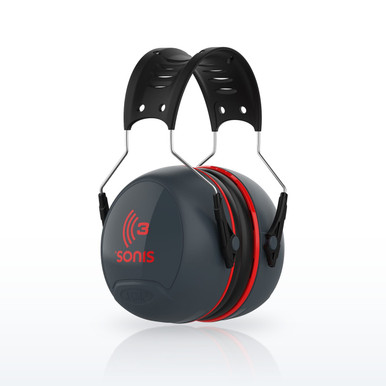 JSP Sonis 3 262-AEB040-HB Earmuffs, Passive Ear Muff, Adjustable HeadbandJSP states the Sonis 3 passive headband earmuff is NRR 31 (SNR 37) with snap-in cushions; the highest-rated muff we carry
What an earmuff is doing on your head. 29 CFR 1910.95(i) requires hearing protectors to be made available when the 8-hour exposure reaches 85 dBA and worn when it reaches 90 or when a worker has had a standard threshold shift; it does not say plug or muff. The muff is the protector that goes on and off in a second, that needs no fitting skill, and that gives close to its label every time because the seal is made by the cushion and the band rather than by how well a plug was rolled. It is also the protector that fails quietly when something sits under the cushion. This page explains the parts, the decibel arithmetic, the top of the NRR range and the trade-offs, and takes the questions about “blocking all noise”, 45 dB plugs and winter earmuffs as they come.
Earmuffs, question by question
NRR figures are the manufacturers’ own; the arithmetic is OSHA’s Appendix B and NIOSH’s derating as the live hearing guides quote them.
The earmuff vocabulary
The words on an earmuff label and in the hearing rule.
- NRR: the Noise Reduction Rating on the EPA label (40 CFR 211), measured in a laboratory. Passive muffs on this site: 22 to 31.
- SNR: the European single-number rating under EN 352; typically a few points above the NRR of the same muff (JSP Sonis 3: NRR 31, SNR 37).
- Appendix B credit: NRR minus 7, taken off the A-weighted level (29 CFR 1910.95 Appendix B). NIOSH derating: 25 percent off a muff’s NRR for field fit.
- Cup, foam, cushion, band: the shell that reflects, the foam that absorbs, the ring that seals, the spring that clamps. The seal is where a muff fails.
- Cap-mounted, full-brim-mounted, neckband, headband, multi-position: the five ways a muff is held. Cap and brim mounts snap into a hard hat; a neckband runs behind the neck; multi-position bands wear over the head, behind the neck or under the chin.
- Dielectric: no metal parts in the band or arms; the muff for work near energized equipment (JSP, Howard Leight VeriShield dielectric, DEWALT DPG660, Radians DCMT25 list it).
- Level-dependent (electronic): microphones and an amplifier that pass quiet sound and cut off above a ceiling. The NRR is the passive cup’s.
- Hygiene kit: replacement cushions and foam inserts. Howard Leight: twice a year or when damaged.
- Bone conduction: sound reaching the inner ear through the skull; the reason no protector blocks more than about 40 to 50 dB and no plug is labeled 45.
Passive and electronic earmuffs on this site by NRR, with the Appendix B credit
| Earmuff | Style | NRR | Credit (NRR − 7) | Manufacturer note |
|---|---|---|---|---|
| JSP Sonis 3 262-AEB040-HB | Headband | 31 | 24 | SNR 37; snap-in cushions |
| Howard Leight Impact Pro 1030943 | Headband, electronic | 30 | 23 | Passive cup carries the NRR |
| PIP V3 263-V3HB | Headband | 29 | 22 | CSA Z94.2 Class A(L) |
| Howard Leight VeriShield 1035195-VS | Headband, dielectric | 29 | 22 | 100 Dielectric series |
| Radians TRPX TR29 / TR0HV hi-vis | Headband | 29 | 22 | — |
| JSP Sonis 3 262-AEB040-FB | Full-brim mounted | 28 | 21 | Same series, hat-mounted |
| DEWALT DPG18 Reducer | Headband | 28 | 21 | — |
| JSP Sonis 3 262-AEB042-CM | Cap-mounted, dielectric | 27 | 20 | Multi-directional fit |
| PIP V3 263-V3CM | Cap-mounted | 26 | 19 | — |
| Howard Leight Sync 1030110 | Headband, stereo input | 25 | 18 | Audio limited to 82 dBA |
| Howard Leight QM24+ QM24PLUS | Multi-position, dielectric | 25 | 18 | Over head, behind neck or under chin |
| PIP V1 263-V1HB | Headband | 23 | 16 | Entry passive muff |
| JSP Sonis 1 262-AEB010-HB | Headband | 22 | 15 | SNR 27 |
| Howard Leight Impact Sport R-025 | Headband, electronic | 22 | 15 | Amplification to 82 dB |
| Studson ED-3B | Helmet-mounted, universal 30 mm | 26 | 19 | ANSI S3.19-1974; EN 352-3:2020; dielectric arm |
| Studson ED-2B | Helmet-mounted, SHK-1 cap style | 24 | 17 | ANSI S3.19-1974 |
NIOSH’s field derating (25 percent off a muff’s NRR) gives a lower figure; the live NRR 25 guide shows all three methods side by side.
Source: NRR as published by each manufacturer on the product pages on this site (PIP Rich Product Data, October 2026; Radians 2026 data); Appendix B credit per 29 CFR 1910.95 for an A-weighted measurement. Studson rows: the Studson ED-3B and ED-2B product pages (studson.com).
Questions people ask
How do ear muffs work?
A rigid cup reflects sound, the foam inside absorbs what gets through, and a soft cushion seals the cup to the head under the clamping force of the band or hard hat arms. The sealed, damped air space around the ear is what reduces the noise.
How many decibels do earmuffs block?
The NRR on the label, 22 to 31 on the passive muffs we carry. OSHA credits NRR minus 7 (an NRR 29 muff is credited 22 dB); NIOSH takes 25 percent off a muff’s NRR for field fit.
Do ear muffs block sound, or do they cancel noise?
They block it passively; the NRR is the measure. Active noise cancellation is a headphone function with no NRR. Electronic hearing protector muffs add microphones so you can hear speech; their NRR is the passive cup’s.
Which ear muffs have the highest noise reduction rating?
On this site the JSP Sonis 3 headband at NRR 31, then the Howard Leight Impact Pro electronic at 30, then the PIP V3, Howard Leight VeriShield dielectric and Radians TRPX at 29. Passive muffs industry-wide top out near 30 to 31.
Are 45 dB earplugs real?
No tested NRR reaches 45; plug labels top out at 33 and muffs about 31. Above roughly 40 to 50 dB of reduction, sound reaches the inner ear through the skull, so a higher number is marketing or a single-frequency figure.
Are there any earplugs or earmuffs that block out all noise?
No. Bone conduction limits every protector. Plugs under muffs give about 5 dB more than the higher NRR, and NIOSH says even both are inadequate above 105 dBA.
What are the disadvantages of wearing earmuffs?
Heat and weight, a seal that breaks under glasses temples, hair, hoods and straps without warning, the clearance they need under hard hats and helmets, and the isolation that tempts people to take them off. Cushions also wear and need replacing.
Are earmuffs supposed to cover the whole ear?
Yes; the cushion seals to the head around the outer ear. An ear pinched under the cushion means a poor fit and a broken seal.
Can I wear earmuffs with safety glasses or a hard hat?
With glasses, yes with some loss where the temple crosses the cushion; thin, flat temples lose least. With a hard hat, a cap-mounted or neckband muff.
What is the difference between earmuffs and headphones?
A hearing protector earmuff carries an EPA NRR label for a tested attenuation; headphones deliver sound and may block little. Some products are both (Howard Leight Sync NRR 25; DEWALT Bluetooth and AM/FM hearing protectors NRR 25), and the NRR belongs to the cup.
Is 25 dB considered quiet, and is 32 dB noise reduction good?
As a sound level, 25 dBA is very quiet (a whisper). As a protector rating, NRR 25 is a mid-range muff credited 18 dB by OSHA; NRR 32 is near the top of the plug range, credited 25 dB. Whether either is good depends on the noise level at the ear.
When should you wear ear muffs?
Whenever the exposure reaches the 1910.95 action level and especially for on-and-off exposure, for people who will not fit a plug properly, for cold work, and (dielectric models) near energized equipment. Above about 100 dBA, with plugs underneath.
How much do ear muffs reduce dB in the real world?
NIOSH credits a muff with 75 percent of its NRR; OSHA’s Technical Manual halves the (NRR minus 7) when judging whether a protector alone is enough. An NRR 29 muff is 22 dB by Appendix B, about 15 by NIOSH’s derating.
Why do people wear earmuffs in winter, and are those the same thing?
Winter earmuffs are a warmth item with no NRR. A rated earmuff is warmer than plugs, which is one reason muffs are chosen for cold work; the rating is what makes it a hearing protector.
How do you clean earmuffs, and how often do you replace the cushions?
Wipe the cups and cushions with mild soap and water; do not soak the foam. Howard Leight states cushions should be replaced twice a year or when they show signs of damage; every manufacturer we carry sells a hygiene kit for its muffs.
What are the OSHA requirements for ear muffs?
1910.95 does not name a type. Protectors must be made available at 85 dBA, worn at 90 or after a threshold shift, offered in a variety the employee chooses from, and attenuate (by Appendix B) to 90 or 85 dBA. A muff that meets that passes.
What does NRR stand for, and what does it measure?
Noise Reduction Rating: the laboratory attenuation in decibels printed under the EPA label, measured to ANSI S3.19-1974; OSHA’s Appendix B credits NRR minus 7 against a dBA exposure. Studson prints NRR 26 for the ED-3B and 24 for the ED-2B.
How many decibels do the Studson helmet-mounted earmuffs block?
Studson prints NRR 26 for the ED-3B and NRR 24 for the ED-2B; with OSHA’s 7 dB adjustment that is a credit of 19 and 17 dB.
Related guides
Ear plugs vs earmuffsWhich gives more protection?Is an NRR of 25 enough?What NRR 22 to 33 leave at the ear, worked the OSHA wayElectronic and level-dependent earmuffsHow they workHearing protection with a hard hatCap-mounted earmuffsDouble hearing protectionWhen to wear plugs and muffs togetherWhat is NRR?How to calculate the protection you actually getThe ratings, test results and standards shown here are the manufacturers' published values, reproduced as published. Nothing on this page is a recommendation by Bayshore Safety that any product is suitable for a particular task, hazard or workplace. Selecting safety products and protective equipment is the responsibility of the end user and the employer, based on their own hazard assessment and the regulations that apply to their work. Confirm every value on the manufacturer's own documentation before use.
© 2026 Bayshore Safety & Industrial Supplies, Inc. All rights reserved. This guide may not be copied or republished without written permission.