
How to detect H2S gas: single-gas and 4-gas monitors, sewer gas, what an H2S detector reads, and how to calibrate an H2S meter
Hydrogen sulfide is detected with an electrochemical H2S sensor, not with your nose and not with the LEL channel. The sensor sits in a single-gas monitor clipped to the collar (RKI Instruments’ HS-04 or a GX-3R Pro single-gas unit) or in a four-gas monitor beside the oxygen, LEL and CO sensors, reads in parts per million to one decimal (RKI: 0 to 200.0 ppm in 0.1 ppm steps) and alarms at the set points loaded (RKI presets 5, 30 and 100 ppm). A space is tested from outside first: a pumped monitor such as the GX-Force draws through up to 100 ft of hose to the bottom of a manhole or wet well, where H2S collects because it is 1.19 times as dense as air. Smell fails: the rotten-egg odor is noticed at 0.01 to 1.5 ppm but the sense of smell is lost near 100 ppm, the NIOSH IDLH, while the gas is still there. Sewer gas is detected the same way, because H2S is its toxic component (NIOSH lists sewer gas as a synonym); methane in it is read on the LEL channel. Calibrating an H2S meter is two steps in RKI’s manuals: a fresh air adjustment in clean air, then a span with H2S calibration gas (25 ppm in RKI’s four-gas kits) through the calibration cap or tubing, with a bump test before each day’s use.
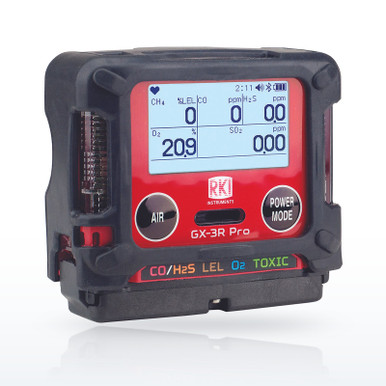 RKI Instruments 72-PQX-A GX-3R Pro Single-Gas Monitor, H2S, AlkalineSingle-gas H2S monitor: 0 to 200.0 ppm, alarms preset at 5, 30 and 100 ppm as RKI states
Why a sensor and not a sense. The NIOSH Pocket Guide says it in one note: the sense of smell becomes rapidly fatigued and cannot be relied upon to warn of the continuous presence of H2S. OSHA’s hydrogen sulfide page puts the first rotten-egg smell at 0.01 to 1.5 ppm and the loss of smell near 100 ppm, which is also the level NIOSH calls immediately dangerous to life or health; the OSHA ceiling is 20 ppm. So the gas warns you at a thousandth of the dangerous level and goes silent at the dangerous level. An electrochemical sensor does the opposite: it reads nothing in clean air, reads 1 ppm at 1 ppm, and alarms at whatever the program loads. That is why the permit-space rule requires a calibrated direct-reading instrument for the pre-entry test and monitoring during entry, and why the entrant leaves on the alarm rather than on the smell (1910.146(h)(5)).
The ways H2S is detected, and what each is for
Every instrument below is in the band with its price.
How to calibrate an H2S meter, as RKI Instruments’ manuals lay it out
- Bump test first, every day: apply the H2S gas and confirm the channel rises and the alarms fire. Both RKI manuals say to calibrate only if the bump test fails (citing IEC 60079-29-2); RKI’s FAQ allows a 3 to 6 month calibration cycle for instruments bump tested daily, monthly for the rest.
- Step 1, fresh air adjustment: in clean air with 20.9 percent oxygen and no gas, run AIR CAL (GX-Force) or the demand zero (GX-3R Pro) so the H2S channel reads 0.0 ppm.
- Step 2, span: connect the H2S cylinder through the regulator the manual names (demand flow to the GX-Force inlet; a 0.25 LPM fixed flow regulator and the calibration cup on the GX-3R Pro), check the cylinder value on the screen against the label, apply gas for the time the manual states and read pass or fail. The GX-3R Pro accepts 1.0 to 200.0 ppm and the GX-Force 0.5 to 200 ppm for the span.
- Vent the regulator while fitting it to a toxic cylinder, RKI’s manual says, so air does not enter the line and dilute the H2S.
- Record it: date, serial number, gas lot and result. OSHA’s bulletin on direct-reading monitors keeps calibration records for the life of the instrument; RKI’s SDM-3R and SDM-Force stations do the test and the record automatically.
- Shelf life: RKI lists H2S in nitrogen in a 34 or 58 L aluminum cylinder at 2 years and prints a use-by month and year on every cylinder.
Hydrogen sulfide: the numbers a detector is set against
| Figure | Value | Source |
|---|---|---|
| Odor threshold | 0.01 to 1.5 ppm | OSHA hydrogen sulfide topic page |
| Loss of smell | about 100 ppm, within 2 to 15 minutes | OSHA hydrogen sulfide topic page |
| OSHA ceiling (general industry) | 20 ppm, one 10-minute peak to 50 ppm | 29 CFR 1910.1000 Table Z-2 |
| OSHA PEL (construction, shipyards) | 10 ppm, 8-hour TWA | 29 CFR 1926.55, 1915.1000 |
| NIOSH REL | 10 ppm ceiling, 10 minutes | NIOSH Pocket Guide to Chemical Hazards (current online edition) |
| NIOSH IDLH | 100 ppm | NIOSH Pocket Guide to Chemical Hazards (current online edition) |
| Relative gas density | 1.19 (air 1.00) | NIOSH Pocket Guide to Chemical Hazards (current online edition) |
| Flammable range | 4.0 to 44.0 percent by volume | NIOSH Pocket Guide to Chemical Hazards (current online edition) |
| RKI measuring range | 0 to 200.0 ppm, 0.1 ppm steps, ± 5 percent of reading or ± 2 ppm | RKI Instruments GX-3R Pro product page and specification table (rkiinstruments.com/product/gx-3r-pro-gas-detector, rkiinstruments.com, fetched Nov 8 2026) |
| RKI preset alarms | 5, 30 and 100 ppm; TWA 1.0, STEL 5.0 ppm | RKI Instruments GX-3R Pro product page and specification table (rkiinstruments.com/product/gx-3r-pro-gas-detector, rkiinstruments.com, fetched Nov 8 2026); RKI Instruments 04 Series product page and specification table (rkiinstruments.com/product/04-series-single-gas-detectors, rkiinstruments.com, fetched Nov 8 2026) |
Source: NIOSH Pocket Guide to Chemical Hazards (current online edition); OSHA Safety and Health Topics, Hydrogen Sulfide; 29 CFR 1910.1000 Table Z-2; RKI Instruments GX-3R Pro product page and specification table (rkiinstruments.com/product/gx-3r-pro-gas-detector, rkiinstruments.com, fetched Nov 8 2026)
Questions people ask
How to detect H2S gas?
With an electrochemical hydrogen sulfide sensor in a single-gas or four-gas monitor, reading in ppm and alarming at set points; a space is tested from outside first with a pumped monitor whose hose reaches the bottom, because H2S is heavier than air. Smell is not detection: it fails near 100 ppm.
What do H2S monitors detect?
Hydrogen sulfide in parts per million on an electrochemical sensor: RKI Instruments’ range is 0 to 200.0 ppm in 0.1 ppm steps with preset alarms at 5, 30 and 100 ppm. A four-gas monitor adds oxygen, LEL and CO on their own sensors.
Do gas detectors detect sewer gas?
Yes. Sewer gas is mostly methane, carbon dioxide and hydrogen sulfide; the H2S sensor reads its toxic part (NIOSH lists sewer gas as a synonym for H2S), the LEL sensor reads the methane and the oxygen sensor shows displacement. A four-gas monitor covers all three.
Is there a way to detect sewage gas?
A four-gas monitor lowered or pumped into the manhole or wet well before entry, then worn by the entrant; the H2S channel is the one that alarms first in wastewater work (RKI presets 5 ppm).
What is an H2S analyzer?
In the trade an analyzer is a fixed or laboratory instrument measuring H2S in a process gas stream; the portable instruments on this page are monitors and detectors worn or carried for worker protection. RKI’s fixed detector heads and controllers are separate from the portable line shown here.
How to calibrate a H2S meter?
Fresh air adjustment in clean air, then a span with H2S calibration gas through the regulator and cap the manual names, after a daily bump test; RKI’s GX-3R Pro accepts 1.0 to 200.0 ppm for the span and its kits carry 25 ppm H2S. The steps are on this page and in the RKI calibration guide.
How much do H2S monitors cost?
The band on this page shows the prices: RKI’s HS-04 single-gas unit at the low end, the GX-3R Pro single-gas configurations above it, then the four-gas and pumped units. The cost guide on this site compares the line.
What ppm H2S is bad?
10 ppm is the NIOSH ceiling and the construction PEL, 20 ppm the OSHA general industry ceiling, 100 ppm immediately dangerous to life or health; the H2S limits guide on this site has the chart of effects by level.
Can a 4-gas monitor detect H2S?
Yes; H2S is one of the standard four (LEL, O2, H2S, CO). RKI’s GX-3R, GX-3R Pro and GX-Force carry a combination H2S/CO sensor in one slot.
What is the H2S range on a BW Clip and an ALTAIR 4XR?
0 to 100 ppm on the Honeywell BW Clip (datasheet) and 0 to 200 ppm, 1 ppm resolution, on the ALTAIR 4XR (bulletin), which also takes a 0 to 100 ppm H2S-LC sensor reading to 0.1 ppm.
Related guides
What is H2S, and why does it kill?Where it comes from and what it doesH2S exposure limitsOSHA, NIOSH and ACGIHIs H2S heavier than air?Where it collectsWhat to do when an H2S monitor alarmsFlammability, odor threshold, how it formsHow to calibrate an RKI GX-Force or GX-3R ProStep by step from the manualsWhat does a 4-gas monitor measure?And why those fourThe ratings, test results and standards shown here are the manufacturers' published values, reproduced as published. Nothing on this page is a recommendation by Bayshore Safety that any product is suitable for a particular task, hazard or workplace. Selecting safety products and protective equipment is the responsibility of the end user and the employer, based on their own hazard assessment and the regulations that apply to their work. Confirm every value on the manufacturer's own documentation before use.