
What to do when an H2S monitor goes off, is hydrogen sulfide flammable, what is its odor threshold, and how does H2S form?
Leave. In a permit space 29 CFR 1910.146(h)(5) requires the entrant to exit as quickly as possible when the entrant detects a prohibited condition or an evacuation alarm is activated, and (i)(6) requires the attendant to order evacuation when a prohibited condition is detected; the air is re-tested from outside before anyone goes back. Hydrogen sulfide is a flammable gas as well as a toxic one: the NIOSH Pocket Guide gives a lower explosive limit of 4.0 percent and an upper limit of 44.0 percent by volume, which is 40,000 ppm against a 20 ppm OSHA ceiling, so the toxic alarm comes long before the LEL channel moves. The rotten-egg odor is first noticed by some people at 0.01 to 1.5 ppm, but NIOSH states the sense of smell becomes rapidly fatigued and cannot be relied on to warn of its continuous presence. It forms where organic matter breaks down without oxygen (sewers, wet wells, manure pits, digesters, which is why NIOSH lists sewer gas as a synonym) and is found in sour crude oil and natural gas. RKI Instruments presets its H2S alarms at 5, 30 and 100 ppm with a TWA alarm at 1.0 ppm and a STEL alarm at 5.0 ppm.
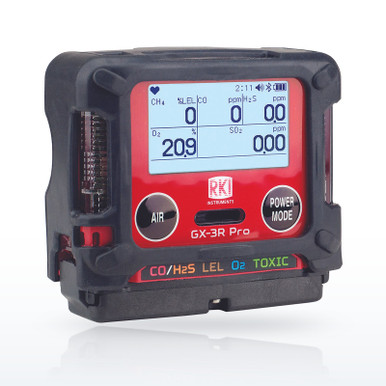 RKI Instruments 72-PQX-A GX-3R Pro Single-Gas Monitor, H2S, AlkalineSingle-gas H2S monitor RKI presets at 5, 30 and 100 ppm, TWA 1.0, STEL 5.0 (RKI data)
Why the answer is to move, not to think. The OSHA permit-space rule is written so that nobody has to interpret a reading under pressure. The permit names the acceptable entry conditions; any reading outside them is a prohibited condition; the entrant who detects one leaves and the attendant who sees one orders everyone out. The monitor’s alarm is the signal that a prohibited condition exists, and the low alarm is set at or below the exposure limit for that reason. H2S adds its own argument: it deadens the sense of smell at the concentrations that are already dangerous, NIOSH lists 100 ppm as immediately dangerous to life or health, and the gas is heavier than air (relative density 1.19), so the bottom of a pit, tank or manhole holds more than the opening where the attendant stands. None of this is a reason to carry an LEL monitor for H2S; at 4 percent LEL the toxic channel would have been pegged for a long time.
What the rule and the data say to do
From 1910.146 and the NIOSH entry; the figures are theirs.
The H2S facts people ask for, with the source for each
- Is hydrogen sulfide flammable? Yes. NIOSH lists it as a flammable gas with an LEL of 4.0 percent and a UEL of 44.0 percent by volume; those are 40,000 and 440,000 ppm against a 20 ppm OSHA ceiling.
- At what temperature does H2S ignite on its own? The NIOSH Pocket Guide does not list an autoignition temperature; the gas supplier's SDS does. This page prints only what its sources state.
- What is the odor threshold? OSHA's hydrogen sulfide topic page gives 0.01 to 1.5 ppm for the first rotten-egg smell and notes the odor becomes more offensive at 3 to 5 ppm; NIOSH warns the sense of smell becomes rapidly fatigued and cannot be relied upon to warn of continuous presence.
- How does H2S form? From organic matter decaying without oxygen: NIOSH's synonyms are sewer gas and sulfuretted hydrogen. RKI states digester gas carries high levels of methane, CO2 and H2S with little or no oxygen, and its wastewater training names wet wells, dry wells, bar screens, lift stations, digesters, thickeners, clarifiers and pump stations as the places it is met. It also occurs in sour crude oil and natural gas.
- What neutralizes H2S? In a confined space the rule's answer is ventilation, not a chemical: 1910.146(c)(5)(ii)(E) requires continuous forced air ventilation to eliminate a hazardous atmosphere before entry and keep it eliminated. Scrubbing and odor control at a plant are process matters outside this page.
- How much does an H2S monitor cost? The prices are in the band: RKI's single-gas HS-04 at the low end, GX-3R Pro single-gas units, and multi-gas monitors with an H2S channel.
- What are the alarm presets? RKI: first alarm 5 ppm, second 30 ppm, third 100 ppm, TWA 1.0 ppm, STEL 5.0 ppm, range 0 to 200.0 ppm in 0.1 ppm steps, user adjustable.
RKI Instruments H2S range and preset alarms
| Gas and sensor | Measuring range (increment) | Accuracy statement | Preset gas alarms (user adjustable) | TWA and STEL alarms |
|---|---|---|---|---|
| Hydrogen sulfide (H2S) | 0 to 200.0 ppm (0.1 ppm) | ± 5% of reading or ± 2 ppm | A1 5 ppm, A2 30 ppm, A3 100 ppm | TWA 1.0 ppm, STEL 5.0 ppm |
Source: RKI Instruments GX-3R Pro product page and specification table (rkiinstruments.com/product/gx-3r-pro-gas-detector, rkiinstruments.com); RKI Instruments 04 Series product page and specification table (rkiinstruments.com/product/04-series-single-gas-detectors, rkiinstruments.com)
Hydrogen sulfide limits and properties
| Figure | Value | Source |
|---|---|---|
| OSHA ceiling (general industry) | 20 ppm; peak 50 ppm once for up to 10 minutes if no other exposure in the shift | 29 CFR 1910.1000 Table Z-2 |
| NIOSH REL | Ceiling 10 ppm (10 minutes) | NIOSH Pocket Guide to Chemical Hazards (current online edition) |
| NIOSH IDLH | 100 ppm | NIOSH Pocket Guide to Chemical Hazards (current online edition) |
| LEL / UEL | 4.0% / 44.0% by volume | NIOSH Pocket Guide to Chemical Hazards (current online edition) |
| Relative gas density | 1.19 (heavier than air) | NIOSH Pocket Guide to Chemical Hazards (current online edition) |
| Odor | Rotten eggs; sense of smell rapidly fatigued | NIOSH Pocket Guide to Chemical Hazards (current online edition) |
| RKI preset alarms | 5 / 30 / 100 ppm; TWA 1.0; STEL 5.0 | RKI Instruments GX-3R Pro product page and specification table (rkiinstruments.com/product/gx-3r-pro-gas-detector, rkiinstruments.com) |
Source: NIOSH Pocket Guide to Chemical Hazards (current online edition); 29 CFR 1910.1000 Table Z-2; RKI Instruments GX-3R Pro product page and specification table (rkiinstruments.com/product/gx-3r-pro-gas-detector, rkiinstruments.com).
Questions people ask
What should I do when my H2S monitor goes off?
Leave. In a permit space 29 CFR 1910.146(h)(5) requires the entrant to exit as quickly as possible when a prohibited condition is detected or an evacuation alarm sounds, and (i)(6) requires the attendant to order evacuation; nobody goes back in until the space is re-tested from outside, and no rescuer enters without SCBA or supplied air and a retrieval line.
What is a hydrogen sulfide leak?
A release of H2S gas from a vessel, pipe, wellhead, sewer or digester into air where people are; at a few hundred ppm it stops breathing within breaths, and OSHA’s ceiling is 20 ppm. A personal monitor alarming (RKI Instruments presets 5, 30 and 100 ppm) is usually how a leak is first known.
What is the odor threshold for hydrogen sulfide (H2S)?
0.01 to 1.5 ppm for the first rotten-egg smell, by OSHA’s hydrogen sulfide page; the odor becomes more offensive at 3 to 5 ppm and the sense of smell is lost near 100 ppm. NIOSH states the sense of smell cannot be relied on to warn of its continuous presence.
What neutralizes H2S gas?
In a confined space, ventilation, not a chemical: 1910.146(c)(5)(ii)(E) requires continuous forced-air ventilation to eliminate a hazardous atmosphere before entry and keep it eliminated. Scrubbers and chemical treatment are process controls on the source, not a way to clear a space someone is entering.
Can you recover from H2S exposure?
A worker removed to fresh air after a low exposure usually recovers; NIOSH’s first aid for inhalation is respiratory support and medical attention. A high exposure that stops breathing is fatal in minutes unless the person is removed and resuscitated, which is why the attendant’s job is retrieval from outside.
Is hydrogen sulfide extremely flammable?
It is a flammable gas: the NIOSH Pocket Guide lists an LEL of 4.0 percent and a UEL of 44.0 percent by volume, 40,000 to 440,000 ppm. Against a 20 ppm toxic ceiling the toxic alarm comes long before the LEL channel moves.
At what temperature will H2S spontaneously ignite?
The NIOSH Pocket Guide does not list an autoignition temperature for hydrogen sulfide; the gas supplier’s safety data sheet does. This page prints only the NIOSH flammability figures (LEL 4.0 percent, UEL 44.0 percent).
How does hydrogen sulfide form?
Organic matter decaying without oxygen, which is why NIOSH lists sewer gas as a synonym and why it is met in sewers, wet wells, manure pits and digesters, and it occurs in sour crude oil and natural gas. RKI states digester gas carries high levels of methane, CO2 and H2S with little oxygen.
How much do H2S monitors cost?
The prices are in the band on this page: RKI’s HS-04 single-gas unit at the low end, the GX-3R Pro single-gas configurations above it, and the four-gas monitors with an H2S channel after that. The cost guide on this site compares single-gas, four-gas and sensor prices across the line.
Why does my monitor alarm at 5 ppm when the OSHA limit is 20?
Because RKI’s factory first alarm is 5 ppm, with TWA 1.0 and STEL 5.0 ppm set to the ACGIH values, warning well before OSHA’s 20 ppm ceiling; the employer may change the set points in User Mode.
What do the alarm patterns on a BW Clip mean?
Honeywell BW’s quick reference guide: low alarm is one beep, one flash and one vibration per second; high alarm and over-limit (OL) are two per second; the alarm persists until the concentration returns to an acceptable range.
Does an H2S alarm clear itself on an MSA ALTAIR?
Low and high alarms clear when the gas falls below the set point; a latched alarm, a STEL or TWA alarm and a sensor-life alarm are cleared with the up button, as the ALTAIR 4X and 5X manuals state.
Related guides
What is H2S, and why does it kill?Where it comes from and what it doesH2S exposure limitsOSHA, NIOSH and ACGIHIs H2S heavier than air?Where it collectsHow to read a gas monitor alarmLow, high, TWA and STELRespiratory protection in confined spaces1910.146 and 1910.134 togetherWhat are the alarm set points on a gas monitor?H2S, CO, O2 and LEL defaults as BW and MSA ship themThe ratings, test results and standards shown here are the manufacturers' published values, reproduced as published. Nothing on this page is a recommendation by Bayshore Safety that any product is suitable for a particular task, hazard or workplace. Selecting safety products and protective equipment is the responsibility of the end user and the employer, based on their own hazard assessment and the regulations that apply to their work. Confirm every value on the manufacturer's own documentation before use.