
How do you stop safety glasses and goggles from fogging up? Why lenses fog, what the anti-fog coatings do and how long they last, dish soap, spit, toothpaste and sprays, wipes, and the Z87.1 X mark
A lens fogs when it is colder than the air next to it and the water vapor in that air condenses into droplets on the surface; the fix is either to keep the lens warmer than the air (vents, indoor/outdoor swaps, a gap at the brow) or to put something on the surface that stops droplets from forming. Manufacturers do the second with a factory coating: MCR Safety’s MAX6 and UV-AF, Radians’ IQuity, UVEX’s Hydroshield and Uvextreme and Bouton Optical’s FogLess 3Sixty are all coatings bonded to the lens, and since the 2020 edition of ANSI/ISEA Z87.1 a lens that stays clear for at least 8 seconds in the standard’s fog test may carry the X mark. Dish soap, spit and the other shop remedies work the same way for a few minutes and then wipe or wash off; toothpaste is an abrasive and scratches polycarbonate. The durable answer is a coated lens, a vented frame that fits, and a cleaning station that does not strip the coating.
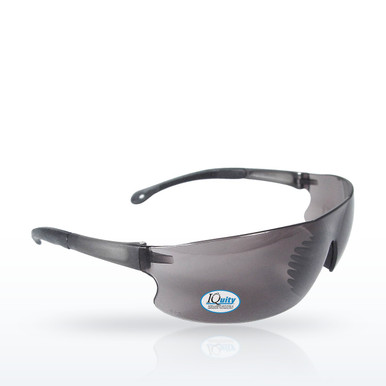 Radians RS1 Safety Glasses, Rad-Sequel IQ, IQuity Anti-Fog Safety EyewearRadians states that IQuity is an anti-fog, anti-scratch, anti-smudge coating; the RS1 is listed at ANSI/ISEA Z87.1+ with 99.9 percent UV protection
Why fogging is a safety problem, not a comfort problem. 29 CFR 1910.133(a)(1) requires eye protection when the worker is exposed to flying particles, molten metal, liquid chemicals, acids or caustic liquids, chemical gases or vapors, or injurious light radiation. A fogged lens is taken off, pushed up or pulled down the nose, and the eye is open at exactly the moment the hazard is present. Every manufacturer we carry sells the same frame with and without an anti-fog coating because the coated lens is the one that stays on the face in a cold warehouse, behind a dust mask, in a humid plant or on a summer roof. This page answers the fogging questions people ask in the order they ask them: what causes it, whether the coatings work, how long they last, what the home remedies do, and what the X on a lens means.
The fogging questions, one by one
Coating names and performance claims are the manufacturers’ own, as printed on the product pages on this site.
What the words on the box mean
The vocabulary of fogging and coatings as the manufacturers and the standard use it.
- Anti-fog (AF): a factory coating that stops condensation from forming as droplets. MCR Safety names its tiers MAX6 and UV-AF; Radians IQuity; UVEX Hydroshield and Uvextreme; North Hydroshield; Bouton Optical FogLess 3Sixty. The name is the manufacturer’s; the test is Z87.1 Section 6.2.
- X mark: ANSI/ISEA Z87.1-2020 Table 3, the anti-fog marking, for a lens that stays free from fogging for at least 8 seconds in the Section 9.20 test. Only on lenses certified to the 2020 edition or later.
- N and K (EN 166): the European anti-fog mark and the European abrasion-resistance mark, printed together on Portwest lenses such as “EN 166 1 FT K N”.
- Hydrophilic and hydrophobic: a hydrophilic coating spreads water into a clear film; a hydrophobic coating makes water bead and run off. Some coatings are described as both (Bouton Optical calls FogLess 3Sixty “enhanced hydrophobic action”).
- Hard coat (anti-scratch): MCR Safety Duramass and MAX3, UVEX Ultra-Dura, the Anti-Scratch coating on Bouton Optical lenses. It protects the polycarbonate, which is soft, and it is the reason toothpaste and paper towels are a bad idea.
- Indirect vent, direct vent, non-vented: the three goggle designs. Indirect vents are baffled against liquid (the D3 splash goggle); direct vents breathe most and fog least; non-vented seals against gas and vapor and fogs fastest.
- Lens cleaning station: a wall or table dispenser of cleaning solution and low-lint tissues. Radians states its formula leaves “an anti-fog / anti-static coating”; MCR Safety states its solution is for plastic, polycarbonate and glass lenses and is silicone free.
Anti-fog coatings by manufacturer, as named on the product pages on this site
| Manufacturer | Coating name | What the manufacturer states | Sold on |
|---|---|---|---|
| MCR Safety | MAX6 Anti-Fog | “Passes ANSI Z87.1 anti-fog test”; premium tier above UV-AF; MAX36 is the next tier | BearKat BK1, Dominator DM3, Klondike KD1, Checklite CL1 and others |
| MCR Safety | UV-AF Anti-Fog | Anti-fog coating over the Duramass scratch-resistant hard coat | BK110AF, BK112AF, CL112AF, KD114AF and others |
| Radians | IQuity | “Anti-fog, anti-scratch, anti-smudge performance”; “one of the most superior and long-lasting anti-fog coatings in the marketplace” | Rad-Sequel RS1, Optima OP, Obliterator OBL1, LPX goggle |
| UVEX (PIP) | Hydroshield | “Patented technology which helps ensure fog-free vision in diverse and challenging working conditions” | Avatar Plus glasses and goggles, Astrospec OTG 3001 |
| UVEX (PIP) | Uvextreme with Ultra-Dura hardcoat | Anti-fog and anti-scratch coating on the same lens | Astrospec 3000 S1359C |
| North (PIP) | Hydroshield | “Provides longer lasting fog free performances” | Adaptec T5900 |
| Bouton Optical (PIP) | FogLess 3Sixty | “Enhanced hydrophobic action resists lens fogging and provides clear vision in extreme working conditions” | Captain 250-46, Anser 250-AN, ECO 250-15 |
| Portwest | Anti-fog (EN 166 N mark) | EN 166 1 FT K N printed on the lens line; Z87.1+ U6 beside it | PS23 and other PS and PW glasses |
A coating name is a manufacturer’s trade name; the only pass/fail claim that belongs to the standard is the X mark (Z87.1-2020) or the N mark (EN 166).
Source: MCR Safety, Radians, PIP (UVEX, North, Bouton Optical) and Portwest product pages as published on this site, fetched Nov 5–9 2026.
What the shop remedies do to a lens
| Remedy | How it works | How long it lasts | Effect on the lens |
|---|---|---|---|
| Dish soap film | Surfactant; spreads droplets into a clear film | Minutes to an hour; gone at the next wipe or rinse | Harmless to the lens; masks a factory anti-fog coating until washed off |
| Spit | Surfactant (saliva) | Minutes | Harmless; unhygienic on a shared lens |
| Shaving cream | Surfactant | Minutes to an hour | Harmless if rinsed |
| Toothpaste | Abrasive polish | Does not stop fog | Scratches polycarbonate and strips coatings |
| Anti-fog spray or wipe | Surfactant film made for lenses | Hours; reapplied | Made for polycarbonate; MCR Safety LFT600, Radians towelettes |
| Factory anti-fog coating | Bonded hydrophilic or hydrophobic layer | The life of the lens if cleaned with a soft tissue | Is the lens; the X or N mark certifies it |
Source: Mechanism descriptions are general; the manufacturer statements are those quoted above. No manufacturer we carry lists a kitchen remedy as a lens treatment.
Questions people ask
How do I keep my safety glasses from fogging up?
Buy the version of the frame with the manufacturer’s anti-fog coating (MCR Safety MAX6 or UV-AF, Radians IQuity, UVEX Hydroshield, Bouton Optical FogLess 3Sixty), keep air moving across the inside of the lens (vented side shields, a frame that does not clamp to the brow), and clean the lens with a cleaning station tissue rather than a paper towel so the coating stays on.
What is a good substitute for anti-fog spray?
A lens with a factory anti-fog coating; it is the only treatment that does not need reapplying. Between those, the pre-moistened anti-fog towelettes the manufacturers sell (MCR Safety LFT600, the Radians cleaning station towelettes) do what a spray does.
Does dish soap prevent fogging?
For a short while. Soap is a surfactant that spreads droplets into a clear film, and the film lasts until the next wipe or rinse. It is not a treatment any manufacturer we carry names, and it hides a factory coating until it is washed off.
Does spitting in goggles prevent fogging?
Briefly, for the same reason as soap: saliva is a surfactant. It is the swimmer’s trick and it lasts minutes. On a shared or a chemical splash goggle it is also unhygienic.
Does toothpaste stop goggles from fogging?
No, and it damages the lens. Toothpaste is an abrasive; polycarbonate is soft, which is why MCR Safety, UVEX and Bouton Optical sell scratch-resistant hard coats. Toothpaste scratches the lens and strips the coating.
Do anti-fog safety glasses really work?
Yes. MCR Safety states its MAX6 lens passes the ANSI Z87.1 anti-fog test; since 2020 a lens that stays clear for at least 8 seconds in the standard’s fog test carries the X mark. The coating cannot cool a sealed goggle being breathed into for an hour; venting does that.
Why do goggles keep fogging up?
Goggles trap warm, wet air against the face, so the lens is almost always colder than the air inside. Sealed (non-vented) goggles fog fastest; indirect-vent splash goggles next; direct-vent goggles least. The anti-fog version of each is sold for this reason.
What kind of glasses do not fog?
None are immune; the ones that fog least are coated lenses in frames with airflow: Radians IQuity glasses, MCR Safety MAX6 glasses, UVEX Hydroshield glasses, with vented side shields. A clear film, a brow gap and a mask that seals at the nose do the rest.
How do I keep safety goggles from fogging up when wearing a mask?
Seal the mask at the nose first (press the nose clip) so breath leaves through the filter or valve, then wear an anti-fog goggle; if the goggle sits on top of the mask edge, the breath goes under it and fogs the lens.
What is the anti-fog marking on safety glasses?
X, under ANSI/ISEA Z87.1-2020 Table 3. It means the lens stayed free from fogging for at least 8 seconds in the standard’s Section 9.20 test. There is no N mark in Z87.1; N is the EN 166 anti-fog mark on European-marked lenses.
Do anti-fog lens wipes actually work?
They put a surfactant film on the lens that lasts hours. MCR Safety sells pre-moistened anti-fog lens wipes (LFT600); Radians states its cleaning station towelettes leave an anti-fog and anti-static coating. They are reapplied; a factory coating is not.
How do I make my own anti-fog spray?
A drop of dish soap in water does what the homemade recipes do: it leaves a surfactant film that lasts until the next wipe. It is not a manufacturer-named treatment, and it is not a substitute for the coated lens or the cleaning station tissue that keeps a coating intact.
Why do my safety glasses fog with a dust mask?
The exhaled air is leaking out at the nose bridge and rising behind the lens. Press the mask’s nose clip until the leak stops, then wear an anti-fog lens; a mask with an exhalation valve sends the breath forward instead of up.
How often should I replace anti-fog safety glasses?
When the lens is scratched, pitted or the coating has been worn off by abrasive cleaning so it fogs like an uncoated lens; the manufacturers do not print a number of days. Cleaning with a soft tissue and solution made for polycarbonate is what makes the coating last.
Is anti-fog required by OSHA?
No. 29 CFR 1910.133 requires eye protection against the listed hazards and that it be marked to Z87.1; it does not require anti-fog. A fogged lens that is removed leaves the worker without the protection the rule requires, which is why the coated lens is bought.
Related guides
Anti-fog safety glassesWhat the anti-fog marking means (it is X, not N)Safety glasses vs safety gogglesWhen each one is requiredSafety glasses over prescription glassesOTG eyewear and what OSHA requiresWhat do chemical splash goggles protect against?The D3 rating explainedWhat does ANSI Z87.1 mean on safety glasses?Z87 vs Z87+, and how to read the markingsOSHA safety glasses requirementsWhat 1910.133 says, and when side shields are requiredThe ratings, test results and standards shown here are the manufacturers' published values, reproduced as published. Nothing on this page is a recommendation by Bayshore Safety that any product is suitable for a particular task, hazard or workplace. Selecting safety products and protective equipment is the responsibility of the end user and the employer, based on their own hazard assessment and the regulations that apply to their work. Confirm every value on the manufacturer's own documentation before use.