
Bayshore Safety & Industrial Supplies Guide
Is nylon a good material for gloves? What a nylon or polyester shell does and does not do (fit and dexterity, no cut rating), what Armor Guys makes its Extraflex, Basetek, Taeki5 and Kyorene shells from, gauge, and the thinnest cut-resistant gloves
Nylon is a good material for the shell of a general-purpose work glove and a poor one for a cut-resistant glove, and the two uses should not be confused. A 13- or 15-gauge nylon knit is thin, stretches to the hand, dries fast and does not lint, which is why Armor Guys knits its Duty and Extraflex general-purpose styles (the 04-001 series, the 06-007 and 06-008) on nylon and its Duty 06-009 and 06-012 on polyester, with a coated palm for grip and no cut level printed. Nylon on its own has no cut resistance worth rating, so Armor Guys’ cut-rated shells are different yarns: HDPE for Basetek, an engineered liner for Extraflex and Extraflex Plus, Taeki5 for the heat styles, and Kyorene and Kyorene Pro, which Armor Guys describes as graphene bonded to the host yarn. Gauge, by the workbook, is stitches per inch, 7 to 21; the 18-gauge Kyorene Pro and Extraflex Plus knits are the thinnest cut-rated gloves here, at A4 to A9.
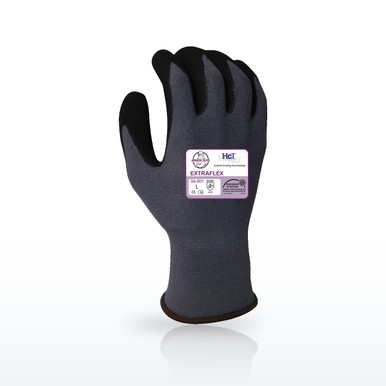 Armor Guys 04-001 Extraflex Nitrile Coated Gloves, Foam Nitrile Palm, Hi-VisThe Armor Guys Extraflex 04-001 is a 15-gauge nylon knit with a micro-foam nitrile palm and no cut level printed, the general-purpose glove, $37.48 a dozen
What the shell does. A coated work glove is a knitted shell, which Armor Guys calls the liner, with a coating dipped onto it. The shell sets the fit, the feel, the breathability and, if the yarn is a cut-resistant one, the cut level; the coating sets the grip. Armor Guys’ workbook describes yarn two ways. Filament yarn, long fibers grouped or slightly twisted, is "smooth to the touch", "non-linting or pilling", "high abrasion resistance", "stronger than spun yarns", "cooler", "minimal absorption", "wicking capable". Staple yarn, short fibers twisted together, is the fuzzy kind, "fabrics like wool, cotton, aramids", warmer, absorbent, "low abrasion resistance", "weaker than filament yarn". Nylon and polyester glove shells are knit from filament yarn, and that is the case for nylon: it is the smooth, cool, quick-drying, non-linting shell, and it is cheap.
What it does not do. Nothing against a blade. Armor Guys prints no cut level on its nylon and polyester Duty and Extraflex general-purpose styles, and where a nylon shell carries one, the hi-vis Extraflex Plus 14-001HV, it is A1, the lowest. Cut resistance comes from the fiber: HDPE (high-density polyethylene, the HPPE family) in the Basetek and Basetek Plus, which Armor Guys prints from A2 to A6 and, on the Perfotek, A9; the engineered Extraflex liner, A2 to A7; Taeki5, which adds the heat figure; and the graphene Kyorene and Kyorene Pro yarns, A1 to A9. Armor Guys also prints that HPPE "will start to melt above 158° Fahrenheit", which applies to the cut-resistant shells, not to nylon’s separate limits; none of the shells here is a heat material except Taeki5.
The questions in short
From the Armor Guys workbook and product pages; the long answers follow.
The questions, one by one
Each answer draws on the Armor Guys workbook, catalog and product pages named in the byline.
Is nylon a good material for gloves?
For the job a nylon shell is given, yes. Armor Guys builds its general-purpose line on it: the Extraflex 04-001 (15-gauge nylon, micro-foam nitrile palm), the 04-002 with a knuckle coat, the 04-005 with a dotted palm, the 04-007 with both, and the Duty 06-007 (smooth nitrile), 06-008 (foam nitrile) and 06-021 (crinkle latex) on 13-gauge nylon. They are the gloves for assembly, warehousing, maintenance and landscaping, where the hazard is abrasion and grip and not a blade, and they cost the least in the band. Nylon is not a good material for a glove that has to stop a cut, and Armor Guys does not pretend it is: those styles print no cut level.
Do nylon gloves exist, and what are they called?
They exist and they are most of the coated work gloves sold: "nylon knit", "13-gauge nylon shell", "polyurethane-coated nylon" and "nitrile-dipped nylon" are the same glove by different names. In Armor Guys’ catalog the shell is listed on each style as the liner, "15g Gray Nylon Extraflex® Liner" or "13g Black Nylon Liner", and the coating under it. Uncoated nylon inspection gloves are a different, lighter product we do not list in this band.
What is the difference between nylon and polyester glove shells?
Both are filament synthetics and both make the same kind of thin, cool, non-linting shell; Armor Guys uses nylon on most of its general-purpose styles and polyester on the Duty 06-009 (polyurethane palm) and 06-012 (micro-foam nitrile palm), its two lowest-priced gloves. Armor Guys prints no difference between them beyond the fiber name and the coating. Neither carries a cut level, and the choice between them for a crew is price and feel, not protection. The one cotton-polyester shell here is the Duty 06-019, a 10-gauge crinkle-latex glove with a staple-yarn feel, warmer and more absorbent by the workbook’s description of staple yarn.
What are Armor Guys’ cut-resistant shells made of?
Four yarns, each printed on the product page. Basetek and Basetek Plus: HDPE, high-density polyethylene, the HPPE family, which Armor Guys prints at A2 to A6 on the Basetek and A4 and A6 on the 18-gauge Basetek Plus, and A9 with a stated back-of-hand A4 on the Perfotek 07-002. Extraflex and Extraflex Plus: an engineered liner Armor Guys does not name by fiber, printed A2 to A5 on the Extraflex and A3 to A7 on the 18-gauge Extraflex Plus. Taeki5: the yarn Armor Guys rates for heat, A2 and A4, with the EN 407 marking. Kyorene and Kyorene Pro: the graphene yarns, A1 to A6 at 13 and 15 gauge on Kyorene and A1 to A9 at 15 and 18 gauge on Kyorene Pro. The fiber guide linked below sets Kevlar, HPPE and Dyneema against each other for the other brands.
What does gauge mean, and is 18 gauge thinner than 13?
The workbook: "Gauge is a measure of glove thickness. It refers to the size and type of needles used in the knitting process for seamless gloves. In other words, it refers to the number of stitches per inch of yarn. For example, an 18 gauge fabric has 18 stitches per inch. Seamless knitted gloves range in gauge size from 7g – 21g." Its table runs 7 gauge heavyweight (poor dexterity), 10 standard weight, 13 and 15 lightweight (good and very good), 18 super lightweight (excellent), 21 extremely lightweight (superior). So yes, 18 is thinner than 13, with more stitches of finer yarn per inch. The gauge guide linked below has the same scale across brands.
What are the thinnest cut-resistant gloves?
Here, the 18-gauge ones. Armor Guys prints 18 gauge on the Kyorene Pro 00-810 (A1) through 00-840 (A4), 00-860 (A6), 00-870 (A7), 00-880 (A8) and 00-890 (A9), on the Extraflex Plus 14-300 (A3) through 14-700 (A7), and on the Basetek Plus 12-400 and 12-420 (A4) and 12-600 and 12-620 (A6). Armor Guys also makes a 24-gauge Kyorene Pro Max line that we do not list at this time. A thinner glove at the same cut level is the one that stays on the hand for small-parts work, which is the reason to pay for it; the gram score behind the level is the same test either way, as the cut-rating guide explains.
What is Kyorene, and what is graphene in a glove?
In Armor Guys’ words from the workbook: "We take raw graphite and separate it down to the appropriate layers to which it becomes graphene. Next, we liquefy the graphene turning it in to Graphene Oxide (GO). From there, we covalently bond the Graphene Oxide (GO) to host yarns. As a result of the covalent bonding, the graphene cannot flake, shed, or come off the host yarn." Armor Guys lists the properties it attributes to the yarn, thermal regulating, odor neutralizing and bacteriostatic among them, on its product pages, and we repeat them as its statements; the figures we rely on are the printed cut, abrasion, puncture and EN 388 levels, which are tested the same way as every other shell in the band. The Armor Guys questions guide linked below has the line names.
In plain words
- Nylon is the right shell for a general-purpose coated glove: thin, cool, quick-drying, non-linting, cheap. It has no cut rating.
- Cut resistance comes from the fiber: HDPE/HPPE (Basetek), an engineered liner (Extraflex), Taeki5 (heat), and the graphene Kyorene yarns.
- Gauge is stitches per inch, 7 to 21; 18 gauge is thinner than 13. The 18-gauge Kyorene Pro and Extraflex Plus are the thinnest cut-rated gloves here.
- Polyester shells do the same job as nylon at the low end; neither is rated for cut.
- Kyorene is Armor Guys’ graphene-bonded yarn, described in its words; the printed cut levels are what the glove is picked on.
Questions people ask
Is nylon a good material for gloves?
For a general-purpose coated shell, yes: thin, stretchy, quick-drying and non-linting. It carries no cut rating, so it is not the shell for cut-resistant gloves.
Do nylon work gloves exist?
Yes; most coated general-purpose gloves are nylon knits, including the Armor Guys Extraflex 04-001 series and Duty 06-007, 06-008 and 06-021.
What are cut-resistant glove shells made of?
HDPE/HPPE, engineered blends, aramids, steel or glass cores, and Armor Guys’ graphene Kyorene yarns, each printed with its ANSI/ISEA 105 level.
What does gauge mean on a glove?
Stitches per inch, from 7 (heavyweight) to 21 (extremely lightweight), per the Armor Guys workbook; 18 gauge is thinner than 13.
What is the thinnest cut-resistant glove?
Here, the 18-gauge knits: Armor Guys prints A4 to A9 on its 18-gauge Kyorene Pro and A3 to A7 on its 18-gauge Extraflex Plus.
Nylon or polyester gloves?
Both are filament shells with no cut rating; Armor Guys uses nylon on most general-purpose styles and polyester on the Duty 06-009 and 06-012.
What is Kyorene?
Armor Guys’ name for its yarn with graphene oxide covalently bonded to the host yarn, in its description; its gloves are rated A1 to A9 on the standard tests.
Does nylon melt?
Armor Guys prints a melt note only for HPPE (above 158 °F); no nylon style here carries a heat figure, and none is a heat glove.
Related guides
What is Kevlar, HPPE and Dyneema in a glove?And how do they differIs 18 gauge thinner than 13 gauge?What glove gauge meansWhat is a glove coating?Nitrile, polyurethane, latex and foam comparedWhat are the four main types of work gloves?Leather, coated knit, cut-resistant and disposableHow are cut-resistant gloves rated and tested?The TDM-100 test, the gram scores and the 2024 badgeWill nitrile gloves melt in heat?What a nitrile coating and an HPPE shell are rated forArmor Guys gloves: questions answeredWho makes them, the series names, graphene and the dozen packagingWhat does EN 407 mean on gloves?The six heat and flame figures and the levels 1 to 4The ratings, test results and standards shown here are the manufacturers' published values, reproduced as published. Nothing on this page is a recommendation by Bayshore Safety that any product is suitable for a particular task, hazard or workplace. Selecting safety products and protective equipment is the responsibility of the end user and the employer, based on their own hazard assessment and the regulations that apply to their work. Confirm every value on the manufacturer's own documentation before use.
© 2026 Bayshore Safety & Industrial Supplies, Inc. All rights reserved. This guide may not be copied or republished without written permission.