
Bayshore Safety & Industrial Supplies Guide
How are cut-resistant gloves rated and tested? The ASTM F2992-15 TDM-100 test behind ANSI/ISEA 105 A1 to A9, the gram scores, the 2024 marking, how to tell a glove is cut resistant, A3 vs A4, the EN 388 cut letters, and why cut-proof is not a rating
A cut-resistant glove is rated by a machine, not an opinion. Under ANSI/ISEA 105 the glove material is clamped in a TDM-100 tester and a straight blade is drawn across it under a load; Armor Guys’ workbook describes the test it uses: "Cuts are applied in the same direction across a length of about 25mm. After each cut, a new blade is used and additional weight is added until cut-through is achieved. The amount of weight + distance is measured to determine the gram score. The gram score is then used to determine a cut level of A1 through A9." The levels are gram bands: A1 200 to 499, A2 500 to 999, A3 1,000 to 1,499, A4 1,500 to 2,199, A5 2,200 to 2,999, A6 3,000 to 3,999, A7 4,000 to 4,999, A8 5,000 to 5,999, A9 6,000 and over. The result is printed on the glove in the ANSI/ISEA 105 pictogram, a shield under the 2016 edition and a pentagon under the 2024 edition, with abrasion and puncture levels beside it; a glove with no pictogram and no EN 388 code has no cut rating, whatever it is made of. "Cut-proof" is not a rating and no manufacturer we carry prints it: A9 means the material held 6,000 grams or more on a straight blade, which is a great deal of cut resistance and not immunity to a serrated edge, a moving blade or a point.
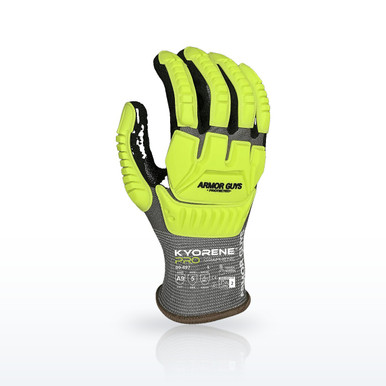 Armor Guys 00-897 Kyorene Pro Impact Gloves, ANSI A9, Foam Nitrile PalmArmor Guys’ highest-rated glove we carry: ANSI/ISEA 105 A9 and EN 388 4X43F on an 18-gauge Kyorene Pro knit with an ANSI/ISEA 138 level 2 impact back, $357.78 a dozen
The test, step by step. The TDM-100 is a sled that carries a straight razor-type blade across a sample of the glove material under a set load. A conductive strip under the sample detects the moment the blade comes through, and the machine records the distance the blade travelled. Each cut uses a fresh blade and a heavier load, and the results are plotted to find the load at which the blade cuts through in a reference distance; that load, in grams, is the score. Armor Guys’ diagram labels the parts: variable load, linear movement, blade, glove sample, conductive strip "(detects cut through)". The score goes into the gram table above and comes out as a level. The 2016 edition of ANSI/ISEA 105 introduced the nine A-levels and the TDM-100 as the single test; the 2024 edition kept the levels and changed the marking.
The marking under ANSI/ISEA 105-2024. Armor Guys’ workbook lists what changed: the pictogram "has pentagon with even angled sides", carries "abrasion, cut, puncture ratings only", the standard title is centered over the pentagon, "the symbol in the top center is the ANSI Cut rating (note, this rating is bigger)", abrasion is on the left, puncture on the right, "an 'X' can be applied in place of a rating to indicate the classification was not tested or is not applicable", and the year 2024 goes in the title on websites and spec sheets. Gloves marked under the 2016 edition carry the shield; both are the same levels.
The other two numbers on the badge. Abrasion is a spinning wheel against the material, 500 grams of load for levels 0 to 3 and 1,000 grams for levels 4 to 6, scored by revolutions to wear through: under 100 for level 0, then 100, 500, 1,000, 3,000, 10,000 and 20,000 revolutions for levels 1 to 6. Puncture is a probe pushed through the material, scored in newtons: 10 to 19 N level 1, 20 to 59 level 2, 60 to 99 level 3, 100 to 149 level 4, 150 and over level 5. Armor Guys prints all three on each rated style, which is why a Kyorene Pro 00-897 reads A9 cut, abrasion 4, puncture 3.
The ANSI/ISEA 105 cut levels, in grams
The gram bands as Armor Guys prints them in its workbook; the use notes are its catalog’s application lists.
The questions, one by one
Answers from the Armor Guys workbook, catalog, FAQ and product pages named in the byline.
How are cut-proof gloves rated?
By the test above, as cut-resistant gloves; there is no cut-proof rating. Every glove that claims a level was cut on a TDM-100 under ASTM F2992-15, and the level is the gram band the material held. Armor Guys’ FAQ makes the point that "cut ratings vary by SKU", so the rating belongs to the style, not the brand, and it is printed on the glove and the spec sheet. If a glove is sold as cut-proof with no level, it has not been rated.
How do I know if my gloves are cut resistant?
Look at the back of the hand or the cuff for the ANSI/ISEA 105 pictogram with an A-number, or the EN 388 shield with a four-to-six character code. Either one is a tested rating; a fiber name alone (Kevlar, HPPE, nylon) is not. Armor Guys prints both marks on every rated style, and the product page and spec sheet repeat them with the abrasion and puncture levels.
How much bigger is A4 than A3?
The floor of A4 (1,500 grams) is 50 percent above the floor of A3 (1,000 grams), and the ceiling of A4 (2,199 grams) is nearly half again the ceiling of A3 (1,499). In the catalog’s language A3 sits in "light/medium cut hazards" and A4 in "medium cut hazards", which is why A4 is the level most sheet-metal and construction specifications start at. The two levels are usually the same gauge and coating in the Armor Guys line; the difference is the yarn.
Do cut-proof gloves exist?
No. A9 is the top of the scale and means 6,000 grams or more on a straight blade drawn across the material; it does not mean a serrated blade, a moving blade, a point or a crushing edge cannot get through. Armor Guys describes its A9 styles by the level and the EN 388 letter F and nothing more, and the cut-levels guide linked below has the same answer from the other manufacturers we carry.
What are the cut resistance levels according to EN 388?
Two of them. The second digit of the code is the coup test, a rotating circular blade, scored 1 to 5. The fifth position is the ISO 13997 test, the same TDM-100 straight-blade test ANSI uses, scored A to F in newtons: Armor Guys’ catalog converts them, A 2 N (203 grams), B 5 N (509 g), C 10 N (1,019 g), D 15 N (1,529 g), E 22 N (2,243 g), F 30 N (3,059 g). The letter is the one to set beside an ANSI level: a D is roughly an A4, an E an A5, an F an A6 and up, though the standards are not identical and a glove carries each result on its own.
What is the thinnest cut-resistant glove, and does thinner mean weaker?
The 18-gauge knits, and no, not at the same level: gauge is stitches per inch, and Armor Guys’ workbook grades 18 gauge "super lightweight, excellent dexterity". Its 18-gauge Kyorene Pro styles run from A4 to A9 and the Basetek Plus 12-400 series is A4 at 18 gauge. What a finer gauge gives up is bulk and, usually, abrasion life, which the abrasion level on the badge shows.
Can cut-resistant gloves be washed?
Some can, by the instructions for the style. Armor Guys’ FAQ: "Laundering depends on the specific liner, coating, contamination, and SKU-level instructions", and its care page: laundering can change cut protection "if the glove is not designed or handled for laundering." The washing guide linked below has the yarn-by-yarn rule; the rating on the badge is for a new glove.
Is a higher level always safer?
Not for the worker who takes the glove off. Armor Guys’ cut-level page says it plainly: "Higher levels are not automatically better for every task because dexterity and compliance still matter", and "the safest selection is usually the glove that meets the documented hazard while workers can keep it on for the full task." The hazard assessment under 29 CFR 1910.132(d) sets the level; the trial sets the style.
In plain words
- Cut resistance is measured on a TDM-100: a straight blade under a load, a new blade each cut, more weight until it goes through; the grams at cut-through set the level A1 to A9.
- The levels are gram bands: A1 200, A2 500, A3 1,000, A4 1,500, A5 2,200, A6 3,000, A7 4,000, A8 5,000, A9 6,000 grams and up.
- The rating is printed on the glove in the ANSI/ISEA 105 pictogram (shield for 2016, pentagon for 2024) with abrasion and puncture beside it, or in the EN 388 code with a cut letter A to F.
- No pictogram and no EN 388 code means no rating; "cut-proof" is not a rating.
- A4 starts 50 percent above A3 and is where medium cut hazards begin in Armor Guys’ catalog.
Questions people ask
How are cut-resistant gloves rated?
On a TDM-100 tester under ASTM F2992-15: a straight blade is drawn across the material under increasing load until it cuts through, and the grams at cut-through set the ANSI/ISEA 105 level A1 to A9.
What is the gram range for A4?
1,500 to 2,199 grams on the TDM-100 test; A3 is 1,000 to 1,499 and A5 is 2,200 to 2,999.
How can I tell if a glove is cut resistant?
By the ANSI/ISEA 105 pictogram with an A-level, or the EN 388 shield with a code, printed on the glove; a fiber name alone is not a rating.
What changed in ANSI/ISEA 105-2024?
The marking: a pentagon pictogram with the cut level large at the top, abrasion left, puncture right, X for untested; the levels did not change.
Are cut-proof gloves real?
No; A9 is the highest rating and means 6,000 grams or more on a straight blade, not immunity.
What is the EN 388 cut letter?
The ISO 13997 straight-blade result, A to F; Armor Guys’ catalog converts it, A 2 newtons (203 g) to F 30 newtons (3,059 g).
What are the abrasion and puncture numbers on the badge?
Abrasion 0 to 6 by revolutions of a wheel (100 to 20,000); puncture 1 to 5 by newtons on a probe (10 to 150 and over).
Can you wash cut-resistant gloves?
By the manufacturer’s instructions for the style; Armor Guys says laundering depends on the liner, coating and contamination and can change cut protection if the glove was not designed for it.
Related guides
What do ANSI cut levels A1 to A9 mean?The ANSI/ISEA 105 scaleWhat are the gloves called that you can’t cut through?The levels in the trade’s wordsANSI A4 vs A5 vs A6 glovesWhat the levels protect againstEN 388 explainedThe four numbers and the letters on a gloveCan cut-resistant gloves be washed?Care and when to replace themWhat is an ANSI puncture rating?And what is needle-stick puncture?Which gloves for sheet metal, glass and sharp edges?By the stated cut, abrasion and puncture levelsArmor Guys gloves: questions answeredWho makes them, the series names, graphene and the dozen packagingANSI/ISEA 105 Hand Protection ClassificationThe rule pageThe ratings, test results and standards shown here are the manufacturers' published values, reproduced as published. Nothing on this page is a recommendation by Bayshore Safety that any product is suitable for a particular task, hazard or workplace. Selecting safety products and protective equipment is the responsibility of the end user and the employer, based on their own hazard assessment and the regulations that apply to their work. Confirm every value on the manufacturer's own documentation before use.
© 2026 Bayshore Safety & Industrial Supplies, Inc. All rights reserved. This guide may not be copied or republished without written permission.