
What does NFPA 10 (2026) require for a nonrechargeable fire extinguisher? Inspection, maintenance and the 12-year rule
A nonrechargeable (nonrefillable) extinguisher under NFPA 10 (2026) 3.4.2 is intended for one use and is not capable of being recharged and returned to service. The standard asks four things of it. Inspect it when placed in service and monthly after that, the same seven items as any unit (7.2). Maintain it once a year with an external examination and a tag, and do not remove its seal (7.3.1.1, 7.3.2, 7.3.2.2.2). Skip the annual and six-year internal examinations and the hydrostatic test, which it is exempt from (7.3.3.6, 7.3.6.3). Remove it from service no later than 12 years from the date of manufacture on the nameplate (7.3.6.3), and when an inspection finds a deficiency, take it out of service: a dry chemical unit is discharged and destroyed or returned (7.2.3.2), a halon unit is returned for recovery without discharge (7.2.3.3, 8.4.1.3), and any nonrechargeable unit with cylinder damage is not hydrotested but discarded (8.4.1.2). Amerex states the same for its Halotron BrX units: external examination at annual maintenance, replacement at 12 years.
Why does the standard treat sealed units this way? Internal examination and hydrostatic testing exist to catch corrosion and weakness inside a cylinder that will be opened, refilled and put back for decades. A sealed unit is never opened, so the standard trades those examinations for a fixed service life. The owner's job becomes simple: monthly look, annual tag, replace at the date.
The owner's checklist for a nonrechargeable unit
What to do and when, by section.
Nonrechargeable vs rechargeable under NFPA 10 (2026)
| Requirement | Nonrechargeable | Rechargeable |
|---|---|---|
| Monthly inspection | Yes (7.2) | Yes (7.2) |
| Annual maintenance | External examination, tag (7.3.2, 7.3.4) | Full maintenance incl. agent and expelling means (7.3.1) |
| Tamper seal at maintenance | Not removed (7.3.2.2.2) | Removed and replaced (7.3.2.2) |
| Annual internal examination | Not required (7.3.3.6) | By type, Table 7.3.3.1 |
| Six-year internal examination | Not required (7.3.6.3) | Stored-pressure types with a 12-year hydro (7.3.6) |
| Hydrostatic test | Not required (7.3.6.3) | 5 or 12 years, Table 8.3.1 |
| Service life | 12 years from manufacture (7.3.6.3) | While it passes |
| After use | Replace (7.1.3) | Recharge (7.8) |
Source: NFPA 10 (2026), sections as cited.
Nonrechargeable clean agent units
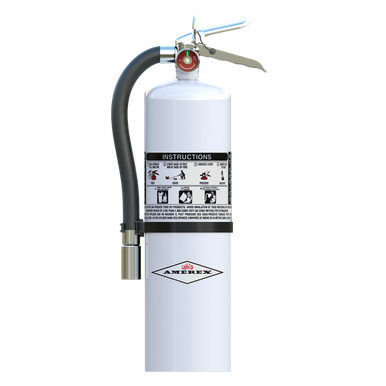
1 items · prices liveAmerex HT Series Halotron BrX, sealed, 12-year service life. Prices are live.
Cabinets, brackets and signs are in Fire protection accessories.
Questions people ask
Does a nonrechargeable fire extinguisher need an annual inspection?
Monthly inspection and annual maintenance both apply (NFPA 10 (2026) 7.2, 7.3.1.1). What it skips is the internal examination and hydrostatic test.
Does a nonrechargeable extinguisher need a hydrostatic test?
No (7.3.6.3). It is removed from service at 12 years from the date of manufacture instead.
Can the seal be removed on a nonrechargeable extinguisher at annual maintenance?
No (7.3.2.2.2).
What happens to a nonrechargeable extinguisher after it is used?
It is removed from service and replaced immediately with a unit suitable for the hazard and of equal or greater rating (7.1.3).
Where is the 12-year date measured from?
The date of manufacture on the nameplate (7.3.6.3).
Does this apply to Amerex Halotron BrX units?
Yes. Amerex lists them as nonrechargeable with a 12-year service life and states that annual maintenance is an external examination only.
Related guides
Do fire extinguishers expire?Rechargeable vs nonrechargeable, and the 12-year ruleInspection, maintenance and hydrostatic testingMonthly, annual, 6-year and 12-year explainedAmerex HT SeriesHalotron BrX units side by sideNFPA 10 requirements explainedSelection, placement, inspection and testing in plain wordsThe ratings, test results and standards shown here are the manufacturers' published values, reproduced as published. Nothing on this page is a recommendation by Bayshore Safety that any product is suitable for a particular task, hazard or workplace. Selecting safety products and protective equipment is the responsibility of the end user and the employer, based on their own hazard assessment and the regulations that apply to their work. Confirm every value on the manufacturer's own documentation before use.