
Is 50 dB noise cancellation good, and is it an OSHA violation to wear earbuds at work? What OSHA’s letters say about headphones and hearing protection
Two different questions with two documented answers. On the number: no hearing protector sold in the United States carries a label near 50 dB. The EPA label rule, 40 CFR 211.204-1, requires every package to state that the range of Noise Reduction Ratings for existing hearing protectors is approximately 0 to 30, and the highest-rated products on the market are foam ear plugs at NRR 33. A “50 dB” figure on consumer headphones is the manufacturer’s own measurement of active cancellation at certain frequencies; it is not an NRR, it was not produced by the ANSI S3.19 test the label requires, and OSHA’s Appendix B method for judging whether a protector is adequate works only from an NRR. OSHA addressed the headphones themselves in a letter dated March 6, 2023: consumer active noise-cancelling (ANC) headphones are designed to block ambient sound for music and podcasts, most are not effective for controlling occupational noise exposure because they do not offer protection from sudden, explosive sounds without the sealing a passive protector gives, and OSHA advises against using them in place of laboratory-tested devices if they are not designed for hearing protection. The same letter notes that some headphones built with both passive and active reduction carry NRRs between 20 and 30 and may be acceptable in some workplaces. On the earbuds: there is no specific OSHA regulation that prohibits headphones on a construction site or any other workplace, as OSHA wrote on September 6, 2019 and repeated in 2023. What the rules require is that the employer protect employees exposed above the permissible limits (29 CFR 1926.52 Table D-2 in construction, 1910.95 Table G-16 in general industry) and provide hearing protectors where needed (1926.101, 1910.95(i)); a portable music player is not a substitute for hearing protection, and the noise reaching the ear, through the job or through volume-limited headphones, must not exceed the table. Use is at managerial discretion unless it creates another hazard, and OSHA names one: music can mask the environmental sounds a worker on an active site needs to hear, when struck-by incidents are one of the four leading causes of death in construction.
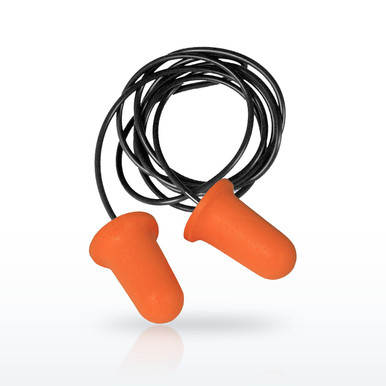 DEWALT DPG65TC2 Ear Plugs, NRR 33, Corded, Disposable FoamFoam ear plug Radians lists at NRR 33, the top of the labeled range, tested to ANSI S3.19-1974 (Radians data)
Why the two numbers cannot be compared. An NRR is produced one way only: under 40 CFR 211 Subpart B, a panel of subjects is fitted by an experimenter, hearing thresholds are measured at nine frequencies with and without the protector, the attenuation is averaged, reduced by two standard deviations so that 98 percent of the panel would get at least that much, and combined into one C-weighted figure that goes on the label beside the statement that existing protectors range from about 0 to 30. OSHA then takes 7 dB off that figure to match the A-weighted meter reading on site and, when deciding whether a protector makes engineering controls unnecessary, halves what is left. An active noise-cancelling headphone generates an inverted sound wave to cancel steady, low-frequency noise and relies on its earcup for anything else; the “dB” the manufacturer quotes is the depth of that cancellation at the frequencies where it works, measured by the manufacturer’s method. It says nothing about a hammer drill, an impact wrench or a nail gun, which is the point OSHA’s 2023 letter makes about sudden, explosive sounds, and it is not a figure the Appendix B arithmetic can use. The earbud question has a direct answer. OSHA’s 2019 letter about headphones marketed as approved by OSHA, and its 2023 letter, say the same thing: no rule bans them, the exposure limits still apply, the music player is not hearing protection, and OSHA does not approve, certify or endorse any product, so a manufacturer claiming its headphones are approved by OSHA, or in full compliance with its rules, is making a misleading claim. Radians and DEWALT list earmuffs on this site with built-in AM/FM radio and Bluetooth; each of those pages prints an NRR because the muff was tested as a hearing protector, which is the distinction the letters draw.
What the two OSHA letters say, point by point
From the letters of September 6, 2019 (Directorate of Enforcement Programs) and March 6, 2023 (Directorate of Standards and Guidance).
What the NRR label does and does not say
From the EPA label rule and the OSHA letter, with the Radians figures from the product pages on this site.
- Area A of the label states “Noise Reduction Rating”; Area B the NRR in decibels for that model, which may be no greater than the value computed under 40 CFR 211.207; Area C the sentence “The range of Noise Reduction Ratings for existing hearing protectors is approximately 0 to 30 (higher numbers denote greater effectiveness)”; and under A-B the words “(When used as directed).”
- The label is required on hearing protective devices. A consumer headphone that is not sold as a hearing protector carries no NRR and no label, and a cancellation figure on its box is not the label value.
- OSHA’s 2023 letter puts laboratory NRRs for earplugs at 15 to almost 30 dBA and says real-world attenuation is much less when they are not used properly; the typical plug is 1/2 to 3/4 inch long and does not reach the eardrum even when fully inserted, and pre-molded and stemmed plugs can be inserted without touching the part that enters the canal.
- Radians prints the NRR and the test standard (ANSI S3.19-1974) on each of its hearing product pages: disposable foam plugs at NRR 31 to 33, reusable flanged plugs at 27 to 28, banded plugs at 23 and 25, the custom molded plug at 26, earmuffs from 19 to 29, with the DEWALT DPG15 radio muff and DPG17 Bluetooth muff at NRR 25. Those are the figures that enter the Appendix B method; no cancellation figure does.
“Is X dB of noise cancellation good?” against the labeled range and OSHA’s method
| Figure on the box | What it is | Can Appendix B use it? | Note |
|---|---|---|---|
| NRR 33 (foam plug) | EPA label value from the ANSI S3.19 panel test | Yes: 33 − 7 = 26 dB credited; 13 dB with the 50 percent safety factor | The top of the labeled range; the label itself says existing protectors run about 0 to 30 |
| NRR 25 (cap-mount or radio earmuff) | EPA label value | Yes: 18 dB credited; 9 dB with the safety factor | Radians lists its DEWALT DPG15 radio and DPG17 Bluetooth muffs at NRR 25 |
| NRR 20 to 30 (headphone built as a protector) | EPA label value on a product designed for hearing protection with passive and active reduction | Yes, as any NRR | The case OSHA’s 2023 letter says may be acceptable in some workplaces |
| “30, 40 or 50 dB noise cancellation” (consumer ANC headphone) | The manufacturer’s own measurement of active cancellation at some frequencies | No: not an NRR, no label, no S3.19 test | OSHA advises against it in place of laboratory-tested devices; no protection from sudden, explosive sounds without a passive seal |
The arithmetic is OSHA’s; whether any protector is adequate depends on the measured dBA at the ear, which is the employer’s to supply.
Source: 40 CFR 211.204-1; 29 CFR 1910.95 Appendix B (NRR − 7); OSHA Technical Manual Section III Chapter 5 (50 percent safety factor); OSHA letter of March 6, 2023.
Questions people ask
Is 50 dB noise cancellation good?
It is not a hearing protection figure. The EPA label states that existing hearing protectors range from about 0 to 30 NRR, the highest foam plugs reach 33, and a 50 dB cancellation claim on consumer headphones is the manufacturer’s measurement at some frequencies, not an NRR. OSHA’s 2023 letter says consumer ANC headphones are not designed as hearing protection and should not replace laboratory-tested devices.
Is 30 dB noise cancellation good?
If it is an NRR 30 on a hearing protector, it is near the top of the labeled range: OSHA credits it with 23 dB by Appendix B and 11.5 dB with the safety factor. If it is a cancellation figure on consumer headphones, the same answer as for 50 dB applies.
Is it an OSHA violation to wear earbuds at work?
No rule prohibits them. OSHA’s 2019 letter: the employer must still keep exposure within 1926.52 Table D-2 (or 1910.95 Table G-16), the music player is not hearing protection, and use is at managerial discretion unless it creates another hazard such as masking warning signals and moving equipment.
Can I wear headphones on a construction site?
OSHA says the employer may permit it at its discretion. The noise through the headphones plus the jobsite must stay within Table D-2, hearing protectors must still be provided and used where required, and the employer must consider the struck-by hazard of a worker who cannot hear equipment and warnings.
Do noise-cancelling headphones work as earplugs?
OSHA, 2023: most consumer ANC headphones are not effective for controlling occupational noise exposure because they lack the passive seal that stops sudden, explosive sounds; headphones designed with passive and active reduction that carry an NRR of 20 to 30 may be acceptable in some workplaces.
Are there earplugs that offer 100 percent noise cancellation?
No. The labeled range is approximately 0 to 30 NRR by the EPA’s own label statement, the highest products are 33, and OSHA derates every label by 7 dB and then by half for the engineering-control decision. Double protection (plug under muff) is credited with 5 dB more than the higher rating, not the sum.
Can headphones be approved by OSHA?
No. OSHA does not register, certify, approve or endorse any product; both letters call such a claim misleading. A headphone that is a hearing protector carries an EPA NRR label, which is a manufacturer test result, not an approval.
Do the DEWALT radio and Bluetooth earmuffs count as hearing protection?
Radians lists the DEWALT DPG15 AM/FM muff and DPG17 Bluetooth muff at NRR 25, tested to ANSI S3.19-1974, so they are labeled hearing protectors; the employer applies the Appendix B method to the NRR as with any muff, and decides separately whether audio is permitted on the site.
Related guides
What is NRR?The lab rating and the derating methodsIs NRR 25 enough?What each NRR leaves at the earWhen is hearing protection required?The OSHA 85 and 90 dB rulesEar plugs vs earmuffsWhat each does wellElectronic earmuffsLevel-dependent muffs and what the NRR coversDecibel level chartCommon sounds and the OSHA tableThe ratings, test results and standards shown here are the manufacturers' published values, reproduced as published. Nothing on this page is a recommendation by Bayshore Safety that any product is suitable for a particular task, hazard or workplace. Selecting safety products and protective equipment is the responsibility of the end user and the employer, based on their own hazard assessment and the regulations that apply to their work. Confirm every value on the manufacturer's own documentation before use.