
Bayshore Safety & Industrial Supplies Guide
Are Z87 glasses good for shooting, and what hearing protection do you wear at the range? Z87.1+ vs MIL-PRF-32432 ballistic eyewear, NRR for gunfire, and electronic earmuffs vs plugs, by the Radians and Crossfire data
Z87.1+ safety glasses are the industrial impact rating: the whole protector stops a quarter-inch steel ball at 150 feet per second and a 500 gram pointed weight dropped from 50 inches, which covers ejected brass, powder residue and most range debris. Ballistic eyewear carries a second mark, MIL-PRF-32432, the military specification that fires a heavier fragment at a higher speed; Crossfire states its BOLO is “tested to be certified for the MIL-PRF-32432 ballistic safety standards” and exceeds Z87.1+, and MCR Safety states the same for its Checklite CL010 and CL110 and its Dominator DM3. For the ears, a gunshot is impulse noise above the 140 dB peak OSHA allows, so the protector is chosen by NRR and fit the way OSHA’s Appendix B works it (NRR minus 7), and the two things that change the answer are indoor ranges, where the muzzle blast reflects and plugs under muffs is the usual answer, and the wish to hear range commands, which is what an electronic muff is for: Howard Leight’s Impact Sport amplifies quiet sound and cuts the amplifier off above 82 dB while the passive cup carries its NRR 22.
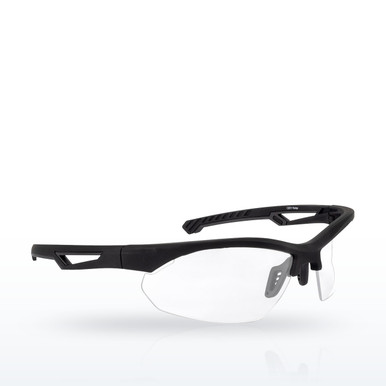 Crossfire 482 Safety Glasses, BOLO Ballistic-Rated Safety EyewearCrossfire states the BOLO is tested to MIL-PRF-32432 and exceeds ANSI/ISEA Z87.1+; clear, smoke and silver mirror lenses, 99.9% UV
Two ratings for the eyes, one method for the ears. An industrial safety supplier does not sell shooting sports gear as such, but the same manufacturers make the eyewear and the hearing protection people wear at the range, and they publish the marks. On the eye side there are two: ANSI/ISEA Z87.1+ is the impact rating OSHA reads for work, and MIL-PRF-32432 is the U.S. military ballistic fragmentation specification that a few styles also pass, which Crossfire (a Radians brand) and MCR Safety print on the BOLO, the Checklite and the Dominator. On the hearing side there is one rating, the NRR, and one way to use it: 29 CFR 1910.95 Appendix B subtracts 7 from the NRR and takes the rest off the measured level, and the Table G-16 footnote caps impulse noise at 140 dB peak, which a gunshot exceeds at the shooter’s ear. The cards below answer the range questions with those facts, and nothing here is a statement about any firearm.
The range questions, one by one
Marks and figures are the manufacturers’ own as printed on the product pages on this site; the NRR arithmetic is OSHA’s Appendix B method.
The marks and figures on range eyewear and hearing protection
The vocabulary that appears on the eyewear and hearing products people take to a range.
- Z87.1+ (Z87+): the ANSI/ISEA Z87.1 impact-rated mark. The complete protector passed the high-velocity (quarter-inch steel ball at 150 ft/s for spectacles), high-mass (500 g pointed weight from 50 inches) and penetration tests, lens retained.
- Z87 (no plus): basic impact; a drop-ball test on the lens. Not the mark a range rule that says “ANSI-rated” is after.
- MIL-PRF-32432: the U.S. military ballistic eyewear specification (MIL-PRF-31013 before it for spectacles; MIL-PRF-32423 is a related mark MCR Safety also lists). A heavier fragment at higher speed than Z87+. Printed as an additional mark on the Crossfire BOLO and the MCR Safety Checklite and Dominator.
- NRR: the EPA-labeled Noise Reduction Rating under 40 CFR 211, a laboratory figure. OSHA Appendix B credits NRR minus 7 against an A-weighted level.
- 140 dB peak: the 1910.95 Table G-16 footnote limit for impulsive or impact noise. A gunshot at the shooter’s ear exceeds it.
- Level-dependent (electronic) muff: a passive muff with microphones and an amplifier that passes quiet sound and shuts off above a ceiling (82 dB on the Howard Leight Impact series). The NRR belongs to the passive cup.
- Derating: NIOSH’s field correction, 25 percent off a muff’s NRR, 50 percent off a formable plug’s, 70 percent off a pre-molded plug’s. OSHA’s Technical Manual halves the (NRR minus 7) when judging feasibility.
- Double protection: plugs under muffs. OSHA’s Technical Manual credits 5 dB more than the higher NRR, not the sum.
Hearing protectors by NRR and OSHA Appendix B credit (NRR minus 7)
| Protector | NRR as published | Appendix B credit (dB) | Type | Note from the manufacturer |
|---|---|---|---|---|
| Howard Leight Max MXM-1 | 33 | 26 | Disposable foam plug | Highest NRR on a plug; roll, pull, hold |
| PIP Mega Flare Plus 267-HPF910 | 33 | 26 | Disposable foam plug | Flared foam |
| Moldex Pura-Fit | 33 | 26 | Disposable foam plug | — |
| Howard Leight Laser Lite LL-5 | 32 | 25 | Disposable foam plug | T-shape |
| JSP Sonis 3 262-AEB040-HB | 31 | 24 | Passive headband muff | SNR 37; snap-in cushions |
| Howard Leight Impact Pro 1030943 | 30 | 23 | Electronic over-the-head muff | Amplifies quiet sound; passive cup carries the NRR |
| Howard Leight Impact Sport In-Ear R-02701 | 29 | 22 | In-ear electronic | Stops amplification above 85 dB; Bluetooth; 10 h run time; clears a stock |
| PIP V3 263-V3HB | 29 | 22 | Passive headband muff | — |
| Radians TRPX TR29 | 29 | 22 | Passive muff | — |
| Howard Leight Impact Sport R-025 | 22 | 15 | Electronic muff | “Electronic Shooting Earmuff: NRR22”; amplification to 82 dB |
The NRR is a continuous-noise laboratory figure; gunfire is impulse noise and the Table G-16 footnote limits it to 140 dB peak. Plugs under muffs add about 5 dB to the higher NRR (OSHA Technical Manual).
Source: NRR as published by each manufacturer on the product pages on this site (PIP Rich Product Data, October 2026; Radians 2026 data); credit per 29 CFR 1910.95 Appendix B for an A-weighted measurement.
Questions people ask
Are Z87 glasses good for shooting?
Z87.1+ (impact-rated) glasses are what range rules asking for ANSI-rated eyewear mean; the protector stopped a quarter-inch steel ball at 150 ft/s and a 500 g weight dropped 50 inches. A ballistic MIL-PRF-32432 mark is an extra margin some styles add.
Is ANSI Z87.1 good enough for shooting?
The plus matters: Z87.1+ is impact rated; plain Z87 is basic impact (a drop-ball test). Look for Z87+ on the frame or lens.
What do ballistic-rated glasses mean?
Eyewear that also passes the U.S. military ballistic fragmentation specification MIL-PRF-32432, which fires a heavier fragment faster than the Z87+ test. Crossfire prints it on the BOLO; MCR Safety on the Checklite CL010/CL110 and Dominator DM3. It is not bullet protection.
Do I need safety glasses for shooting if I wear glasses?
Yes, unless the prescription pair is Z87.1-marked. Wear OTG safety glasses over them (Radians Chief, Sheath; UVEX Ultra-spec) or have Z87.1 prescription safety glasses made.
Which ear plugs have the highest NRR for shooting?
Foam plugs at NRR 33: Howard Leight Max, PIP Mega Flare Plus and Mega Bullet Plus, Moldex Pura-Fit, DEWALT DPG63/DPG65. The rating is reached only with a deep, rolled fit.
Which is better for shooting, earmuffs or earplugs?
A muff gives close to its label every time; a plug gives its label only when seated deep. Indoors, plugs under muffs. A muff can lift a long-gun cheek weld, which is what low-profile and in-ear electronic protectors are for.
How much noise reduction do I need for shooting?
OSHA credits NRR minus 7 (Appendix B). Gunfire exceeds the 140 dB peak impulse limit at the ear, so the higher the credited reduction the better, and indoors double protection is the practice. NRR 29 is credited 22 dB; NRR 33, 26.
Is 29 dB hearing protection good for shooting?
An NRR 29 muff is credited with 22 dB by OSHA’s method, which is among the highest a muff reaches (the top muff we carry is NRR 31). Outdoors it is what most people use; indoors add plugs.
Are foam earplugs good enough for shooting?
At NRR 33 they are the highest-rated protector, if rolled thin, seated deep and held while they expand; NIOSH derates a foam plug by half in the field for that reason. Indoors, under a muff.
Do electronic ear muffs work?
Yes. The passive cup carries the NRR (Impact Sport 22, Impact Pro 30) and protects with the batteries dead; the microphones and amplifier let you hear speech and commands and shut off above 82 dB on the Impact series.
Are there ear muffs that let me hear conversations while shooting?
That is the electronic (level-dependent) muff: Howard Leight Impact Sport and Impact Pro, the in-ear Impact Sport R-02701, DEWALT’s Bluetooth and AM/FM hearing protectors. Quiet sound is amplified; the blast is not.
What decibel ear protection for a shooting range?
The highest NRR you can get, fitted properly: NRR 33 foam plugs, NRR 29 to 31 muffs, and both together indoors. There is no 45 dB earplug; plug labels top out in the low 30s.
What type of eye protection should you wear when shooting a gun?
Z87.1+ wrap-around glasses with side coverage; ballistic-marked styles for steel-target and action shooting; amber for contrast in flat light, gray for sun, clear indoors.
What is special about shooting glasses?
Usually nothing beyond Z87.1+, a wrap-around frame, an amber or gray lens, and on a few styles a MIL-PRF-32432 ballistic mark. The marks are what to read, not the word “shooting”.
Where can I buy ballistic glasses?
The Crossfire BOLO and the MCR Safety Checklite CL010/CL110 and Dominator DM3 on this site carry the manufacturer’s MIL-PRF-32432 statement; we sell nationwide.
Related guides
Are brand sunglasses Z87 rated?How to tell, and what counts on the jobWhat does ANSI Z87.1 mean on safety glasses?Z87 vs Z87+, and how to read the markingsIs an NRR of 25 enough?What NRR 22 to 33 leave at the ear, worked the OSHA wayElectronic and level-dependent earmuffsHow they workDouble hearing protectionWhen to wear plugs and muffs togetherHow to insert foam ear plugs correctlyRoll, pull, holdThe ratings, test results and standards shown here are the manufacturers' published values, reproduced as published. Nothing on this page is a recommendation by Bayshore Safety that any product is suitable for a particular task, hazard or workplace. Selecting safety products and protective equipment is the responsibility of the end user and the employer, based on their own hazard assessment and the regulations that apply to their work. Confirm every value on the manufacturer's own documentation before use.
© 2026 Bayshore Safety & Industrial Supplies, Inc. All rights reserved. This guide may not be copied or republished without written permission.